
Protesters made Columbus statue a target. Will Miami reconsider a complicated legacy?
As protests continue in the wake of the killing of George Floyd by a Minnesota police officer three weeks ago, a historic figure from more than 500 years ago has been thrust into the narrative in Miami — Christopher Columbus.
Seven protesters vandalized the Bayside Marketplace statue of Columbus on Wednesday evening and were arrested by Miami police. Another statue, one honoring fellow explorer Juan Ponce de León, was also damaged. Both statues have stood in the Bayfront Park area since the 1950s, each moving from original spots in the 1980s but generating little attention or controversy.
A correlation between past and present
That has been changing — particularly for Columbus memorials. What is the correlation between the modern Black Lives Matter movement and an ancient explorer? For some social justice activists, particularly Native Americans and those in some Caribbean nations, Columbus represents the original white European oppressor — a symbol of all the colonizing the forces that would follow to brutalize and enslave indigenous and African populations.
“That man literally has blood on his hands. Us putting the fist on his chest and the blood on his hands is symbolic,” one protester told the Miami Herald.
But included with fists, the letters “BLM” and the name “George Floyd” was a Soviet hammer and sickle — long a symbol of communism and an image reviled by Miami’s Cuban exile population.
Miami police denounced the actions. “In the City of Miami, we support peaceful protests but there will be zero tolerance for those who hide behind the peaceful protesters to incite riots, damage property, and hurt members of the public or our officers,” Miami police said in a release.
Early Thursday morning, Florida Sen. Marco Rubio reacted on Twitter, saying he supported peaceful protest and racial equality but had “NO TOLERANCE for arson, looting, vandalism and violence.”
“Because nothing says justice more than a Soviet hammer & sickle! Don’t let anyone twist this,” Rubio wrote.
The Columbus legacy has been celebrated for generations, his name and image on statues a symbol of Western culture and America marking an annual Columbus Day.
The Italian explorer’s four voyages across the Atlantic Ocean in the late 1400s opened up what the European colonizers dubbed “the New World” but most American history books also downplayed or ignored the ugly side of conquest — the destruction of native cultures and communities.
Columbus in South Florida
In South Florida, his name has resonated for generations.
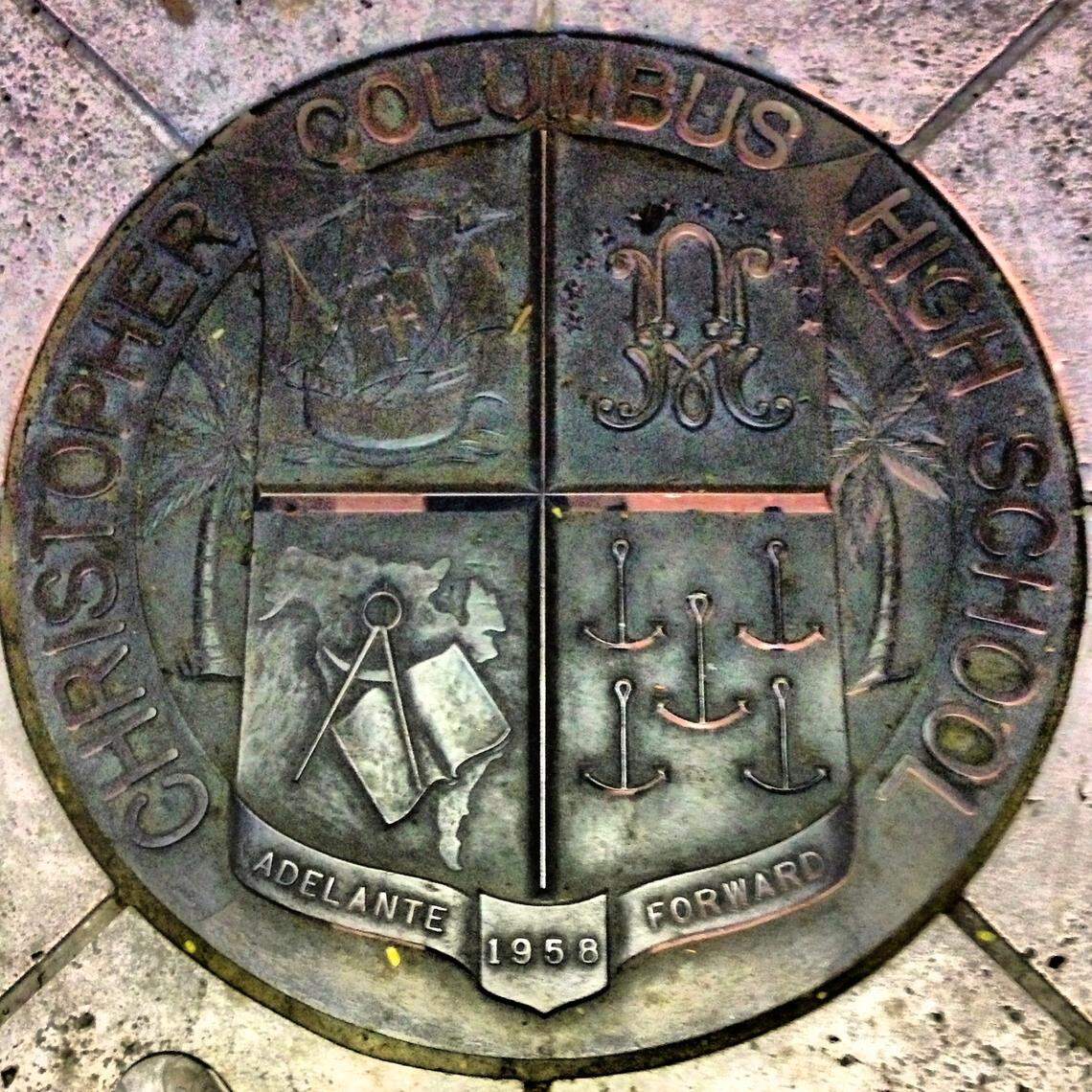
There’s Christopher Columbus High School, a private, Catholic boys’ preparatory school in Westchester, founded in 1958, from which Miami-Dade Mayor Carlos Gimenez graduated in 1972. Columbus also produced poet Richard Blanco, who delivered President Barack Obama’s second inaugural poem; football star and executive Alonzo Highsmith; and many other movers and shakers in Miami.
There’s the Columbus Day Regatta, which, for 65 years, gathers sailors from around the world to compete on Biscayne Bay in October to commemorate “a small boat cruise in 1492.”
And then there is the Bayfront Park Columbus statue, which first went up on Columbus Day in 1953, amid much hoopla with money raised by a local Italian American group. It initially stood on a base of black African marble, said Miami historian Paul George, and was moved in the 1980s during a redesign of Bayfront Park. Perhaps the most attention it had received until this week was when the figure was wrapped in a colorful cloak for Art Basel last year.
The nearby statue of Ponce de León, the Spanish conquistador credited with the first exploration of Florida in 1513, originally stood in front of the Main Library in Bayfront Park but was also moved during the park overhaul closer to the Torch of Friendship plaza, according to George.
Ponce de León has many South Florida namesakes as well — a major thoroughfare running through Coral Gables, which is home to a middle school of the same name, along a hotel and an apartment complex.
Cultural changes amid Floyd marches
The Floyd marches have already super-charged efforts to remove statues of Civil War heroes and other symbols of the South’s “Lost Cause.” NASCAR, the nation’s most popular racing circuit, announced it was banning the Confederate flag at events. The classic 1939 film “Gone With the Wind” was temporarily been pulled from HBO. Even popular country music group Lady Antebellum announced on Instagram an official name change to its fan-given nickname, Lady A, on Thursday.
And Plantation resident Dharyl Auguste drafted a Change.org petition aimed at Gov. Ron DeSantis to change the name of the Broward County city.
New scrutiny over Columbus
The protests — at least potentially — also may put some institutions bearing the Columbus name under new scrutiny, said George.
“Columbus was revered when Christopher Columbus High school opened in Fall ‘58. Now the school and it’s name face possible criticism,” said George. “The annual Columbus Day regatta could be renamed and that quasi-holiday may undergo a renaming, too.”
In the Caribbean, demands for racial justice in the United States have given new momentum to excising monuments with colonial and racist legacies. Among them: Naval commander and slavery sympathizer Horatio Nelson in Barbados, and monuments to Christopher Columbus in the Bahamas and Trinidad and Tobago. In South Florida, that seems like a long-shot for now.
Columbus High, for one, has no intention of a name change, said spokeswoman Cristina Cruz.
The school, founded in 1958 as the first all boys Catholic high school in South Florida, is now run by the Marist Brothers, a religious order founded by Champagnat near Lyon, France, on Jan. 2, 1817, for the Christian education of French youth.
There is not even a statue to its namesake on campus, said Cruz. There is a courtyard statue of Columbus’ founder, St. Marcellin Champagnat. And the school’s local legacy is what now matters, she said, “educating a diverse student body with the motto ‘Adelante,’ meaning Forward.”
“Today, Columbus has an enrollment of approximately 1,700 students and over 15,000 alumni including notable names in business, public service, healthcare, athletics, journalism and religious life,” Cruz said.
.jpg "IMG_5677 (1).jpg")
A discussion among Columbus grads
Still, the vandalizing of the statue did spark online discussions among some alumni, but no support for abandoning the name.
Gerald Pierre, an African American attorney practicing in Weston, who graduated from Columbus in 1981, said he doesn’t favor rewriting history but rather suggests learning from the past and moving forward in a more enlightened manner.
On Thursday, Pierre posted a quote from British writer and theologian C.S. Lewis on Facebook Thursday: “You can’t go back and change the beginning but you can start where you are and change the ending.”
Pierre’s social media postings led to a discussion among fellow grads on the What’s App platform.
“The end of all human repression is that the need for human dignity is acknowledged and action taken to give all individuals complete control of their dignity,” wrote Michael Gibbons, a Class of ‘81 Columbus grad. “Was Columbus flawed? He sure was. Am I? I sure am. When I die, just judge me in the context of the time in which I lived. Black Lives Matters exists, and will continue to be an issue, because of a systemic lack of human dignity.”
“The intolerance and demand for moral perfection displayed by the movement to remove statues of Columbus and other flawed heroic figures will leave us impoverished indeed,” wrote his 1981 classmate Javier Camps. “What lionized leaders modern or ancient will survive the demand for unblemished moral purity?”
Pierre responded: “Michael and Javier were on point. Study history, place historical figures in context, and learn from it.”
Rejecting a giant Columbus
There has been controversy over another Columbus statue in South Florida before — but for very different reasons.
In the mid-1990s Russian sculptor Zurab Tzereteli gifted to the United States a 311-foot, 5,000-ton, $22 million dollar Christopher Columbus statue. Miami Beach didn’t want the gargantuan tribute. Fort Lauderdale said no thanks. Orlando and Clearwater took a pass, too.
And Florida couldn’t give it away to New York — it was taller than the Statue of Liberty.
It sat unwanted and unloved for three years in a Port Everglades warehouse, the Miami Herald reported in 1995. Former Miami Herald columnist Fred Grimm opined that the statue was “a 5,000-ton symbol of Russia’s eternal gratitude at being drubbed in the Cold War.”
Tzereteli’s Columbus was finally unveiled in Arecibo, Puerto Rico in 2016.
This story was originally published June 12, 2020 at 9:27 AM.
