
South Florida nonprofits are ramping up aid amid the pandemic, but it’s costing them
Big Brothers Big Sisters of Miami, the nonprofit group best known for matching disadvantaged kids with one-on-one mentors, had a major decision to make when the coronavirus pandemic shut down its programs: Could it somehow continue helping its kids and their families during the emergency?
A survey of their needs identified one overriding need: Food. That meant Big Brothers had to pivot. And fast.
Within days, the mentorship and educational organization had transformed itself into a supplier of free food in bulk. Supported by local restaurants and Feeding South Florida, it began providing its families with hot pizza and meals and staples like rice and bread through pickups at its headquarters near Miami International Airport and deliveries across Miami-Dade. At the same time, it had to figure out how to keep its mentoring program for 2,100 kids going through virtual apps and other remote means.
But it’s all come at a cost.
To keep its 100 full-time staffers working from home, Big Brothers Big Sisters had to invest significantly in tech — an expense it hadn’t planned for. It also had to let some contractors go and dip into program funds, while launching a campaign asking supporters for new donations.
It’s been one of the lucky ones: The agency was approved for a $430,000 federal paycheck protection relief payment, CEO Gale Nelson said. “It buys us eight weeks, but it’s just not enough,” Nelson said.

It’s a story repeated over and over during the pandemic across Miami-Dade and Broward counties. With its widespread areas of high poverty and growing economic inequality, the region has thousands of families that rely on hundreds of nonprofit service organizations offering tutoring, job training, legal aid, family counseling, financial literacy, tax preparation and even jobs.
Virtually all of those organizations have had to reconstitute operations and services on the fly, scrambling to help thousands of people who find themselves in sudden economic and emotional distress as jobs are lost and businesses shut down.
Stress factor
Even in the best of times, these organizations run on tight budgets. Now the situation for many has turned precarious.
In the short term, administrators at a sampling of service nonprofits across the county say they are managing, even if their resources and staffers are in some cases becoming over-stressed. Most depend on some combination of financial support from state, federal and local grants and donations from foundations and individuals. That money has for the most part continued to flow, nonprofit administrators say.
But they fear for the near future should shutdowns and high unemployment persist into the summer, as seems increasingly likely. If that happens, they’ll be forced to burn through budgets that did not anticipate spiking demands for services and staffs working with clients remotely. Some have lost fees normally charged on a sliding scale or have had to dip into modest emergency reserves. Many have had to buy laptops and other tech for employees sent to work from home and licenses for virtual-meeting platforms.
Gepsie Metellus, executive director of Sant La Haitian Neighborhood Center, said she has been able to avoid laying off any of her 19 full-time employees thus far. The demand for the group’s services — unemployment applications, tax return preparation, food assistance — has been so overwhelming that she reopened the North Miami office location this week after having sent her staff home to work remotely, per Miami-Dade Mayor Carlos Gimenez’s orders.
“There are certain services we provide that have to be done in person, such as signing authorization forms to qualify for food assistance,” Metellus said. “A lot of people in the Haitian-American community we serve don’t speak English or are illiterate. Many of them are not tech-savvy or don’t have internet at home. It was a perfect storm of circumstances that led us to reopen.”
While most of her employees still work remotely, Metellus said a rotating staff of three are manning the office Monday-Thursday from 9 a.m. to 1 p.m. Two work inside, while a third manages the line of customers outside. Clients are allowed in only two at a time.
But although the nonprofit is funded by a variety of sources, including Baptist Health, the City of Miami and the Knight Foundation, Metellus said she worries about the economic aftermath of the coronavirus shutdown.
“I am hoping I will be able to retain everybody,” she said. “But the next fiscal year is going to be very telling. If the impact isn’t as bad as it’s been projected, we will be able to hang onto everybody. But if it looks like another 2008 recession, there may have to be a reduction. I will do everything that I can to keep everyone, even it means cutting hours.”
Loss of funding
Some of the smaller nonprofits don’t have relationships with banks, so they found it hard even to apply for federal relief loans or aid for small businesses.
As critical spring fundraising events are canceled or postponed, moreover, they fear that donors who have taken financial hits will pull back or that state and local governments will slash support as tax collections dive and deficits loom.
“That’s a huge hit in terms of operating cash they will never be able to recover,” said Lindsey Linzer, head of grants and programs at the Miami Foundation, which provides $2 million annually in support to service nonprofits. “There is going to be an increased burden on local governments and nonprofit organizations.”
With a solid endowment, the foundation itself does not expect to trim back its grants, Linzer said. It’s launched a COVID-19 emergency relief fund for individuals and has been flexible in allowing grant recipients to use funding earmarked for specific programs as general operational money.
As nonprofits retool their operations and offerings, the United Way of Miami-Dade, which raises millions to help fund around 60 service nonprofits, has been helping with technical expertise, advice and, in some cases, dollars, spokeswoman Cristina Blanco said.
Its special pandemic response fund has raised $2.6 million to date, she said — money that’s going to individual and small-business assistance, as well as to some nonprofits to support direct services to their clients.
“We have seen such an outpouring of support,” Blanco said.
Precisely what the financial impact to the nonprofits will be, however, won’t become clearer until the end of the current fiscal quarter or the start of summer, Blanco said. That includes United Way, which raises a portion of its contributions to member agencies through donors’ paychecks.
Big Brothers pivot
At Big Brothers, which has a $6 million operating budget and doesn’t charge any fees for its programs, CEO Nelson had to cancel fundraisers expected to bring in at least $50,000 for mentoring and scholarships. Meanwhile, it had to transform its job-training, educational and health and wellness programs, which serve about 3,000 families, into virtual operations.
When its survey found nearly half of thise families needed help with food, it turned to local restaurants including Café La Trova, Pincho, Sushi Maki and Power Pizza, as well as Burger King. On the day it opened for what’s now a weekly food distribution, the cars were lined up all day long, Nelson said. Demand has proven so high that it’s taking food out on the road to far-flung families. On Tuesday, he said, it is planning a caravan to Homestead to deliver food.
Big Brothers is now hoping to recruit additional restaurants as well as donations to support the food program through its website, Nelson said.
“Before the pandemic many of these families had existing challenges. The pandemic, unfortunately, really added insult to injury to our families,” Nelson said. “We wanted to focus on some of their most basic needs. But we are also helping these kids still stay connected to society and their future.”

Feeding South Florida, which last year distributed 62 million pounds of good, has experienced a six-fold increase in demand across the region and has ramped up volunteer recruitment and fundraising for a vastly expanded list of pickup sites. On Saturday, famed DJ David Guetta, performed a live virtual set at 6 p.m. outside of the Icon Brickell and W Brickell towers in downtown Miami which was livestreamed on social media and raised $600,000 for the nonprofit, among other food charities.
Even some far larger service nonprofits are struggling to cope with drastically changed circumstances.
Goodwill shut down
One of the largest, Goodwill Industries of South Florida, has had to virtually shut down operations and lay off most of its 2,300 workers, the majority of whom have a disability or other issues that make it hard to find jobs.
The giant agency, unique among its peers, is also a nonprofit business that generates most of its $150 million budget through sales of donated clothing and goods at its 36 stores in Miami-Dade and Broward counties. All of its stores are closed by the pandemic; an apparel-manufacturing facility and a commercial laundry are still in operation because it serves most local hospitals.
Because it’s so big, Goodwill did not qualify for federal relief aid, which focused on small businesses. But with little revenue coming in, the organization is threatened with insolvency, though most of its landlords seem willing to abate rent for three months, CEO David Landsberg said. The agency hopes to snag a federal loan through a new Treasury Department program set to roll soon.
“It has to happen soon,” he said. “We’re going to burn through $8 million in a four-month period. It’s a very uncomfortable position to be in.”
Meanwhile, an emergency relief fund to help its laid-off employees has raised $250,000 so far, Landsberg said.
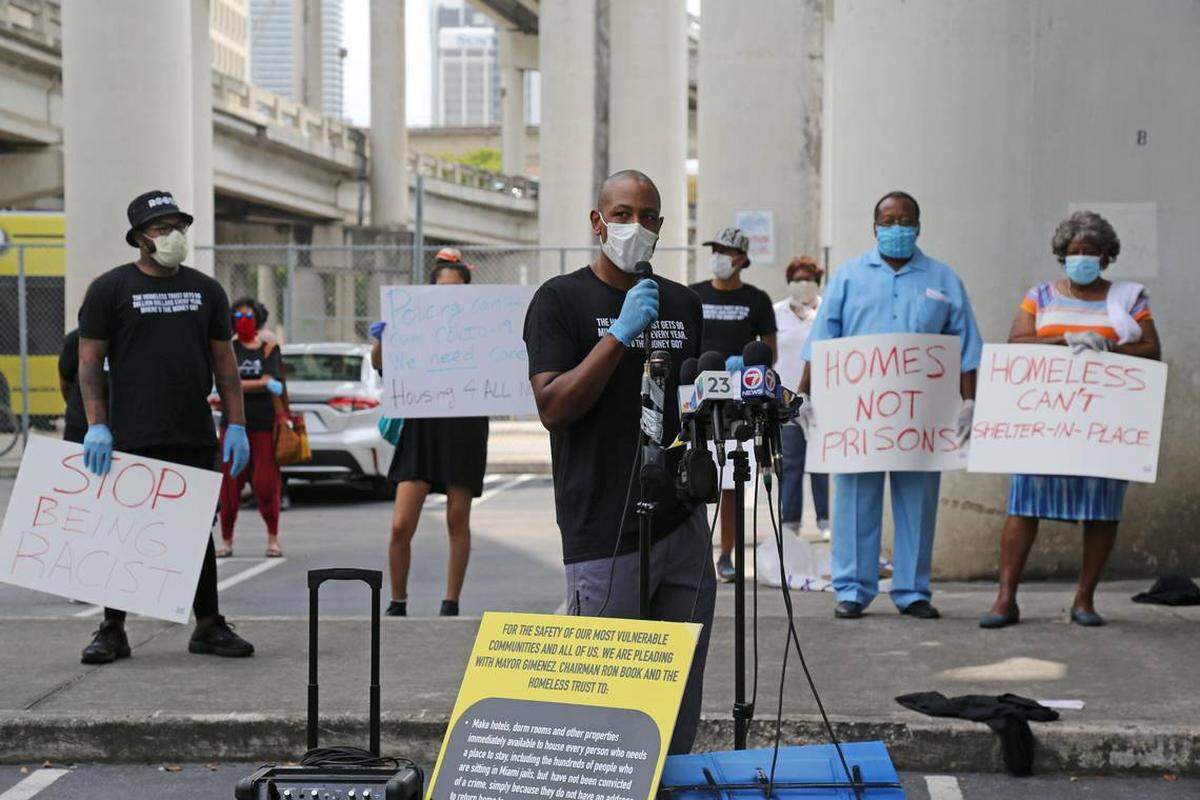
Another prominent nonprofit has faced the opposite problem: Camillus House, the big homeless shelter and assistance program, cannot shut down or send staff home to work remotely. Though the pandemic has not yet dramatically led to increased demand for shelter space, it’s still operating almost fully staffed and at capacity, said CEO Hilda Fernandez.
That has required significant extra spending on overtime pay for staff and food, and for making sure everyone is as safe as possible — meaning protective gear for hundreds of workers and shelter residents.
Luckily, the agency saw the pandemic coming early. In February, before demand surged for touchless thermometers, sanitizers, surgical masks, gloves, gowns and other protective gear, Camillus House placed a massive order, Fernandez said.
It also built isolation rooms with negative ventilation to quarantine residents with possible COVID-19 symptoms at its main residential facility just north of downtown Miami, which houses about 500 people in shelter dorms and transitional apartments. It bought sprayers to disinfect dorms and facilities, rented wash stations and instituted strict screening protocols and a stay-at-home rule for residents of its half-dozen residential facilities.
Everyone must weak a mask at all times, and no resident can leave the main shelter except to visit the doctor or go to work. People coming to its day program who are still living on the street are still fed, now with bag meals, but not allowed in. Someone retrieves their mail for them.
The protective gear alone cost over $200,000, and one sanitizing machine was $6,000; the contractor who built the isolation rooms has not sent a bill yet, Fernandez said. That’s money she said Camillus House needs to recoup somewhere.
Though it boasts a $17 million budget, nearly half of it raised privately, that money is already stretched thin to meet demand as the number of homeless people in the county has grown amid a housing affordability crisis. The agency also had to postpone a big spring fundraiser and shift it to a virtual platform, so that Fernandez expects a drop in proceeds.
But spending the money on preventive measures has paid off. So far, the agency has not seen a single positive for the new coronavirus out of more than a dozen tests performed, Fernandez said.
“We have to continue operating,” she said. “There is no other way.”
Camillus House accepting new residents
With its residents not allowed to leave, that means Camillus House is serving significantly more meals — so its food costs are up and staff overtime ballooning, even as the squads of volunteers who help at mealtimes can’t come in anymore. It’s also setting up a commissary to sell basic goods at cost, and Fernandez had to come up with activities for 400 cooped-up shelter residents.
“We have to keep our people from developing cabin fever, so we hit the Dollar Tree for games and crossword puzzles,” she said. Camillus House is also showing three movies a day — with proper social separation — and setting up outdoor bingo.
But the pandemic has also, at least temporarily, forced the agency to refocus.
“Normally we are preparing people to move on” out of homelessness and into permanent homes and even jobs, Fernandez noted.
“Right now, there is very little moving on,” she said.
In shifting from normal business to pandemic response, one prominent nonprofit had to let much of its staff go.
On March 13, Broward-based Hispanic Unity of Florida had a staff of 224 assisting immigrants with ESOL classes, citizenship, voter registration and financial management for students. By March 16, the count at the 38-year-old agency was down to 65.
Josie Bacallao, president and CEO of the group, said 125 of those positions were part-time staffers already employed with the Broward County Public Schools system who helped with after-school programs for students, one of the 12 programs the nonprofit provides for 15,000 people per year.
“Basic needs are the focus for us now,” she said. “That means making sure our clients have access to food and shelter, that they can pay for utilities and medications. It also includes ensuring they have continued access to their phones and digital services, because that’s a lifeline now that we’re all stuck at home.”
The group is still adjusting to the work-from-home pivot, which Bacallao admits has forced them to scramble.
“We’ve always conducted our programs in person, and we’ve had to pivot to using tools that keep us apart and are cold. We’re still figuring out how to continue to provide our services with technology, which is one of the things we always knew we weren’t great at it. We’ve discovered how woefully unprepared we are,” she said.
For now, Hispanic Unity is communicating with clients through WhatsApp and texting. They are partnering with axishelps.org, a newly launched online resource to help residents and business owners, to file virtual tax returns for their customers.
Bacallao said a cash-flow analysis shows the group — which relies on federal programs, local and national foundations and United Way grants — is poised to ride out the summer.
“But what happens beyond the next six months is still to be determined,” she said. “We don’t know what the world is going to look like after that and whether funding will still be there.”
This story was originally published April 20, 2020 at 6:00 AM.
_pp%20Cropped.jpg)