Mayor blocks deal to bring jai-alai and poker room to Miami’s Edgewater neighborhood
Miami Mayor Francis Suarez has vetoed a lawsuit settlement that would allow a jai-alai fronton and poker room in Edgewater — a plan one of the mayor’s wealthiest donors tried to block by orchestrating a change to the city’s zoning laws.
The veto, issued Friday afternoon, came amid questions about the role played by billionaire auto magnate Norman Braman, one of Suarez’s political benefactors, in getting the law changed to block the gaming establishment.
The mayor’s move also sparked another disagreement with City Attorney Victoria Méndez, who in an email Friday stated she believed the mayor could not legally veto the settlement vote. It’s unclear what will happen at Monday’s commission meeting if elected officials hear the veto. If valid, it can be overruled by four of five commissioners.
So goes the melodrama at Miami City Hall, with a web of crossed legal wires hanging over plans to build a new gambling locale and well-heeled activists using their political muscle to stop it.
This chapter began in 2019. Magic City Casino sued the city after commissioners voted to create stricter zoning requirements for gambling facilities in the city — a change in law that came after the casino received a state permit for the cardroom and fronton in the summer of 2018. The project is part of a larger complex planned at 3050 Biscayne Blvd. by Miami Beach developer Russell Galbut’s Crescent Heights. News of the permit incensed local cultural and business luminaries, including developer Jorge Pérez and auto magnate Norman Braman, who pledged to fight the plan.
Braman took the lead. According to email records first reported by the Miami Herald last week, the car dealer and his attorneys from law firm Weiss Serota Helfman Cole & Bierman were the behind-the-scenes architects of the new zoning requirements, from the text of the ordinance to even the city’s purported staff analysis of the change. Braman and his team sent the mayor’s personal email account a memo with a favorable analysis of the new law on city letterhead — a document that later resurfaced virtually unchanged as a recommendation from city staffers, with the planning director’s signature on it.
The casino’s owners, the Havenick family, claimed the city improperly changed the rules after initially issuing zoning opinions that stated gambling was permitted under the Miami 21 zoning code. Under the new regulations, new gaming facilities would need approval from four of five city commissioners and public hearings would be required.
On Feb. 13, commissioners voted 3-2 to settle the lawsuit after a private meeting to discuss the case. The law permits elected officials to meet privately to discuss litigation.
Suarez vetoed the vote on Friday afternoon. In his veto message, he said the vote to settle was “premature and limited public participation and consideration” because the exact terms of the settlement have not been disclosed.
Under terms that were disclosed before the Feb. 13 vote, the Havenicks would be permitted to open the jai-alai fronton and seek a three-vote commission approval of the cardroom later. The owners also agreed not to install slot machines and not to pursue legal fees from the city. Suarez wrote that even the terms that are public should be rejected.
The mayor seemed to respond to the Herald’s reporting by stating that the change to the zoning law was supported by more than just one constituent.
“Despite recent reports to the contrary, the commission’s revision to Miami 21 Code enjoyed wide support of multiple constituents,” Suarez wrote, adding that Sue Nelson, president of Tower Association Condominium, supported mandating unanimous commission approval for gambling uses.
“The 4/5 vote I don’t even think is strong enough,” Nelson said at a public hearing in September 2018. “I think it should be a unanimous vote by the commission in order to get anything like this in anyone’s neighborhood.”
In his veto, Suarez also aims to pierce the Havenicks’ legal argument. The mayor argues that the 2012 and 2018 zoning letters the Havenicks used to secure the state permit were not reliable because the city failed to meet its own requirements when officials did not notify local neighborhood and homeowner association leaders of the interpretations.
A statement from a casino spokesman said the owners are “disappointed and appalled that Mayor Suarez has vetoed the settlement,” emphasizing that the deal avoided expensive court costs for the city.
“The now prolonged litigation will senselessly burden taxpayers, costing them hundreds of thousands of dollars in legal bills,” read the statement.
Money and influence
Braman, a donor to Suarez’s political campaigns through the years, gave a political committee controlled by the mayor $25,000 on the same day commissioners first considered the change to the zoning law in September 2018. A month later, when the change became law following a 4-1 commission vote, Braman gave Suarez’s committee another $25,000. At the time, Suarez was campaigning to become a “strong mayor,” the top administrator overseeing Miami’s $1 billion government. Voters rejected the mayor’s plan.
Suarez denied being swayed by Braman’s contributions, saying he had also received political support from the Havenicks in the past.
Braman defended his heavy involvement, saying it was “completely appropriate” for someone to petition the government and urge legislation. He’s taken aim at pro-gambling interests and their lobbyists, who Braman contended were used to obtain a questionable interpretation from the city’s zoning chiefs without any notice to the public. He and his lawyers have argued that members of the public should have the right to share their opinions on any new gaming establishment.
The auto dealer’s passion for fighting gaming was clear in new emails obtained by the Herald this week, messages collected during discovery for the lawsuit. In an email chain from August 2018, a month before the zoning law received final approval, Braman’s lawyer suggested the law change went far enough to discourage gaming in Edgewater while still making it look like the casino would have a shot at opening its facility.
“Although it would be nice to expressly prohibit the use everywhere including Biscayne Blvd., I think that it is legally important to at least give the appearance that Havenick has the possibility of the use,” wrote attorney Stephen J. Helfman. “I think it makes it much more defensible.”
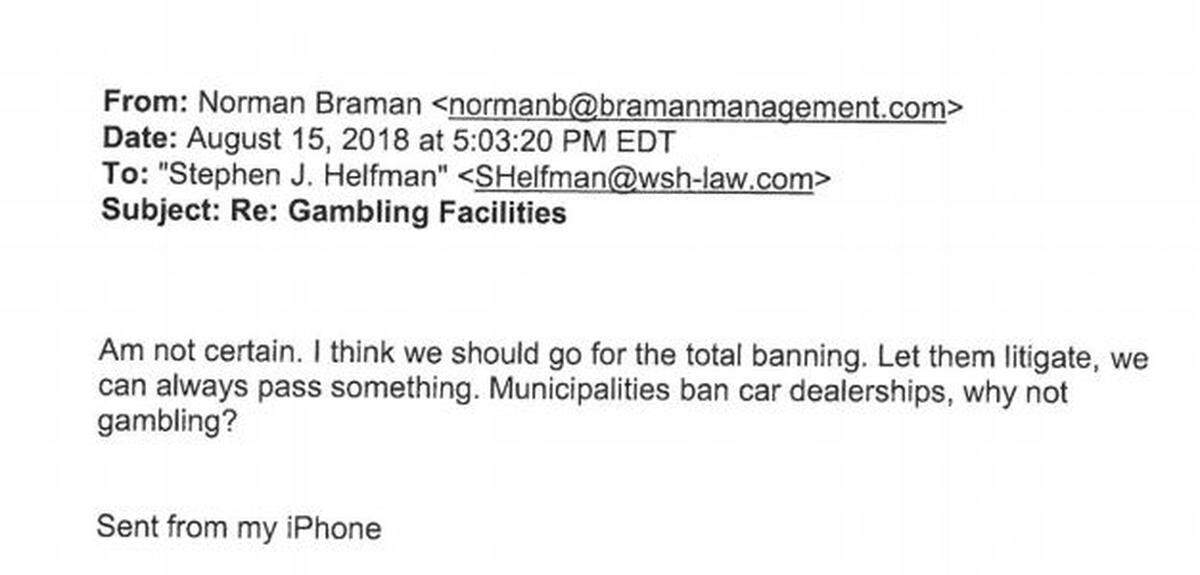
Braman wanted to go further.
“I think we should go for the total banning,” he wrote. “Let them litigate, we can always pass something. Municipalities ban car dealerships, why not gambling?”
In text messages sent to Commissioner Ken Russell in January 2020, Braman expressed his displeasure that the case was heading toward a settlement.
“The city attorney wants to get rid of problems and in my opinion is not the most qualified,” he wrote.
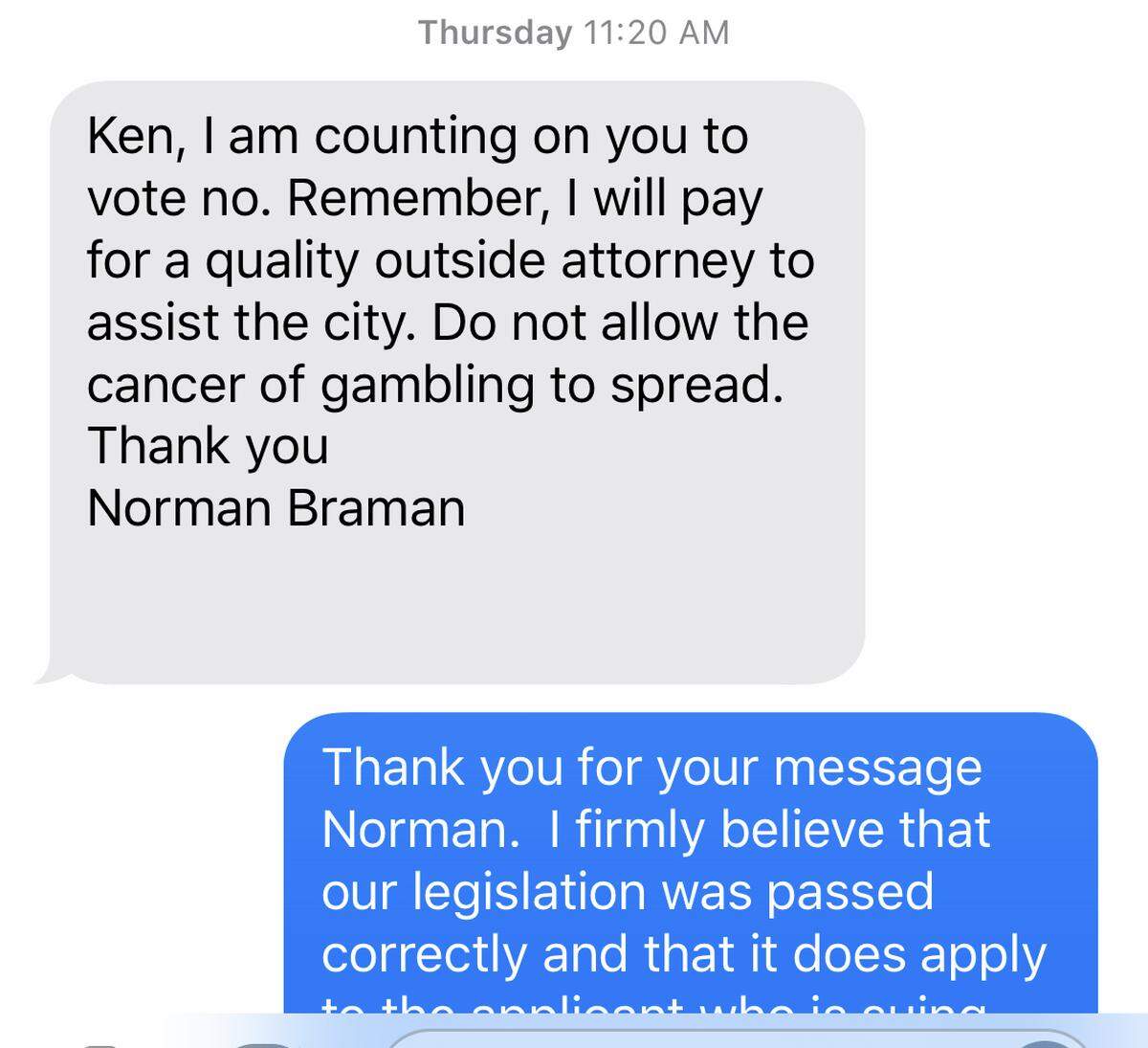
On Feb. 13, before Commissioners Keon Hardemon, Alex Díaz de la Portilla and Manolo Reyes voted to settle, Braman texted Russell again to say that if money was an issue, he would foot the bill.
“Ken, I am counting on you to vote no,” he wrote. “Remember, I will pay for a quality outside attorney to assist the city. Do not allow the cancer of gambling to spread.”
Russell, along with Commissioner Joe Carollo, voted to continue the litigation.
The veto
The ability to veto the commission’s actions is one of the few powers held by Miami’s mayor under a government system where he does not have a vote on the commission. That power has been the source of debate in recent months over a disagreement between the mayor and Méndez over what he can and cannot veto.
The pair butted heads during the holidays over whether Suarez could veto commissioners’ vote to have the auditor general investigate allegations of impropriety against City Manager Emilio González.
Friday’s veto will likely further fuel the feud after Méndez advised the clerk that Suarez’s veto doesn’t belong on Monday’s agenda because he cannot veto commission resolutions on litigation settlements.
Suarez, who lacks a clear majority of allies on the commission, has previously suggested he might sue the city to resolve the veto issue. Such a suit would ironically rack up more courts costs for the city’s legal department.
Read Suarez’s veto message below:
This story was originally published February 21, 2020 at 4:42 PM.