Biden chooses Miami’s Ketanji Brown Jackson for historic Supreme Court nomination
READ MORE
Miami’s Ketanji Brown Jackson gets historic Supreme Court nomination
President Joe Biden nominated federal appeals Judge Ketanji Brown Jackson for the U.S. Supreme Court, a historic pick which will make the Miami Palmetto High School graduate the first Black woman on the nation’s high court if she is confirmed by the U.S. Senate.
Expand All
President Joe Biden nominated federal appeals Judge Ketanji Brown Jackson for the U.S. Supreme Court, a historic pick which will make the Miami Palmetto High School graduate the first Black woman on the nation’s high court if she is confirmed by the U.S. Senate.
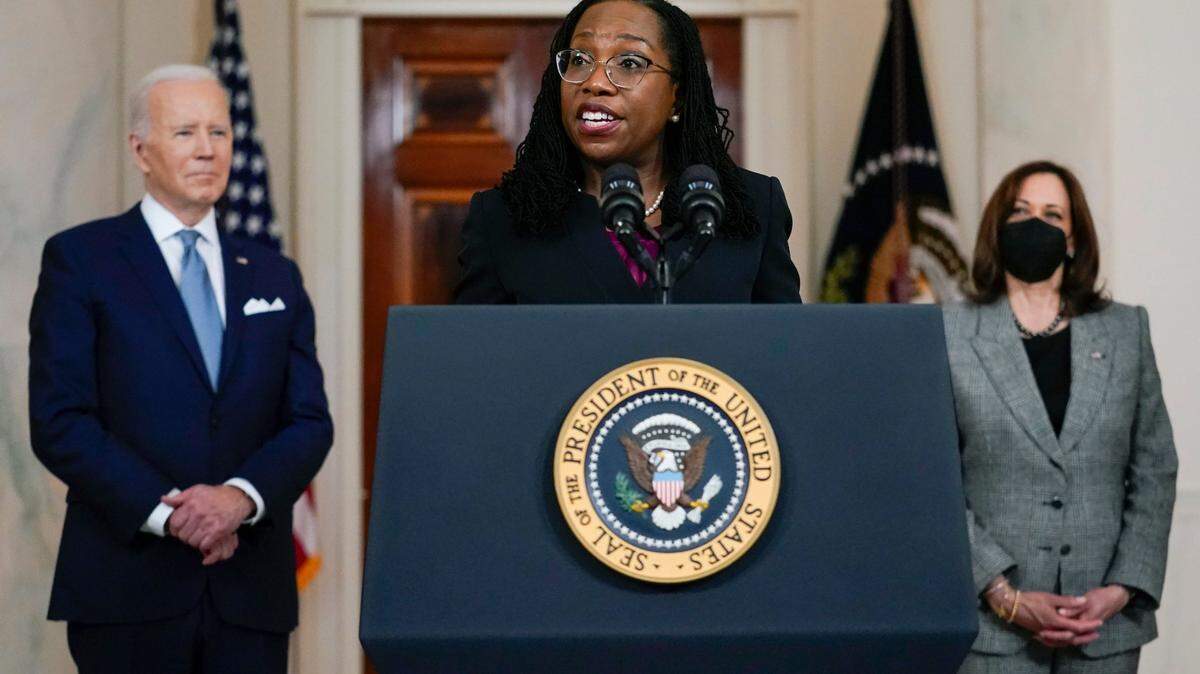
“For too long, our government, our courts, haven’t looked like America,” Biden said Friday at the White House as he stood alongside Brown Jackson and Vice President Kamala Harris.
Born in Washington, D.C., Brown Jackson, 51, spent the bulk of her youth in South Florida where her father, Johnny Brown, worked as an attorney for the Miami-Dade School Board and her mother, Ellery Brown, worked as a high school principal.
The judge, whose parents were watching from their home in Florida, pointed to her father’s decision to transition from his career as a public school teacher to attend law school at the University of Miami as helping to set her on the path to potentially take a place on the nation’s high court.
“Some of my earliest memories are of him sitting at the kitchen table, reading his law books. I watched him study, and he became my first professional role model,” Brown Jackson said.
A 1988 graduate of Miami Palmetto High School, Brown Jackson thrived on the school’s debate team, an experience which she has credited with preparing her for her legal career. Biden referenced the judge’s background as a high school class president and debate star as he reflected on her journey from her Miami childhood to the federal bench.
“She was a standout in the speech and debate team. And it was after a debate tournament that took place at Harvard when she was in high school that she believed she could one day be a student,” Biden said. “There are those who told her she shouldn’t set her sights too high. But she refused to accept limits.”
After earning her graduate and law degrees from Harvard University, Brown Jackson early in her career served as law clerk for Supreme Court Justice Stephen Breyer, the retiring justice she’s been tapped to succeed.
Brown Jackson said Friday that she would never fill Breyer’s shoes even if she filled his seat, but the White House explicitly compared the judge to her mentor in an announcement that said the president “sought a nominee — much like Justice Breyer — who is wise, pragmatic, and has a deep understanding of the Constitution as an enduring charter of liberty.”
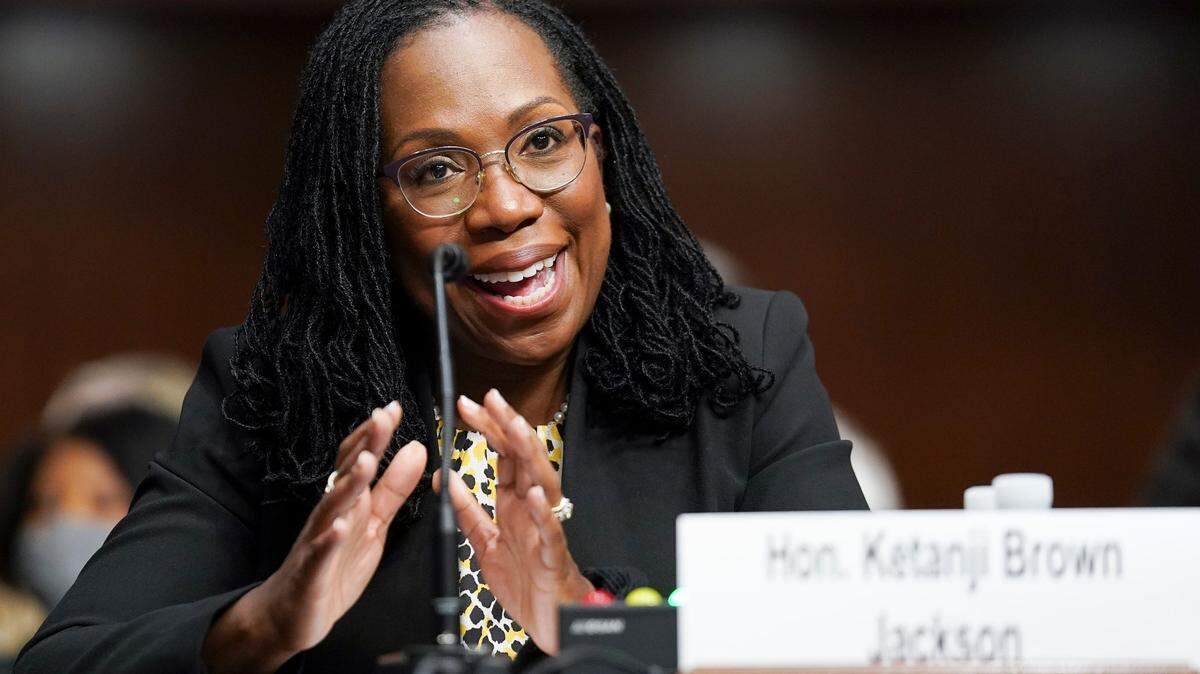
During a 2017 lecture at the University of Georgia School of Law., Brown Jackson spoke of her time working for Breyer: “Even today I feel so lucky to have had the chance to work inside an institution that has such a significant impact on the lives of Americans and that few people even get to see, much less be a part of.”
Brown Jackson’s nomination enables Biden to fulfill a campaign promise to appoint the first Black woman to the nation’s highest court.
“America is in dire need of a Black woman Supreme Court justice who will work tirelessly to support systems of justice and equality for all people, and I believe Ketanji Brown Jackson will do just that,” Rep. Frederica Wilson, a South Florida Democrat and a member of the Congressional Black Caucus, said earlier this month in support of the judge’s nomination. “Ketanji is a product of the Miami-Dade Public School System, and I am proud to have been a supporter and friend of both she and her family for decades now.”
Wilson said on Twitter Friday that she had spoken with the judge’s family and that they “could not beam brighter with Dade County public school pride.”
If confirmed, Brown Jackson will join Justices Sonia Sotomayor and Elena Kagan as a member of the court’s liberal bloc, which has seen its power wane after former President Donald Trump’s appointment of conservative Justice Amy Coney Barrett following the death of liberal icon Ruth Bader Ginsburg in 2020.
Progressive groups applauded the selection of Brown Jackson, arguing she would bring a needed perspective to the court as it weighs a host of issues that affect women and communities of color.
“At a time when this nation continues to fight the battles of voting rights, abortion rights and others we thought were already won, Judge Jackson brings exceptional credentials, unimpeachable character, and an unwavering dedication to equal justice under the law to the nation’s highest court,” said Aimee Allison, the founder and president of She the People, a national organization that works to elevate the voices of women of color.
“Her lived experience as a Black woman and a public defender qualify her to serve the American people honorably.”
Brown Jackson reflected Friday on how her family background has given her a unique vantage point on the judicial system.
“You may have read that I have one uncle, who got caught up in the drug trade, and received a life sentence. That is true,” she said, referring to news coverage of her uncle Thomas Brown’s conviction.
“But law enforcement also runs in my family. In addition to my brother, I had two uncles who served decades as police officers, one of whom became the police chief in my hometown of Miami, Florida,” said the judge, whose uncle Calvin Ross served as Miami’s police chief in the 1990s.
Brown Jackson could have bipartisan appeal
Brown Jackson quickly emerged as the front-runner to succeed her former boss because she had received bipartisan support for her confirmation last year to the prestigious U.S. Court of Appeals for the D.C. Circuit, widely considered the second most powerful court in the country because it handles many cases pertaining to the federal government.
Every Senate Democrat and three Republicans — Maine Sen. Susan Collins, Alaska Sen. Lisa Murkowski and South Carolina Sen. Lindsey Graham — backed the judge’s confirmation to the D.C. Circuit, a traditional launching pad to the Supreme Court.
But Graham, a member of the Senate Judiciary Committee, quickly criticized the selection of Brown Jackson over his preferred pick of Judge J. Michelle Childs, a federal district court judge in South Carolina who faced opposition from organized labor groups.
“If media reports are accurate, and Judge Jackson has been chosen as the Supreme Court nominee to replace Justice Breyer, it means the radical Left has won President Biden over yet again,” Graham said on Twitter Friday morning, signaling his potential opposition to Brown Jackson’s nomination.
Three of the court’s current members — Chief Justice John Roberts, Justice Clarence Thomas and Justice Brett Kavanaugh — also spent time on the D.C. Circuit before their elevation to the Supreme Court. Ginsburg served on the D.C. Circuit prior to her appointment to the Supreme Court in 1993.
Sen. Ted Cruz, R-Texas, a member of the Senate Judiciary Committee who opposed Brown Jackson’s confirmation to the D.C. Circuit, acknowledged last month that she would be likely to win confirmation to the high court if nominated based on the previous confirmation votes.
“It’s hard to find something tangible in her record to object to, and she got three Republicans last time,” Cruz said in an episode of his podcast recorded after Breyer’s retirement announcement.
Biden noted Friday that Brown Jackson has already earned confirmation from the Senate three times, including her appointments to the U.S. Sentencing Commission and U.S. District Court for the District of Columbia during the Obama administration.
Still, the highly scrutinized Supreme Court confirmation process is likely to be more grueling than the judge’s past confirmations after the famously contentious confirmation fights under former President Donald Trump.
Sen. Marco Rubio, R-Florida, hinted Friday at his likely opposition to the judge despite her Florida ties, saying in a statement that Biden “wrongly believes the Supreme Court should act as a legislative branch, actively overriding the will of the people and the Congress.”
Rep. Val Demings, a Florida Democrat running to unseat Rubio, said in a statement that Brown Jackson had demonstrated impartiality throughout her career and that in “less partisan times she is the kind of nominee who might have been confirmed unanimously by the U.S. Senate.”
If Brown Jackson cannot win over a Republican in the 50-50 Senate, it’ll set up a scenario in which Harris, the first Black woman to serve as vice president, can cast the deciding vote for the historic nominee as long as Democrats maintain unity around Biden’s pick.
Brown Jackson served a relatively short time on the D.C. Circuit. She was confirmed in June of last year and authored her first appellate opinion earlier this month, siding with the American Federation of Government Employees in a lawsuit against a Trump-era rule that sought to limit the collective bargaining rights of federal workers.
She was also part of a three-judge panel that ruled in December that Congress was entitled to see White House records related to the Jan. 6 Capitol attack, rejecting an argument from Trump’s lawyers that he retained power to seal the records after leaving office.
A diverse legal career
Before her appointment to the D.C. Circuit, Brown Jackson served on the U.S. District Court for the District of Columbia from 2013 to 2021 after being nominated by former President Barack Obama and confirmed by a Senate voice vote, a sign of bipartisan support.
During her tenure on the lower court, Brown Jackson ruled against the Trump administration in a number of important cases, including in 2019 when she ordered White House counsel Don McGahn to comply with a House Judiciary Committee subpoena in a ruling that stated, “Presidents are not kings.” The appeals court upheld part of her ruling, and McGahn eventually agreed to deliver closed-door testimony last year.
Brown Jackson’s tenure on the federal bench followed a legal career that spanned a diverse set of jobs, including a stint as a federal public defender, time at international law firms and four years as vice chair of the U.S. Sentencing Commission, a bipartisan agency which works to reduce disparities in criminal sentencing.
Biden cited this range of experiences Friday, noting that the only current member on the court to serve on the Sentencing Commission is Breyer.
Her experience as a public defender will be unique on the court. Only 7% of active federal judges have worked as public defenders, according to a 2022 report by the Courthouse News Service citing data from the Federal Judicial Center. The court currently includes a former federal prosecutor in Justice Samuel Alito and former Department of Justice attorneys in Roberts and Justice Neil Gorsuch.
Brown Jackson’s name had been floated as a potential contender for the court six years ago when conservative Justice Antonin Scalia passed away during the final year of the Obama administration. The vacancy was ultimately filled by Trump’s pick, Gorsuch, after Republicans refused to hold confirmation hearings on Obama’s nominee, Merrick Garland.
During her 2017 lecture at the University of Georgia, Brown Jackson recounted an anecdote about how her youngest daughter, Leila, who was 11 at the time, decided to write a letter to Obama on her mother’s behalf during this period.
“It has been a lot of hard work trying to balance work and motherhood. And like so many other people, I often feel like I’m failing in both arenas. But in that one brief, shining moment as I read Leila’s letter, I got a glimpse of my professional and personal life combined and what I saw made me feel as if my husband and I are well on our way to achieving success in both worlds,” said Brown Jackson, who has two daughters with her husband, Patrick Graves Jackson, a gastrointestinal surgeon whom she met when they were both students at Harvard.
Standing alongside a different president on Friday, Brown Jackson addressed both of her daughters from the podium after being selected for the job Leila had recommended her for years earlier.
“Talia and Leila, you are the light of my life. Please know that whatever title I may hold or whatever job I may have, I will still be your mom. That will never change,” she said.
McClatchy reporters Alex Roarty and Francesca Chambers contributed to this report.
This story was originally published February 25, 2022 at 9:15 AM.

.JPG)
.JPG)