Elon Musk’s brain chip was put in a patient at Miami-area hospital. What to know
A paralyzed military veteran is one of seven people in the country — and the first patient at a Miami hospital — to be implanted with an Elon Musk-backed brain chip as part of a clinical trial underway in South Florida.
The goal is to test whether the chip, created by Neuralink, a company co-founded by Musk, can give people who are paralyzed the ability to use their mind to control computers, smartphones and other electronic devices.
Surgeons at the University of Miami Miller School of Medicine implanted the device, known as the Link or Telepathy, in the patient’s brain as part of the FDA-approved clinical trial. And so far, the tech seems to work. Video recently shared by UM shows the veteran, who was only identified as RJ, using his mind to wirelessly play a video game on a computer. Photos posted online also show Musk making the “U” sign in celebration with UM medical staff at the hospital.
“They’re giving me my spark back … my drive back. They’ve given me my purpose back,” RJ said in a statement.
RJ, who has a spinal cord injury stemming from a motorcycle accident, received the Neuralink implant in April at UHealth Tower, the Miami flagship hospital of the University of Miami Health System. As of last week, RJ was one of seven people in the country who have received the Telepathy implant since clinical trials began last year, according to Neuralink co-founder and president DJ Seo.
He’s also the first patient to get the implant through The Miami Project to Cure Paralysis at UM’s medical school, which was tapped earlier this year to be the second site in the country to test the safety and effectiveness of the chip. The first patient, Noland Arbaugh, had his Link surgically implanted last year at the Barrow Neurological Institute in Phoenix.
“We’re very cautious with Neuralink in humans” and are working closely with regulators, Musk said during a June update on Neuralink’s progress creating devices that improve or restore movement, vision and speech. “That’s the reason we’re not moving faster than we are, is because we’re taking great care with each individual to make sure we never miss and, so far, we haven’t.”
READ MORE: What’s it like to use Elon Musk’s brain chip? How does it work? ‘Like using the Force’
For the Telepathy trials, researchers are looking for volunteers 22 to 75 years old who have limited or no ability to use both hands to participate in the clinical trial. The paralysis must be from a cervical spinal cord injury or from ALS, a rare disease with no cure that causes nerve cells to stop working and muscles to become weak, leading to paralysis. Neuralink has also received approval to launch similar trials in Canada, the United Kingdom and United Arab Emirates, according to Seo.
“We hope this partnership is another significant step in finding meaningful solutions for the millions living with paralysis and other significant motor deficits,” Marc Buoniconti, president of The Miami Project to Cure Paralysis and the son of the late Miami Dolphins linebacker Nick Buoniconti, previously told the Miami Herald.
Marc Buoniconti became a quadriplegic following a spinal cord injury while playing in a 1985 college football game. His father helped establish the Miami Project.
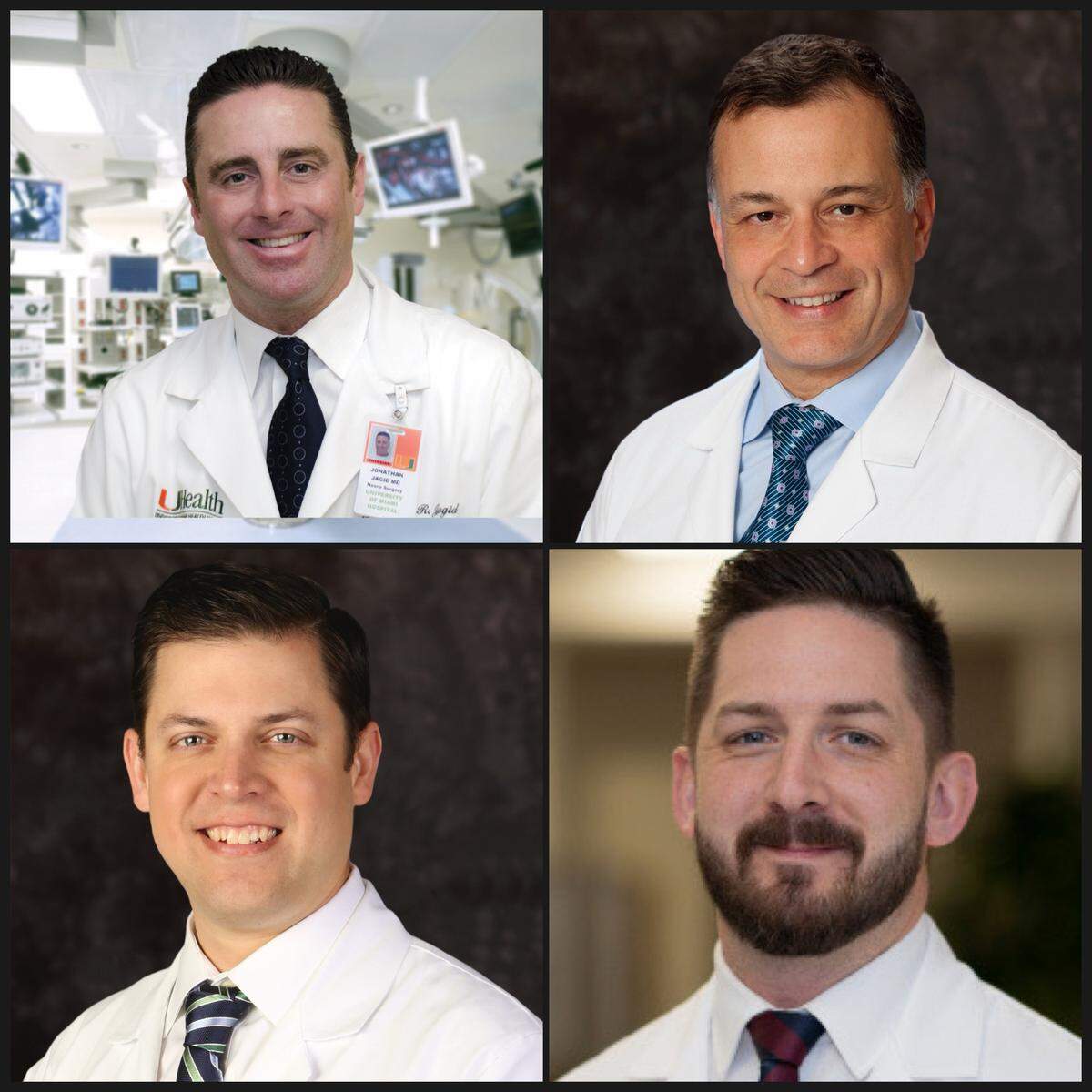
And unlike other types of brain surgeries, the surgical implant of the Link is not as invasive, according to Dr. Jonathan Jagid, UM’s principal investigator for the clinical trial and part of RJ’s surgical team.
How does Neuralink’s brain chip work?
Surgeons made a relatively small incision to implant a wireless, rechargeable coin-sized brain chip in the part of RJ’s brain that handles thoughts and body movement. A Neuralink surgical robot with a needle that’s thinner than a human hair is used to implant more than 60 flexible ultra-thin “threads.” The threads are so fine that they can’t be inserted by human hand, according to Neuralink.
“The surgery went perfect,” Jagid told the Herald in a phone interview this week while discussing RJ’s procedure. The veteran was discharged from the hospital a day after his surgery, he said.
The device records electrical signals sent between brain cells and wirelessly transmits it to Neuralink’s software, which will be running on a computer or another device. The software will then decode and translate the neural data into actions, such as moving a cursor or a chess piece on a computer screen, playing video games and even using design software. Neuralink is also testing whether its brain chip can help patients control a robotic arm.
“I think my favorite thing’s probably [being] able to turn on my TV, like the first time in two and a half years I was able to do that. That was a pretty sweet move,” RJ said during a recorded video call with several other Telepathy users. The recording was played during Neuralink’s June 27 event.
RJ, who identified himself as the fifth person in the country to receive the Link, was also shown playing Call of Duty and Mario Kart with the other Neuralink patients. All of it was done wirelessly using their minds.
“I like shooting zombies. That’s kinda nice,” said RJ, whose shirt read: “I do a thing called whatever I want.”
For Jagid, the UM doctor, the technology is a step in the right direction for The Miami Project’s mission to find a cure for paralysis from spinal cord injuries and help improve patients’ quality of life.
And RJ’s involvement in the trial will help “move the science forward in order to help everybody else who suffers with these types of injuries,” he said.
This story was originally published July 2, 2025 at 1:49 PM.