Florida has a COVID vaccine residency requirement. Are snowbirds still eligible?
Now that Florida is requiring proof of residency, does this mean snowbirds can no longer get the COVID-19 vaccine in the Sunshine State?
Snowbirds, or seasonal residents, are still eligible.
Florida is giving vaccines to healthcare workers with direct patient contact, long-term care facility residents and staff, and people 65 and older. Hospitals can also choose to give the vaccine to people with health conditions that make them “at risk” of falling seriously ill with the disease.
On Jan. 21, State Surgeon General Scott Rivkees issued a public health advisory prioritizing vaccines for Florida residents to stop “vaccine tourism,” or people flying in from another state or country to get the vaccine. The only cited exception to the residency mandate are healthcare workers who are working directly with patients.
Snowbirds are also allowed to get the vaccine, but the criteria requirements are different, according to the Florida Department of Health. The advisory applies to every vaccine provider in Florida.
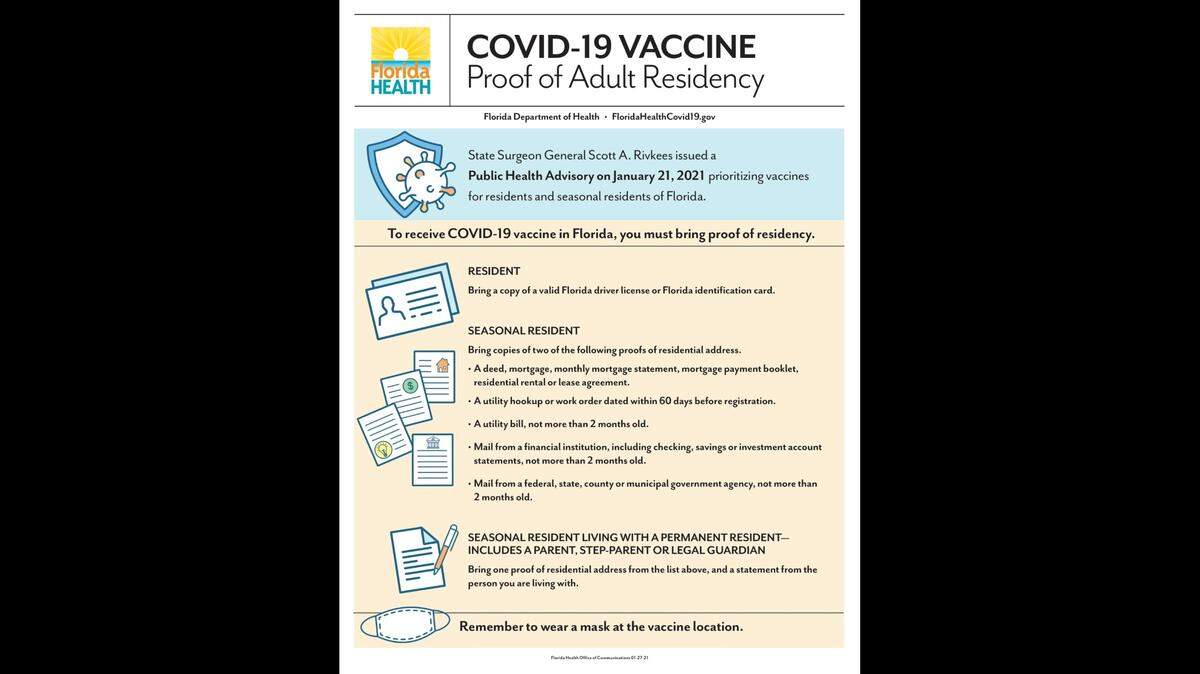
State residents need to show a copy of a valid Florida driver’s license or identification card before they can get their first dose of the Pfizer-BioNTech or Moderna vaccine. Snowbirds will need to show two proofs that they live at a Florida residential address to be eligible.
Here’s what to know:
Who is considered a snowbird or seasonal resident in Florida?
The Florida Division of Emergency Management, which is tasked with the state’s vaccine distribution, says a snowbird or “seasonal resident” for the purpose of the COVID-19 vaccine is:
Anyone who temporarily resides in Florida at least 31 consecutive days each calendar year and maintains a temporary residence in the state. They must also return to the state or jurisdiction of his or her residence at least one time during each calendar year and is registered to vote or pays income tax in another state or jurisdiction.
Non-residents who received their first dose in Florida prior to the public health advisory will still be eligible to receive their second dose, even if they do not meet the criteria.
Florida COVID-19 vaccine: What proof do snowbirds need to show?
The Florida Department of Health says snowbirds 65 and older will need to show two of the following to be eligible for the COVID-19 vaccine:
▪ A deed, mortgage, monthly mortgage statement, mortgage payment booklet or residential rental or lease agreement.
▪ A utility hookup or work order dated within 60 days before registration.
▪ A utility bill, not more than 2 months old.
▪ Mail from a financial institution, including checking, savings, or investment account statements, not more than 2 months old.
▪ Mail from a federal, state, county, or municipal government agency, not more than 2 months old.
Can snowbirds who live with a permanent Florida resident get the COVID-19 vaccine?
Seasonal residents 65 and older who live with a permanent Florida resident, including a parent, step-parent or a legal guardian, can get the COVID-19 vaccine. You’ll just need to bring proof that the person you are living with is a Florida resident (refer to list above for what qualifies as proof) and a statement from them that you are residing with him or her.
This story was originally published January 29, 2021 at 9:23 AM.