Florida sees sudden spike in reported coronavirus cases as more than 1,000 are confirmed
After Florida saw its highest day of confirmed cases and then a five-day decline, the state reported over 1,000 new cases on Thursday, going back to the trend lines of early April.
Since Wednesday evening, the Florida Department of Health reported 1,072 new cases, bringing the state total to 29,648. The death toll rose by 60 for the second consecutive day, leading the state deaths to reach nearly 1,000 at 987.
South Florida remains at the epicenter of the state’s cases. As of Thursday evening, the four counties in South Florida — Miami-Dade, Broward, Palm Beach and Monroe — had 17,647 of the state’s 29,648 cases, or more than half. Miami-Dade had the majority of the cases in South Florida at 10,588 cases.
Also on Thursday, state health officials said Florida had conducted 301,721 tests. This was the first time the state had surpassed 300,000. Of the 301,721 tests, 271,499 tested negative. The remaining tested positive or are awaiting results.
On April 17 — six days ago — Florida saw 1,413 new cases reported in a single day, the highest since the pandemic began. The following days saw new reported cases not breaking the 1,000 threshold, until Thursday.
Of the 60 new deaths, 37 were in South Florida. Information on the newest deaths has not yet been released by health officals. Here is what was reported in Thursday morning’s report:
▪ Six women between the ages of 51 and 98 and two men, a 65-year-old and a 75-year-old, died in Miami-Dade County.
▪ Seven men between the ages of 54 and 91 and two women, a 75-year-old and a 91-year-old, died in Broward.
▪ Eight people between the ages of 50 and 97 died in Palm Beach County.
The other deaths were in Charlotte, Lake, Lee, Manatee, Martin, Polk and St. Lucie counties.
Health officials say the state has had 4,640 hospitalizations relating to COVID-19, the disease caused by the novel coronavirus.
The statewide and county-level data for COVID-19 hospitalizations includes anyone who was hospitalized during their illness and “does not reflect the number of people currently hospitalized,” according to the Department of Health.
The state says it does not “have a figure” to reflect current hospitalization data.
Florida pushes to reopen economy. Is it too soon?
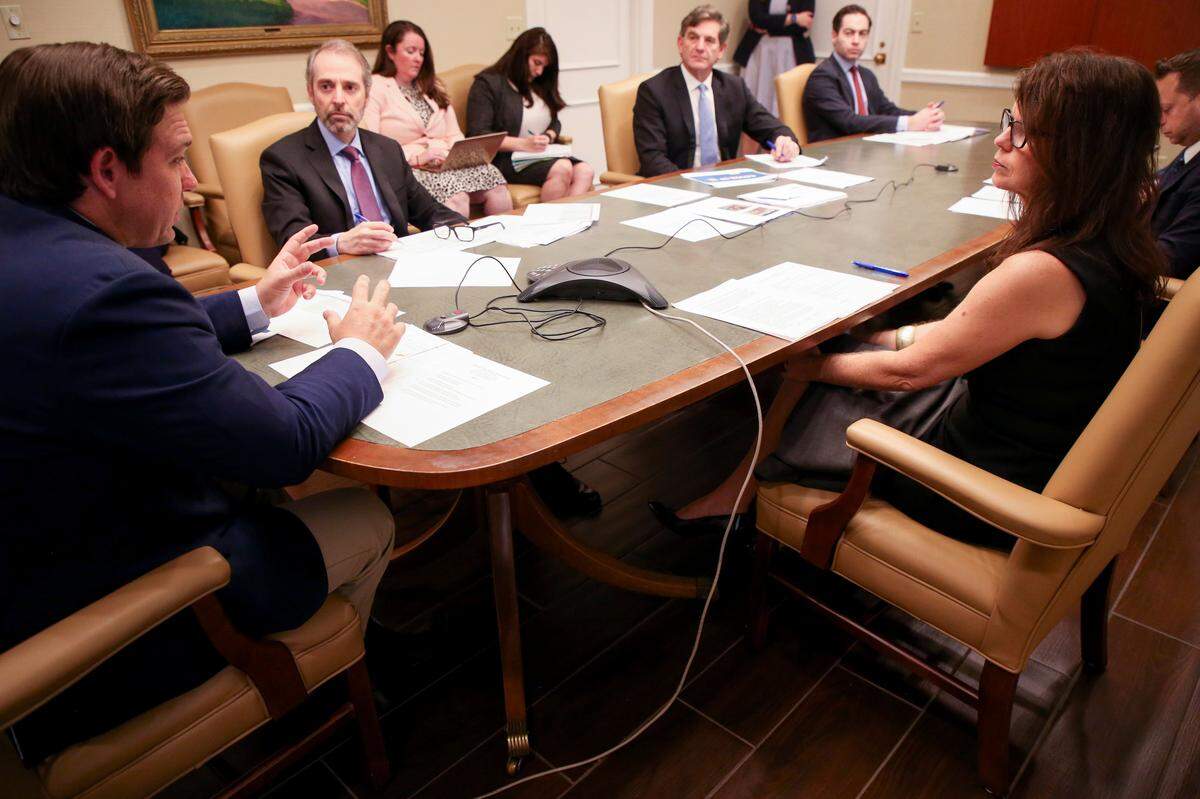
Despite the daily reports of additional confirmed cases and deaths, Florida Gov. Ron DeSantis announced earlier this week that the state’s coronavirus curve had flattened.
But health experts are concerned the statewide total of confirmed cases is significantly undercounted because Florida reports only the number of Floridians waiting to hear test results from state labs, not private ones — and private labs are completing more than 90% of state tests.
The results of thousands of pending tests from private labs have taken as long as two weeks to be added to the state’s official count. The state’s website does not say its figures exclude the vast majority of pending tests for the novel coronavirus.
On Wednesday, DeSantis announced two new contracts with laboratories that will increase COVID-19 testing capacity by 18,000 samples per day by using rapid tests that provide results in one or two days.
More than 10 new walk-up sites would also be set up in Miami-Dade, Hillsborough, Duval, Leon and Orange counties in the coming weeks, he said.
Three drive-thru testing sites in Miami-Dade — Marlins Park, the Youth Fair site at Tamiami Park and the South Dade Government Center — also began to schedule free retesting appointments Thursday. The appointments are for those who previously tested positive for COVID-19 and want to be tested again.
Previously, retesting for the disease was not allowed at the free drive-thru sites, forcing people to seek second tests from private healthcare providers, a more costly alternative.
DeSantis is also expecting to receive a list of recommendations Friday from the Re-Open Florida Task Force, which had its first meeting Monday on how the state can reopen. On Wednesday, the task force — comprised of lawmakers and executives from large corporations — said it needed advice from doctors on what safety measures reopened businesses would have to follow.
Counties and cities across the state have also begun to reopen beaches with limited access in an attempt to return life to normalcy. In Miami-Dade, the plan so far is to allow parks, marinas and golf courses to reopen in the near future but not beaches.
Monroe County leaders are also starting to work on a “framework” to relax restrictions for residents along the island chain but say there is no date as to when it will happen. The Florida Keys reported a new case Thursday evening, but since Saturday no new confirmations have been made.
Officials say the island chain will likely not reopen to visitors until its neighboring counties to the north, including Miami-Dade, significantly ease their COVID-19 restrictions.
The push to reopen Florida and several other states comes after millions in the country were left unemployed as businesses shuttered their doors during stay-at-home and shelter-in-place orders.
Dr. Robert Redfield, the director of the Centers for Disease Control and Prevention told “Fox & Friends” last week the COVID-19 outbreak had “stabilized” across the U.S. but had not hit its peak yet.
“We’ve stabilized and I anticipate that we will begin to see a decline in the days ahead, but we have got to just continue to take it day by day and look at the data,” Redfield said.
He said people would know once the U.S. hit its peak because the number of new confirmed COVID-19 cases would start to drop. The U.S. would then have to gradually reopen “in a thoughtful, prudent way, jurisdiction by jurisdiction, based on the data about what’s the state of transmission of this virus in those areas,” he said.
As of Thursday morning, the United States had more than 842,620 confirmed cases of COVID-19, more than any other country in the world, according to Johns Hopkins University & Medicine in Maryland, which is tracking county-by-county data in the U.S. Of the known U.S. cases, 76,614 have recovered.
Miami-Dade County, which has the highest number of confirmed COVID-19 cases and deaths in Florida, is ranked at No. 16 in the university’s list of counties with the most COVID-19 cases in the U.S.
While some support the country’s economic reopening, others worry it’s too soon.
A recent report in the New York Times cites a Harvard study saying to safely open the country by mid-May, between 500,000 and 700,000 tests daily have to be performed nationwide; the U.S. is averaging about 151,000 tests a day.
In Florida, a majority of voters say they are not ready for the state’s stay-at-home order to be lifted, according to a new poll by Quinnipiac University.
Based on the poll results, 72% of voters say Florida should not loosen social distancing rules before the end of April and nearly three-quarters of voters say Florida’s economy should not reopen until public health officials say it’s safe, compared to 17% who say it should reopen even if public health officials warn against it.
Confirmed COVID-19 cases in South Florida
As of Thursday evening, here’s what Florida’s Department of Health data showed:
Miami-Dade County had 232 additional confirmed cases of COVID-19, raising the county total to 10,588 confirmed cases. Of those cases, 10,457 are residents, 130 are non-residents and one is a resident who is not in Florida. Those who have fallen ill range from 0 to 105. (A person who is listed as age zero means they are less than 1.) The county has had 1,183 hospitalizations and 270 deaths, Florida’s highest death toll.
Broward County reported 116 additional confirmed cases, raising the county total of confirmed cases to 4,431. Health officials say 4,307 are residents and 124 are non-residents. Those who have fallen ill range from 0 to 102. The county has had 849 hospitalizations and 157 deaths.
Palm Beach County had 86 additional confirmed cases of COVID-19, raising the county total to 2,554. Health officials say 2,496 are residents, 56 are non-residents and two are residents who are not in Florida. Those who have fallen ill range from 0 to 104. The county has had 397 hospitalizations and 144 deaths.
Monroe County reported one additional confirmed case of the disease. The county has 74 known cases of COVID-19. Only eight of them are non-residents. Those who have fallen ill range from age 6 to 80. The Florida Keys have had three deaths and 11 hospitalizations.
Miami Herald staff writers Gwen Filosa, David Goodhue, Samantha Gross, Douglas Hanks and McClatchy DC reporter Alex Daugherty contributed to this report.
This story was originally published April 23, 2020 at 11:33 AM.