
When a farm becomes a lifestyle amenity: ‘Agrihood’ battle brewing in Miami-Dade

A high-end version of life on the farm could be the next trend in suburban real estate outside Miami if a developer can loosen limits for construction on agricultural land near the Everglades.
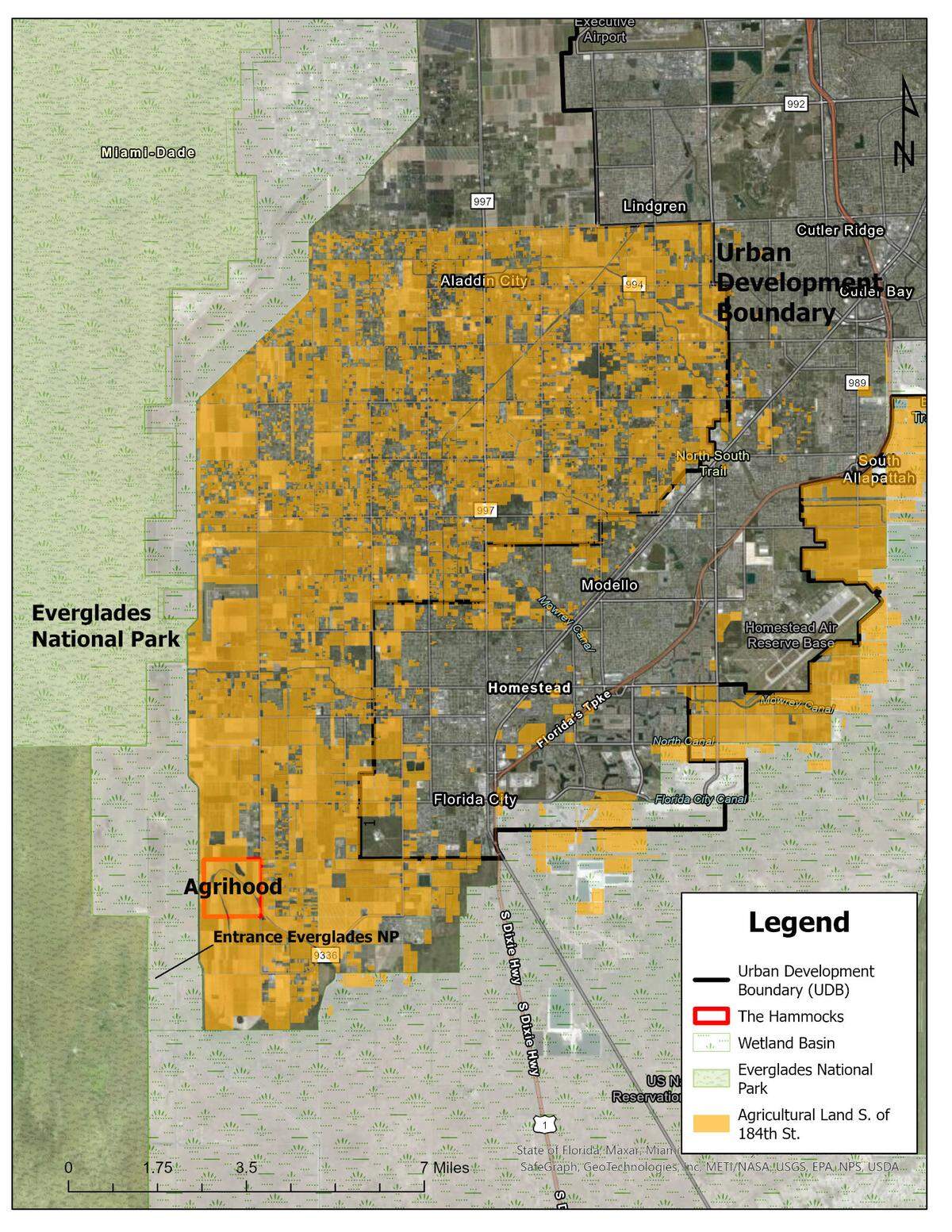
Legislation before the Miami-Dade County Commission would allow developers to create “agrihoods,” a term for residential communities centered on farmland, with land for homegrown fruits and vegetables replacing golf courses or lakes as amenities for buyers.
“They’re high-end homes. For people who like that lifestyle,” said Tim Gomez, a lobbyist representing the developer who wants to build a 500-acre residential development with stables and horse trails on southern farmland if the agrihood changes pass. “People just want to get out of the city.”
READ MORE: To expand the UDB, developer needs Miami-Dade to change county policy on flood risks
On Thursday, commissioners voted to delay preliminary consideration of the agrihood legislation, extending the timetable for when the proposal faces its first test in Miami-Dade.
While pitched as a way to keep farming viable as land values soar, the proposal has sparked the latest fight over suburban sprawl, Everglades protection and holding back construction from thousands of acres of farmland outside the county’s Urban Development Boundary. That’s the imaginary line enshrined in Miami-Dade zoning law that separates the western and southern suburbs from farmland, wetlands and other areas that buffer the Everglades from large developments.
Technically not a UDB expansion, but critics still alarmed
The agrihood proposal wouldn’t expand the UDB, but critics say the new rules would water down development restrictions enough that developers would find it much easier to build residential subdivisions on rural farms largely off-limits under current regulations in the southern half of Miami-Dade.
“This would make the Urban Development Boundary irrelevant in South Miami-Dade,” said Laura Reynolds, a leader of the Hold the Line Coalition, which represents environmental groups and other organizations in UDB debates.
READ MORE: Miami-Dade’s fight over farming, ‘agrihoods’ and the Everglades: A look at impacts
The UDB hadn’t moved for nearly a decade before commissioners last year voted to expand it to allow a new warehouse complex in South Miami-Dade. Mayor Daniella Levine Cava opposed the expansion, and planning staff under her also are recommending against the agrihood proposal.
In a memo to commissioners released Wednesday afternoon, Levine Cava said the agrihood proposal incentivizes sprawl and promotes “the suburbanization of the Redland,” a farming community in southern Miami-Dade. She also noted the new developments would be approved without affordable-housing requirements, and largely outside the county’s public hearing process.
Developers have adopted the agrihood concept across the country as a way to attract high-end buyers. In Palm Beach County, pre-construction prices start at $600,000 in Arden, where the slogan is “Welcome to the Agrihood” and residents use the “Harvie” app to coordinate when they can pick up produce from the community farm. There are also pickleball courts, pools and a splash pad.
Outside Atlanta, townhouses start at $650,000 in Serenbe, a mixed-use development that has its own newspaper, the Serembe Hamlet, which noted in a recent issue on design trends that “Glam Farmhouse is in.” The project includes an organic farm growing 300 types of vegetables, fruits and flowers that are sold within the community and to nearby restaurants.
Restaurants, other businesses could also pop up
In a Nov. 23 report, the county’s planning staff wrote the changes would dilute current restrictions on developing farmland by allowing hotels, restaurants and other commercial uses on agricultural land.
The report also criticized the proposal for requiring only 30% of an agrihood property to be reserved for farming, and half of the acreage allowed for residential. Developers would need 250 acres of farmland to qualify for the agrihood rules, which would only apply to land outside the UDB and south of Southwest 184th Street.
If approved, the plan would end up “relegating agriculture to a residential amenity,” the report read. “Approval of the application could result in a proliferation of ‘farm-themed subdivisions,’ reducing the supply of land for true agriculture production and setting the stage for additional conflicts between agriculture and residential uses.”
The agrihoods proposal comes from developer Rishi Kapoor, founder of Location Ventures, a development firm in Coral Gables that’s behind a line of URBIN co-living projects in the Miami area and the Commodore Inn apartment project in Coconut Grove.
He wants to use the proposed rules to develop 500 acres of farmland outside the UDB and below Southwest 360th Street, with plans for a hotel, equestrian center and about 100 houses, according to a July 11, 2022, letter to the county from a lawyer representing the venture. The project plans a privately run sewage facility to service the new construction located miles from Miami-Dade’s existing water-and-sewer pipes.
Gomez said Kapoor’s options with the land highlight the need for the agrihood legislation because existing rules already allow construction of one house for every five acres of farmland outside the UDB. There are no requirements to continue farming land in the agricultural zone under current rules, and septic tanks are allowed if approved by regulators.
“We can build 100 homes there now, by right,” Gomez said. “On septic. And not be required to grow a single harvestable plant.”
This article was updated to include the results of Thursday’s meeting of Miami-Dade County commissioners.
This story was originally published January 18, 2023 at 7:35 PM.