
Construction begins on Miami’s first supertall tower. Who won the race to the sky?
READ MORE
The Sky’s the Limit
In a city with its share of tall buildings already, construction begins on Miami’s first supertall tower. The $426 million, 100-story Waldorf Astoria skyscraper will include 360 condos and 205 hotel rooms and suites,
Expand All
For years, many a developer has vowed to give Miami its first supertall tower — a class of cloud-piercing skyscraper that rises to a dizzying pinnacle of 1,000 feet or more. But no one has managed to deliver it.
Until now.
Miami’s race to the sky at long last appears to have a winner: It’s the Waldorf Astoria Hotel & Residences, which has broken ground. For real.
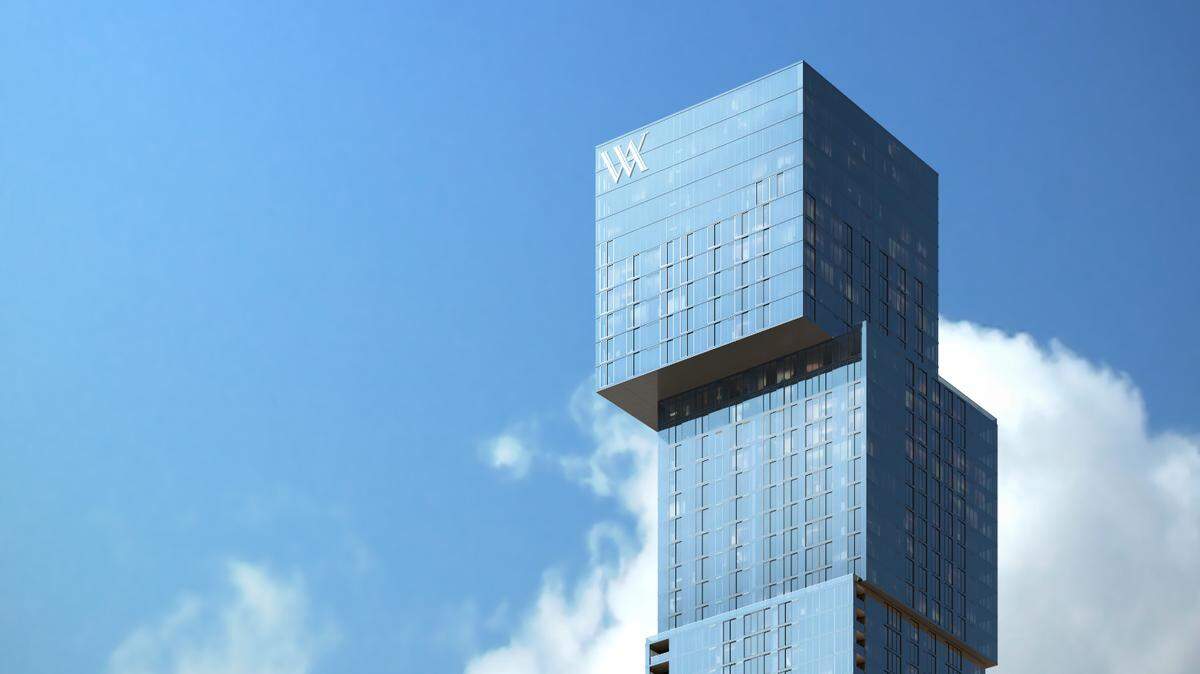
With foundation preparation permit in hand, the tower’s developers have begun drilling and pouring a special concrete for support pilings into the ground on Biscayne Boulevard in downtown Miami across from Bayside Marketplace. They say the 1,000-plus-foot, 100-story tower, a slender, Jenga-like stack of glass cubes, will be the first supertall in Florida and the tallest residential building south of New York City, once it’s completed in about four and a half years.
“I think it’s a big deal, not just for us, but for the community,” said Ryan Shear, managing partner at Miami’s PMG, which is developing the Waldorf tower with Canada-based Greybrook Realty and other partners. “It’s not every day a supertall starts construction. As a Miamian, I take a lot of pride in it. It’s not just another groundbreaking. This one is a bit special.”
In another first, the arrival of the Waldorf Astoria tower — to be marked with a formal groundbreaking Oct. 27 — signals the Miami debut of the storied New York City hotel brand owned by Hilton. The luxury-loving Miami area has its share of Ritz-Carlton, Four Seasons and St. Regis hotels, condos and resorts, with a couple more St. Regis towers on the way. But the nearest Waldorf is in Orlando.
The $426 million, “beyond luxury” Miami Waldorf, as Shear put it, will include 360 condos and 205 hotel rooms and suites. PMG said more than 85% of condos have been sold.
The colossus will top off at 1,049 feet above ground level, the maximum allowed by the Federal Aviation Administration in downtown, which sits directly below flight paths to and from Miami International Airport. To be considered a supertall, a tower technically must exceed 300 meters in height, or around 984 feet.
The Waldorf won’t come anywhere near the nosebleed heights of the world’s tallest buildings, which exceed 2,000 feet. The global titleholder is, at least for now, the Burj Khalifa in Dubai, which reaches a head-spinning 2,717 feet. The Jeddah Tower in Saudi Arabia was designed to bust the record by reaching an unfathomable 1 kilometer, or 3,281 feet in height, but construction has stopped and remains on hold for mysterious reasons.
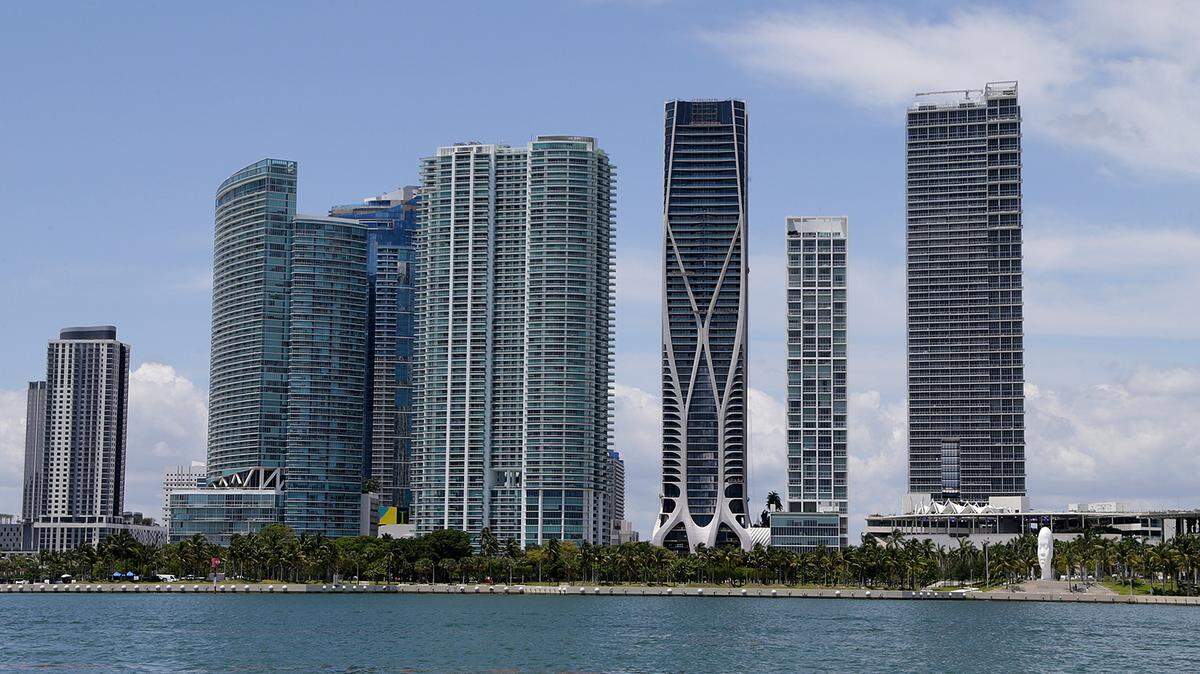
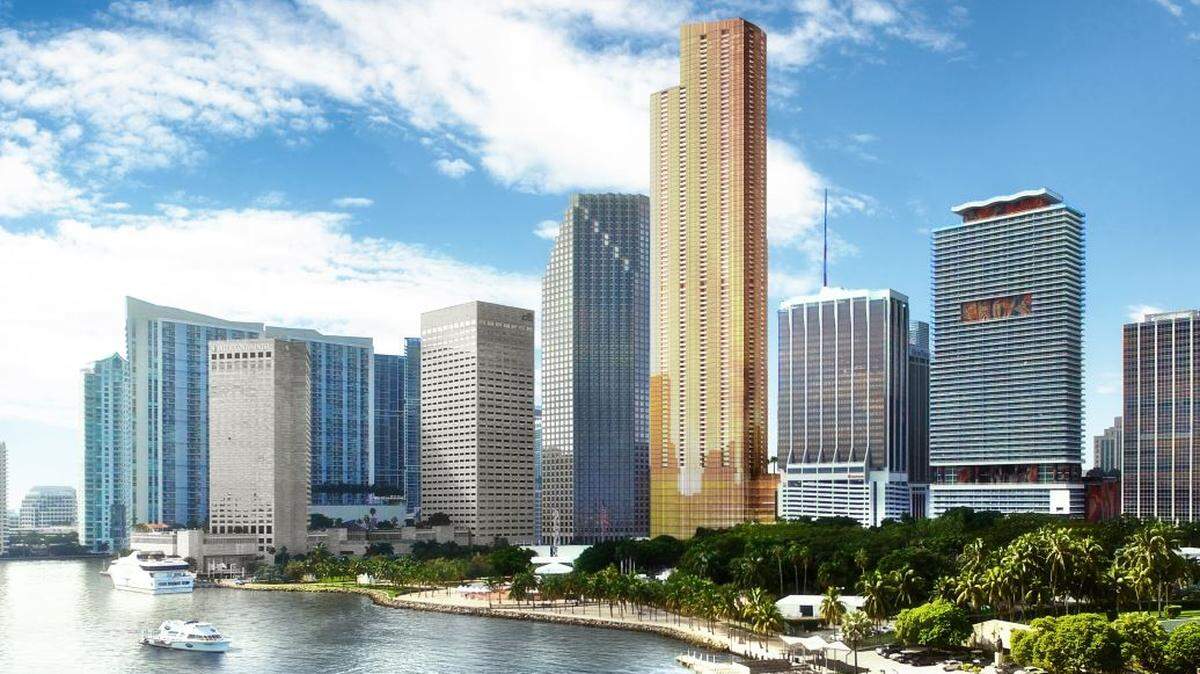
But the Waldorf will handily best the current holder of the record as Miami’s tallest building, the Panorama Tower, a residential high-rise in Brickell that’s 85 stories and 868 feet high.
In the planning for some five years, the Waldorf’s Miami tower was designed by Uruguayan-born Carlos Ott and Miami’s Sieger Suarez Architects. The project’s principal engineers are MG Engineering and the general contractor is John Moriarty Associates Florida. Renderings of the 2017 design depict a slender column of unevenly stacked boxes rising from a compact one-acre lot to make its downtown neighbors seem Lilliputian by comparison.
“It’s going to stick out, so it has to be beautiful,” PMG founder and CEO Kevin Maloney said.

This is not PMG’s first dance with a supertall. It was co-developer of Manhattan’s 1,428-foot-tall 111 West 57th Street, which opened this year. Also known as the Steinway Tower, it’s one of a run of controversial supertall, superskinny billionaires’ condo towers that jut up like matchsticks from the Midtown Manhattan skyline.
Planning, designing and engineering the Miami supertall was “a Herculean effort,” said Dan Kaplan, also a PMG managing principal. He joked the partners learned “what not to do” on a supertall from the Steinway tower, which some leading architecture critics have nonetheless called the best designed of the New York superskinnies.
“In a nutshell, it’s complicated,” Shear said of developing a supertall. “It’s a science. You’re dealing not just with structure. You’re also dealing with wind, settlement, constructibility. The taller the tower, the more complicated it is.”
For one thing, the tendency of a slim tower to sway must be restrained. The Waldorf is the first skyscraper in Miami to use what’s called a tuned mass damper, a sphere or another heavy object — sometimes a pendulum — that is mounted on springs near the tower’s top to slow and counteract that sway and ensure building motion remains imperceptible. The Waldorf’s will weigh 600 tons, Maloney said.
Some details that wouldn’t be so important in a conventional tower become critical, Shear and Kaplan said. For instance, normal drywall would crack because of the building’s slight movement and settling. Drywall at the Waldorf tower will have slip joints, like expansion joints in bridges, to absorb movement without producing cracks.
The elevators have to be rocket-fast. They move at 1,800 feet per minute, or about six times the speed of normal high-rise elevators. That’s fast enough to make your ears pop, Maloney said.
Add to that the challenge of ensuring that the complex design and engineering also produce a Waldof Astoria worthy of the name. The developers said they were glad to have the more than five years it took from project announcement to start of construction to tweak and refine.
“You’re looking at it through a different lens,” Shear said. “If you want to do it right and deliver a five-star experience in a supertall, every detail is critical. We were able to analyze and refine every square inch of the building. It was not all rushed, and it’s nothing short of spectacular.”
The reception has been unusually enthusiastic, the developers said.
“The height alone is one of the reasons. So is the design, with the nine offset cubes. A lot of people gravitate to that,” Shear said. “People say, ‘Wow, this is new, this is different.’ “
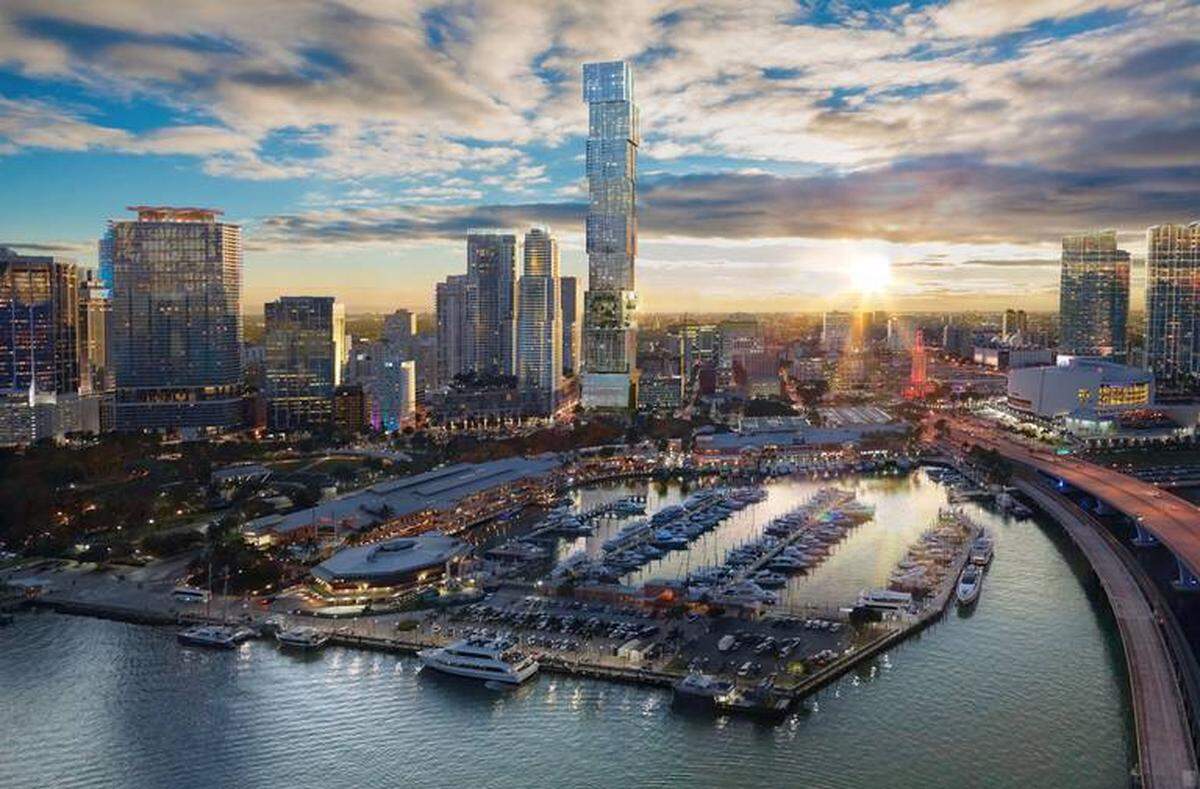
The tower has only foundation permits for now. City of Miami building officials are reviewing PMG’s application for full construction permits and Shear said he expects those to be approved in a few months. Maloney said that won’t slow construction since work on the foundation, which will have poured pilings reaching 180 feet below ground, will take 10 months or so to build.
The original Waldorf Astoria, a 1931 Art Deco icon on Park Avenue in Manhattan, has one strong historic Miami link. It was designed by the architecture firm of Schultze and Weaver, a New York firm that rose to prominence in part for its earlier designs for downtown Miami’s Freedom Tower and landmark Ingraham Building, as well as two classic South Florida hotels, the Biltmore in Coral Gables and Palm Beach’s Breakers.
The Waldorf tower almost certainly won’t long remain the only supertall in Miami. But it has a solid head start on the competition. Miami developers have been unveiling supertall proposals for years, but financing or engineering and construction obstacles have delayed the plans or forced cancellations, underscoring the difficulties inherent in building beyond 1,000 feet.
Three other supertall proposals, however, have received permitting or zoning approvals and appear ready to move forward.
They include a 1,049-foot office tower, One Brickell City Centre, an expansion of the multiblock City Centre complex, by Swire Properties and Related Companies of New York, as well as a massive public-private redevelopment of the downtown Hyatt Regency and James L. Knight Center complex that will include one 1,046-foot supertall and go to Miami voters in November for a referendum.
A third project, consisting of a pair of twin 83-story towers by J3T Ventures of New York at the south end of Brightline’s MiamiCentral train station complex, received Miami-Dade County approval at 848 feet, short of supertall status. But the developers are asking the FAA to approve a height over 900 feet.

The supertall push, developers say, is motivated by the shrinking availability of land to develop in and around downtown Miami. Going taller means developers can squeeze more onto compact lots.
But that hasn’t translated into easy success.
One scrapped supertall was perhaps the most outlandish: Veteran Miami developer Jeff Berkowitz’s SkyRise Miami, a hairpin-shaped observation tower and vertical amusement park that would have been erected behind Bayside Marketplace, but was thwarted by financing difficulties. It also would have boasted the world’s longest bungee-cord jump.
Another was scuttled after the developers got an offer they couldn’t refuse. Tibor Hollo’s Florida East Coast Realty sold a vacant 2.5-acre bayfront lot on Brickell Bay Drive, where it had planned a pair of supertalls, to an affiliate of Citadel, the financial services giant run by hedge-fund billionaire Ken Griffin that’s moving to Miami from Chicago, for a record $363 million.
Hollo’s already announced project would have consisted of two connected towers designed by UK-based Foster + Partners, one of the world’s top architecture firms. Still, it’s widely expected that Citadel’s development partner, Chicago’s Sterling Bay, will build a supertall on the site.
FECR says it’s moving forward with another long-planned supertall. This one would replace the firm’s current headquarters, a 1963 office high-rise at South Biscayne Boulevard at Southeast First Street that FECR intends to demolish in the first quarter of 2023. The new, 1,049-foot One Bayfront Plaza would comprise office, commercial, hotel and residential space.
The status of some other announced Miami supertalls is murkier. One Brickell supertall dubbed Major, announced to great fanfare late last year, would have paired Major Food Group, purveyor of fine dining at spots such as Carbone and Sadelle’s, with heavyweight developer Michael Stern’s JDS Development Group — which partnered with PMG on the Steinway Tower in New York.
But in a joint statement in July, JDS said Major Food Group had pulled out, though Stern has said he plans to carry on under a different, more prosaic name, 888 Brickell. The announced plan calls for a hotel and condo with extensive food and beverage amenities rising 90 stories and the maximum 1,049 feet.
Yet another contemplated supertall, by Miami’s 13th Floor Investments, would replace a parking lot on Biscayne Bay behind the historic First Presbyterian Church on Brickell. The $240 million land sale had been held up by a parishioner’s challenge, but church authorities gave the go-ahead this month. Though a conceptual rendering of the tower has been released, there is no actual design yet and nothing has been submitted for approval by the city of Miami, a 13th Floor representative said.
The fact that PMG was able to move ahead on the Waldorf tower, when others stalled, the partners attribute to what Shear called an unusually extensive and wide-ranging “true collaboration” among a large team of developers and investors, designers, engineers and city of Miami planning and building officials.
“It requires a lot of people working together,” Shear said. “It’s a big moment for everybody.”
This story was originally published October 16, 2022 at 5:30 AM.