
Humble beginnings lead Sweetwater developer to give back to residents with affordable homes
Walking around Sweetwater’s Li’l Abner I apartment complex on a recent sweltering afternoon, Raul Rodriguez didn’t break a sweat. He greeted every person he ran into as if he’d known them for years. From the jovial reactions of the residents to grinning staff members, it’s most likely that he has.
As the developer of the 87-unit apartment complex and manager of the adjacent 900-unit Li’l Abner Mobile Home Park, Rodriguez, 44, focuses his real estate business exclusively on affordable housing.
He has used his nurturing as the son of a self-taught property investor and his real estate experience to support the mobile home community he grew up working in. At a time when the area needs many more homes priced affordably and economic dynamics are challenging developers to build them, he’s doing his part to help address Miami-Dade County’s housing-affordability crisis.
Rodriguez’s father always instilled in him the importance of not forgetting his family’s humble beginnings in Sweetwater and to give back whenever possible.
That sentiment has resulted in the younger Rodriguez’s commitment to provide homes for people with lower incomes like the forthcoming Li’l Abner II apartment complex. Set to open in 2023, the community will have another 244 affordable apartments in walking distance of Li’l Abner I.
He also believes in giving back through philanthropy. In 2010, he launched the Li’l Abner Foundation, a nonprofit that benefits Sweetwater community members by providing free healthcare services, camps for students and more.
When Rodriguez isn’t working on development plans, the avid rock climber is preparing to continue climbing the seven highest mountains in the world. He thinks the difficulty required to do that parallels the challenges that come with developing affordable housing in Miami-Dade.
In 1982, Rodriguez’s father Raul Rodriguez Sr. bought Li’l Abner Mobile Home Park. A Cuban immigrant, Rodriguez Sr. earned money selling newspapers and washing dishes. He started in real estate by buying one small property at a time and eventually shifted to running the park full-time.
The younger Rodriguez began learning the ins and outs of the mobile home park as a child. At nine years old, he’d pick up trash and help however he could, while getting to know the residents.
From that point on, he became a fixture there. While in school, each Wednesday afternoon, spring or winter breaks and during the summer, he did many tasks around the mobile home community and helped his father tend to the homes.
“While my friends were going to the beach and going partying, I had to go to work,” Rodriguez said. “I saw what people go through in life that weren’t as fortunate as I was and that humbled me.”
After graduating from Sweetwater’s Belen Jesuit Preparatory School, Rodriguez studied for two years in Spain through a program at Saint Thomas University and followed that with two years at the University of Anchorage. He attended Florida International University, before starting a family of five children and deciding to pursue a career in real estate development.
Over several years, Rodriguez noticed how flooding and South Florida’s annual hurricane season made life difficult for the mobile home residents. He approached his father about pivoting from adding more mobile homes on nearby land and instead building something more durable.
“I went to my father and I asked him if instead of putting more mobile homes, why don’t we try to build something solid, something concrete that some of the old residents here that can’t maintain the mobile homes can move into,” he said in a recent interview.
Li’l Abner I, an affordable housing complex for residents age 55 and older, opened in 2013. Rodriguez was intentional about offering apartment rentals to tenants that already had lived in mobile homes in the nearby park.
Adela Castellon, 90, has lived in one of the apartments for seven years. Before moving there in 2015, she lived in the nearby mobile home park for several years. She recalled seeing Rodriguez as a youth working on the property, before he took over his family’s business.
She appreciates the upgrade of her apartment over the mobile home park.
“It’s better to live here because here you feel safe,” she said, alluding to South Florida’s hurricane risks. “I feel comfortable and completely safe.”
Aurora Ruiz Cortez, 78, another apartment resident who had been living in a mobile home, moved to Miami from Cuba to be closer to her daughters Yamile, 51, and Mabel, 55. As salsa music played in the background of the senior care center she frequently visits, she talked about Sunday dinners with sumptuous oxtails her daughters enjoy eating and the quality of life her apartment has brought her.
Searching for affordable housing options, Cortez learned about the Li’l Abner I apartments. She was elated when she found out she qualified for an apartment.
“There’s no comparison between the trailer and my apartment,” she said.
Funding affordable housing ventures is not easy for any developer. Private-public partnerships were key to the construction of Li’l Abner I, yet they only go so far. Rodriguez is also the founder and CEO of National Health Transport, a company providing emergency transport services for hospitals, healthcare centers, nursing homes, among others. Revenue from that business helps support his real estate business.
Rodriguez said increasing building materials and insurance costs have made affordable housing construction more difficult for developers. Also, escalating real estate taxes can easily deter developers from building affordable homes.
He estimated his insurance costs for the mobile home park and Li’l Abner I property rose 300% over the past five years from $67,000 to $117,000. Building for people earning $41,100 annually or 60% of the area’s median income of $68,300 has become more difficult because of those swelling expenses.
Bluenest Development CEO Salim Chraibi is also familiar with the challenges of building affordable homes in Miami-Dade’s 34 municipalities. He thinks that county Mayor Daniella Levine Cava is doing an adequate job of supporting local affordable housing development with a variety of incentive programs.
However, in Miami, Chraibi said developers could use much more, however.
“In the City of Miami, permitting takes so long that many people are avoiding it,” he said. “It is very difficult to obtain a permit there. I think Mayor Levine Cava is really pushing and other people should look at her work as an example, especially in low-income areas like Liberty City and Brownsville.“
Housing Trust Group is an affordable housing developer based in Coconut Grove with 40 years of experience in Florida and the Southeast. Its CEO Matthew Rieger said more resources from the federal government are necessary to be able to build more affordable homes.
“We have an incredible demand because incomes have not risen enough for people to afford a market-rate rental,” Rieger said. “Because of that, the need for affordable housing is huge. A tremendous amount of resources need to be allocated to solve this problem. Even if I got all the resources tomorrow, the housing is not going to be built tomorrow. We’re talking years.”
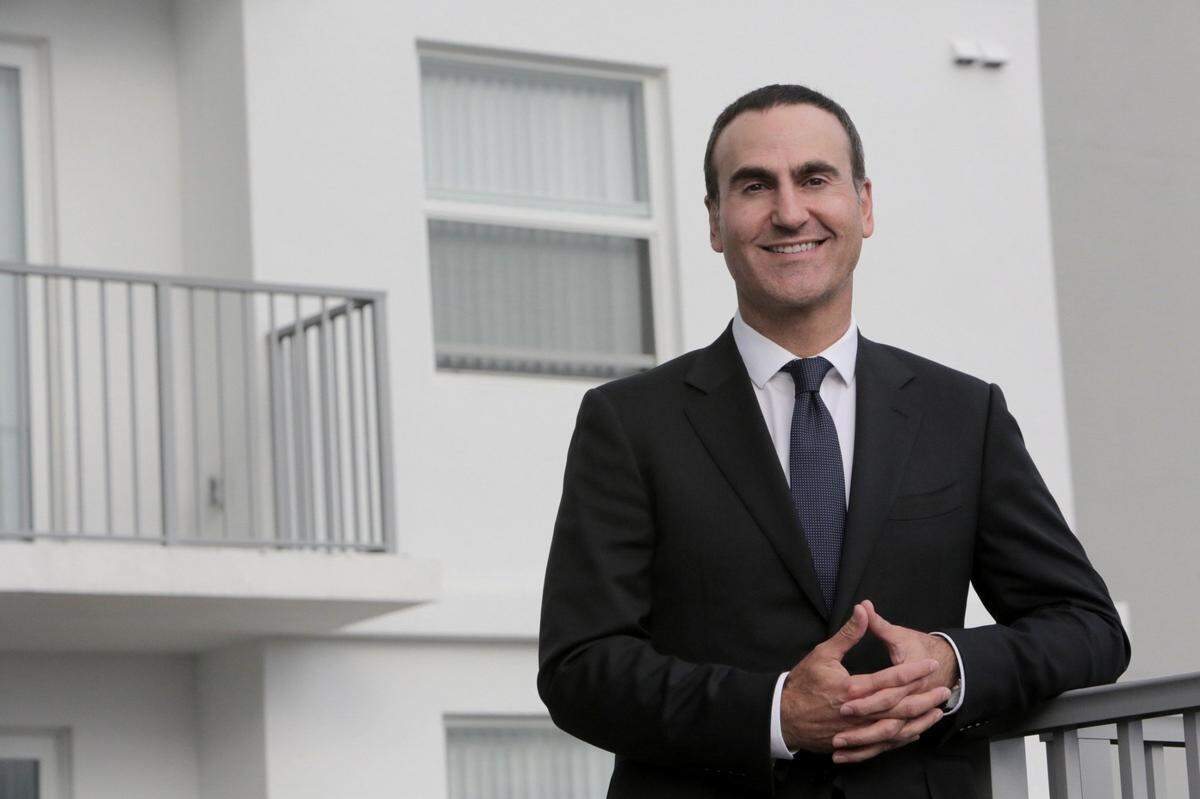
Rodriguez said the pandemic has worsened the home-affordability crunch in Miami-Dade. Without affordable homes for local workers, Rodriguez sees the county’s workforce shifting to only the people that can afford to live in the area. Increasingly, workers in a variety of local services and hospitality are leaving because their lower and stagnant wages no longer allow them to make ends meet and afford to live in the county or even in South Florida.
Rodriguez has noticed the exodus because of the county’s higher cost of living.
As he prepares for next year’s opening of his Li’l Abner II apartment community, he’s keenly aware of the growing waiting list of close to 1,000 names for 244 apartments. The long list reflects the dire need among Miami-Dade residents for places to live for the working class.
Rodriguez said his work — and others committed to equitable housing access — is only the beginning of a solution for the affordability crisis.
“The housing market that we face is a mountain right now,” he said, thinking like a rock climber. “We have to strategize how we’re going to accomplish the mission of climbing it properly.”
%20Cropped.jpg)