This Miami family was unable to buy a home. A black-owned bank got them through the door
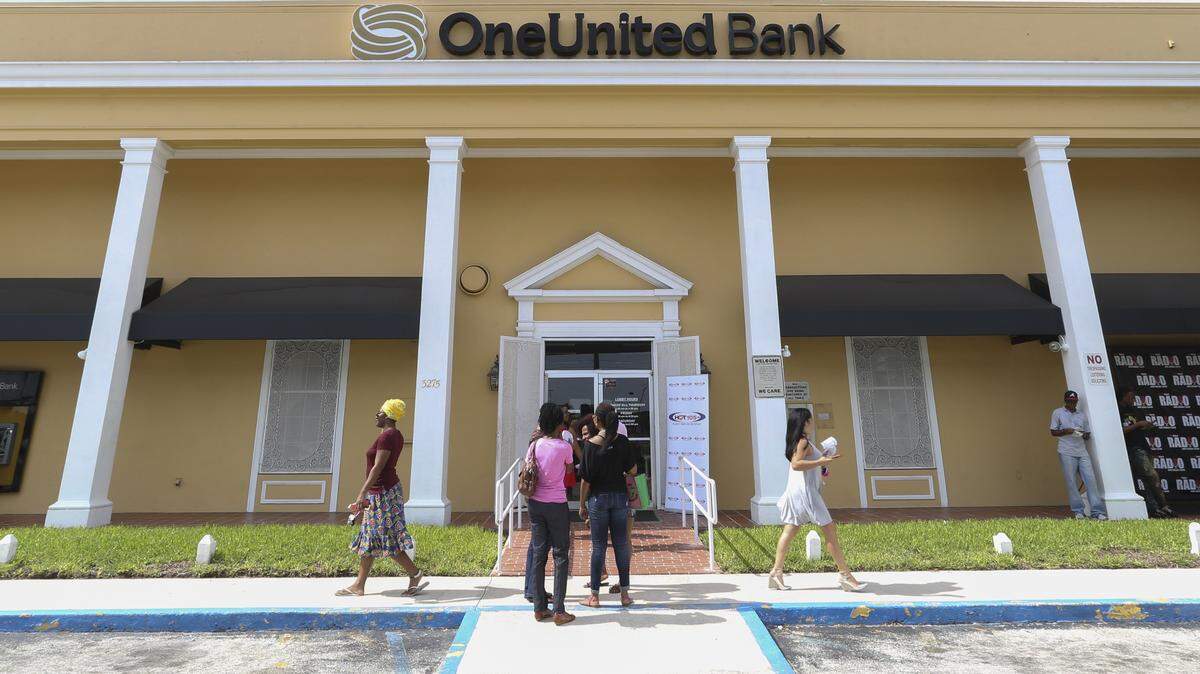
The Crichlow family had been renting their modest home in North Miami for about 20 years.
That changed last week, thanks to a Miami-Dade County-backed program targeting first-time homebuyers, and a loan from one of the largest black-owned banks in the United States, OneUnited Bank.
The Crichlows say they found their dream home thanks to the program: A three-bedroom house in Miami Gardens with a “beautiful” kitchen and living room, according to Mrs. Crichlow, and a big yard. It is perfect for their two young sons. (The Crichlows declined to use their first names so they could speak freely about their personal finances.)
“We’re so happy to be a homeowner,” said Mrs. Crichlow, who works for Miami-Dade County Public Schools. Mr. Crichlow is a truck driver.
“It has been a journey, but the Crichlows were awesome people to work with,” said Ernst Joseph, site manager loan consultant at OneUnited. “They were always ready and made everything easier. It was a long journey for them, but we go through the process every day.”
.jpg)
Home as opportunity
OneUnited is one of many loan originators that work with Miami-Dade on its home affordability programs; others include City National Bank, IBERIABANK, and Paramount Residential Mortgage Group. OneUnited is the only black-owned one. Founded in 1968, OneUnited bills itself as the largest black-owned bank in the U.S. Though based in Boston, Miami is where the bank creates programs to reach the black community; these are then deployed nationally.
Teri Williams, president of OneUnited Bank, says the idea of homeownership has taken so much flack in recent years that it is sometimes difficult to convince prospective local buyers that her program is real.
“What we’re saying to them is, first of all, homeownership is an opportunity for them to not only have place to stay but also build equity in life,” she said. “The biggest factor in the black and white wealth gap is home equity.”
Williams also tries to drive home the message that the program can help leapfrog a future homeowner ahead of wealthier buyers or developers in neighborhoods that are seen as up and coming,
“We’re telling them: You should be buying now,” she said. “I don’t care if you have to buy a hut, buy something now. At some point these communities, five or 10 years out, are going to be unaffordable.”
Miami outperforms
The gap between black and non-black homeownership rates remains substantial both nationally and in the Miami metro area. According to Zillow, 41.5% of black households in the U.S. now own their home, compared with 67.2% for non-black households—a 25.7 percentage-point gap.
But the Miami market is outperforming national rates on an overall level of black homeownership, as well as in having closed the local racial gap. Here, 45.6% of black households now own their home. That is 1.7%-higher than the average rate seen in the middle of the last decade. In the U.S., the improvement has only been 0.4%.
And while it is still well below the 63.1% rate for non-black Miami households, the gap is 17.5 percentage points.
Zillow economist Jeff Tucker says there is no special sauce driving Miami’s gains. Nor, according to his data, is it the result of changing residential patterns among Black South Floridians, changes that have seen a decline in Miami-Dade’s black population flatlining.
it is simply a matter of a strong economy and low interest rates.
“Both are helping black families improve households finances,” he said. “That means more income, more assets, and that is enabling the move into homeownership.”
Since 1995, the Miami-Dade Economic Advocacy Trust (MDEAT) has worked with banks like OneUnited to help provide down payment and closing-cost assistance to thousands of local first-time homebuyers. Of the nearly 7,600 familes it has worked with, roughly 40% identified as black or African-American.
A debate now rages about whether it is better to rent or buy. In Miami-Dade, it is essentially a wash: According to data from ATTOM Data Solutions, which says the cost of renting or buying now costs about 51% of average local wages.
How to qualify
There are guidelines for who may qualify for the county’s program, but participants like OneUnited maintain broad discretion over who it chooses to pre-qualify.
Among the criteria OneUnited looks at are credit scores, debt-to-income ratio, the prospective buyer’s current living arrangement (i.e. whether one is divorced or separated from a spouse), and recent tax filings. Williams says there is a nominal minimum credit score of 650, but some applicants still may qualify if they come in below that figure.
Williams estimates that “thousands” of people in Miami-Dade would already be pre-qualified.
To get some of these individuals through the door, the bank has created “homebuyers clubs,” including one for residents in and around Liberty City. These are free membership groups that meet at the bank, which walks prospects through the process and allows them to ask questions in a “non-threatening” setting.
Overcoming obstacles
Williams says the bank is not reaching as many people as it desires. It is the main reason it is hosting a fair at the end of this month.
“We had individuals go all the way through process and then not close on the loan because certain family members were afraid of homeownership.”
There are also towering, historic, and persistent obstacles preventing blacks in particular from buying homes, Zillow’s Tucker says. This includes racial discrimination among some sellers who refuse to sell to black buyers.
But it also includes the origins of the wealth gap in the first place. After World War 2, blacks were almost universally red-lined out of homebuying opportunities by both banks and developers, setting the stage for a disparity in assets that persists to this day.
The upshot: When it comes time to make a down payment on a home, many white families rely on parents or relatives for help. For many black families, that option does not exist.
“When you’re trying to come up with the money for a down payment, or when you’re building credit, having help from a family member can make a huge difference,” he said.
He continued: “A lot of the inequity created [in the past] is now baked into the landscape of homeownership today. So those inequities are inherited by today’s generations.”
Still affordable
The Crichlows said they’d been turned down by numerous banks because—they were told—they were not making enough money. They also said their credit score was “not super great.” At one point they became discouraged.
“We tried not just one time, but a lot of times,” Mrs. Crichlow said.
The Crichlows are thankful. Mrs. Crichlow says anyone skeptical of the program should know that the money being offered is “real.”
“Don’t be scared,” she said.
OneUnited’s Williams also has a message.
“There are still affordable homes in Miami-Dade.”
OneUnited Bank will be hosting a first-time homebuyer fair Sat., Feb. 29 at 3275 N.W 79th Street, Miami, Fl., 33147 in Liberty City. More information at OneUnited.com.
OneUnited Bank
Bank officers: Kevin Cohee, CEO and co-owner; Teri Williams, president, COO and co-owner
Headquarters: Boston, Mass., with offices in Miami and Los Angeles
Year founded: 1968
Year opened in Miami: 1999, after acquiring Peoples National Bank of Commerce
Assets: Approximately $654 million
This story was originally published February 24, 2020 at 6:33 AM with the headline "This Miami family was unable to buy a home. A black-owned bank got them through the door."