
After hours of debate, Miami commissioners seek still more housing plan specifics
After nearly five hours of deliberation and public testimony, the Miami Affordable Housing Master Plan took another small step closer to fruition Friday after City of Miami commissioners voted 5-0 to accept the study’s findings.
But the commission stopped far short of adopting and implementing the detailed plan, which lays out a 10-year strategy to build or preserve 32,000 affordable housing units within the City of Miami limits.
The unanimous vote came at the end of a marathon four-and-a-half-hour hearing punctuated by digressions from Commissioner Joe Carollo, who did not attend the commission’s Jan. 9 workshop on the study and requested a second one.
Friday, commissioners asked the Jorge M. Pérez Metropolitan Center at Florida International University to share more specifics about the plan, including the raw U.S. Census data cited in the report and the methodology used to reach the plan’s recommendations. The study was a year in the making and included community outreach sessions and collaborations with city officials and housing groups.
The commissioners also asked city administrators to vet the plan’s conclusions and weigh in on what they think is feasible and legal.
Much of the focus was on a request for clarification on the 82-page plan’s proposal to leverage $85 million of voter-approved bonds into four to six billion dollars’ worth of investments that would pay for the needed housing.
“The only thing that’s real here is that this commission will give up control of $85 million that the voters of the City of Miami gave the commissioners the right to allocate as they see fit, because they are representatives of the people of the city of Miami,” said Commissioner Alex Díaz de la Portilla. “It’s taking $85 million and putting it in a different bank account with different shareholders that were not the people the City of Miami voters voted for when they voted for the Miami Forever bond.”
FINANCING MODEL
The proposed plan hinges on the creation of the Miami Affordable Housing Finance Corporation, whose appointed board members would work independently of city government. The board would also create the Miami Housing Innovation Fund, using the $85 million as seed money to attract banks, investors, philanthropic donations and other grants.
“This is the potential shift of dollars from this duly-elected body to a non-elected entity, the Miami Housing Finance Corporation, [which is] appointed by us but still taken away from the direct representatives of the City of Miami,” de la Portilla told FIU’s Kevin T. Greiner and Ned Murray, the two principal authors of the study. “That’s really what’s happening here. I appreciate your study. We are grateful for your work. But we have a deep responsibility to get this right and address [the crisis] for future generations. Let’s move it forward but let’s get it right.”
During Friday’s meeting, Carollo questioned the report’s validity, citing page numbers of the report that appeared to contain errors or duplicated sentences in passages referring to the area median income of city districts. He also questioned the math of some of the calculations in the plan and pointed out that the Empty Homes Vacancy Tax floated in the plan as one potential source of revenue is illegal in Florida.
“I want to make sure there wasn’t an [FIU] intern who partied too much after they beat UM in the football game and weren’t careful about the numbers they put in,” Carollo said. “Or maybe you had an intern who was feeling stressed that week and overdid it with their medical marijuana prescription.”
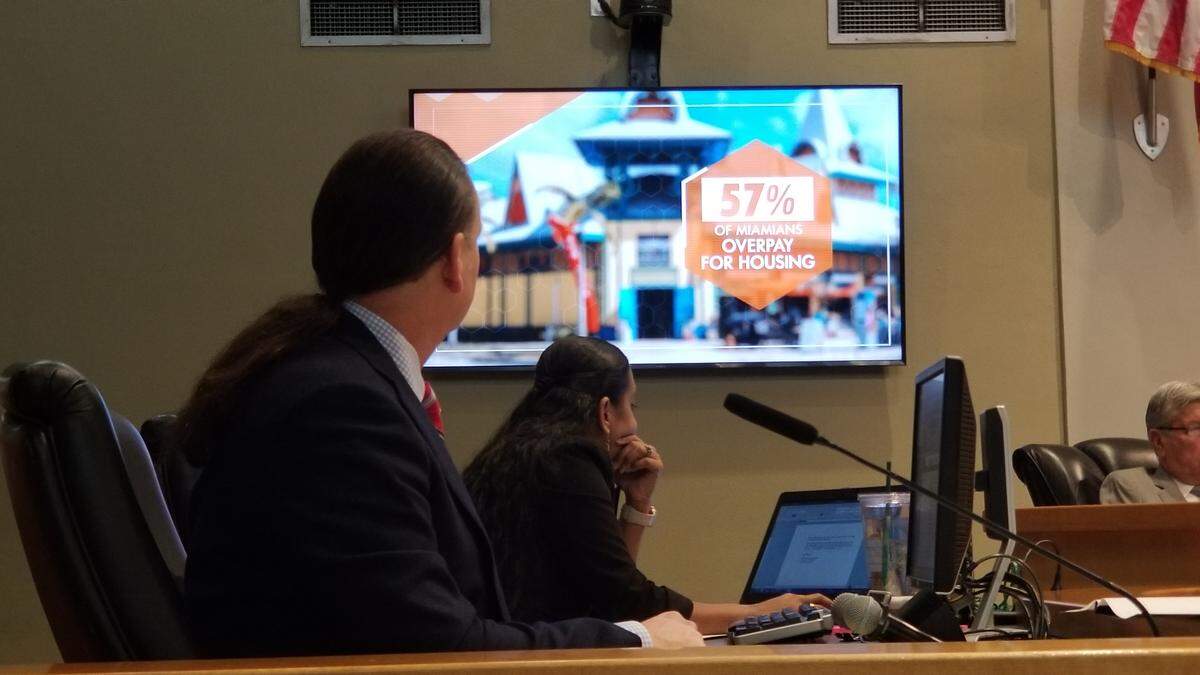
Greiner and Murray agreed to provide the raw data they used in the study, which was commissioned by the City of Miami at a cost of $110,000, and to provide more granular details on their analysis of the various districts.
Commissioner Manolo Reyes also requested more workshops with developers, investors and non-profit groups to hear their opinions about the study.
“I’m very pleased,” Grenier said after the hearing. “The city is taking a very cautious and prudent approach. The commissioners demonstrated they are taking this responsibility extremely seriously and they’re committed to taking major steps on affordable housing. They’re being asked to take a big step, and I think they took it in the right way today.”
PUBLIC OPINION
Nearly two dozen people — all in favor of the FIU plan — spoke during the public comment portion of the meeting. They included residents concerned about the gentrification of their neighborhoods, developers and lenders arguing that radical action is needed.
“As a developer, I can’t tell you you can’t build a single-family home for less than $200,000,” said Kimberly Henderson, president and CEO of the non-profit Neighborhood Housing Services of South Florida. “We’re at this tipping point across the country and in Miami, when there is interest from the private sector, philanthropists and the government at the same time. This is a good plan. We all need to be in this together.”
Albert Milo Jr., principal and senior vice president of Related Urban Development, argued that streamlining the city’s laborious permitting process was one of the key solutions to the development of affordable housing — something the plan addresses with its “one-stop shop” approach for developers.
Although the commission did not set a date for the next round of discussions about the plan, housing advocates were cautiously optimistic after Friday’s vote.
“It’s very good that they accepted the data and acknowledged they have a problem,” said Annie Lord, executive director of Miami Homes For All. “That’s good progress. I wish that they had spent more time discussing the recommendations and less time on the validity of the data. But I really appreciate the commissioners moving forward and taking action today.”
Friday’s session was scheduled after a commission meeting on Jan. 23, where a vote on the plan was postponed to give commissioners more time to dig through its findings.
The 82-page Miami Affordable Housing Master Plan can be downloaded here.
This story was originally published February 4, 2020 at 7:00 AM with the headline "After hours of debate, Miami commissioners seek still more housing plan specifics."
_pp%20Cropped.jpg)