
Miami’s radical plan for affordable housing gets good marks at first public hearing
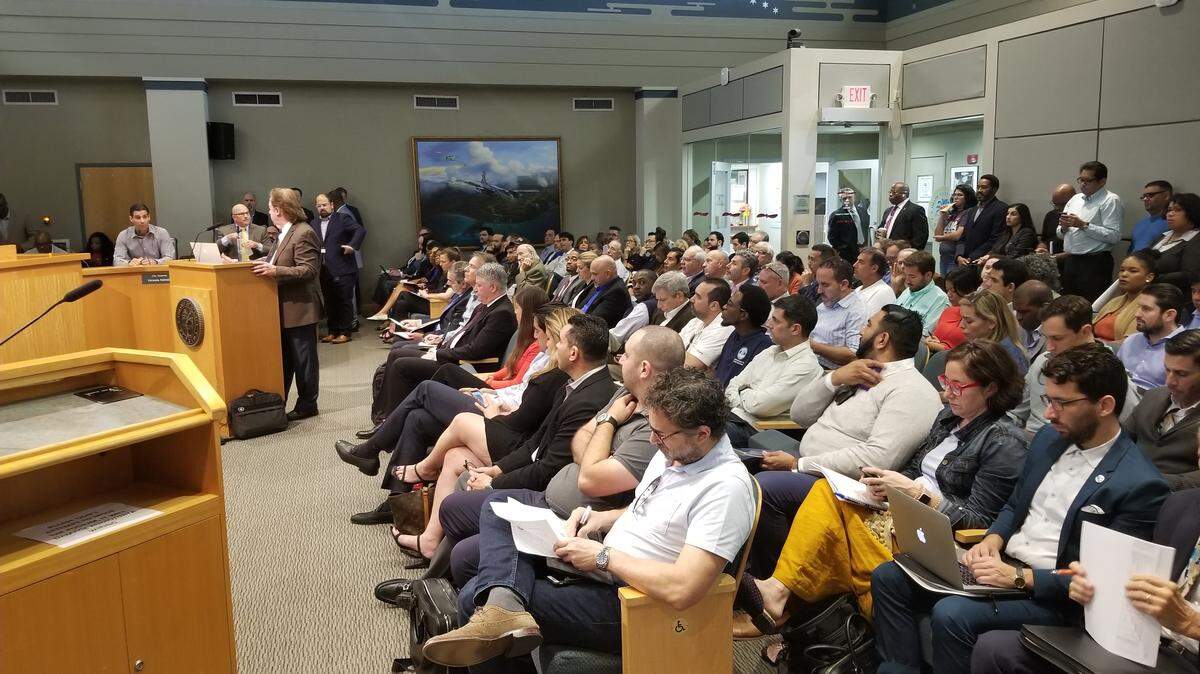
The Miami Affordable Housing Master Plan, a radical 10-year road map to address the housing affordability crisis of the 470,000 residents of the City of Miami, was finally unveiled on Wednesday to a mostly positive response.
Mayor Francis Suarez and City Commissioners Manolo Reyes, Alex Díaz de la Portilla and Ken Russell took notes while the two authors of the study — Kevin T. Greiner, a senior fellow at the Jorge M. Pérez Metropolitan Center at Florida International University, and Ned Murray, associate director of the Center — presented highlights of their findings during a two-hour hearing at a packed City Hall.
The session, known as a Sunshine meeting, allowed the public to listen while commissioners made recommendations or requested changes to the plan before it goes up for an approval vote on Jan. 23. The public will also be able to weigh in on the plan on that day.
The plan resulted from a year’s worth of community outreach, focus-group meetings with investors and input from city government staff. Among its chief recommendations is the formation of a Miami Affordable Housing Finance Corporation.
The entity, comprised of appointed board members, would be overseen by the city but work as an independent corporation. That would allow faster processing of funding sources, permits and project approvals for building new housing and refurbishing existing homes for residents making 80 percent or less of the area median household income of $33,999, or up to $27,200. (The median household income for Miami-Dade County residents is $49,930.)
Greiner explained that in order to meet the plan’s goal of raising the supply of affordable housing from the existing 20 percent to 25 percent of all units by the year 2030, the city would need to preserve, rehab or develop 32,000 units.
Also needed: A way to prevent the annual loss of 1,200 affordable units by owners or renters too cost-burdened to make the required payments or maintenance repairs on their homes. Those lost units, whether rentals or single-family homes, are either snapped up at market rates or demolished altogether.
“If you can’t stem that loss, you’re on a treadmill and you can never catch up,” he said. “You’ve got a large number of people who can’t afford to stay in the single-family home they already own. We have to act quickly, at a scale that addresses the gravity of the problem, relying on the intelligence of Miami’s existing real estate industry.”
Housing fund
Greiner also argued for the formation of a Miami Housing Innovation Fund that would use the city’s existing $85 million earmarked for affordable housing from voter-approved bonds as seed money that could be leveraged into $1 billion in incentives over 10 years.
“That doesn’t mean you would be putting $1 billion into a bank account,” he explained. “It means you are getting partners to commit. Banks are committing to long-term loans. You tell a bank ‘We’ve put in $85 million. Join us. Put in a $100 million loan at a reasonable interest rate.’”
Combined, the corporation and the fund could serve as a one-door, one-stop shop for moderately sized and nonprofit developers interested in building or rehabbing smaller buildings, between 5 and 50 units.
“You have to expedite access for affordable housing development or else the plan won’t work,” Greiner said.
Some of the commissioners argued the formation of an independent government arm would undercut their decision-making abilities as elected officials.
“We’re elected to represent our communities,” Commissioner Russell said. “Who determines who gets the funds? Traditionally we issue an RFP (request for proposal) on projects. Are we open to setting that $85 million into this fund and stepping aside a little bit as commissioners?”
But Greiner explained the commissioners themselves would appoint the board members of the Finance Corporation and would always have final approval before a project moved forward.
“You can configure the board any way you want,” Greiner said. “You set targets, you have weekly or quarterly reviews, you sign off on the spending and then you monitor it. These community development programs are used around the country. You have to give them a charter to allow them to move quickly.”
Commissioner de la Portilla sided with Greiner, playfully admonishing Russell for worrying about loss of oversight, although he was skeptical the plan could be properly retooled in time for the scheduled vote.
“If we are appointing representatives, how are we stepping away?” de la Portilla said, addressing Russell directly. “We have to be less parochial. We decide the makeup of the board, who sits on it, what kind of expertise they have. Keep the politics out of it. That may be a little naïve, but there are corporations that do this. We can get there. I just don’t think we can get there by [January] 23rd.”
Commissioner Reyes agreed, saying he approves of the corporation as a concept as long as it is carefully scrutinized.
“I’m willing to consider it, using very strict parameters to see how the board is put together,” he said. “I’m not going to reward any political ally by getting them on the board.”
“Because that never happens here,” de la Portilla joked.
A concrete strategy
Mayor Suarez told the Herald he was encouraged by the plan, although he too has some reservations.
“It was very detailed and gave real concrete solutions as opposed to being aspirational,” Suarez said. “One of the things we want to do is drill down into the details, like the idea of setting up a fund that is in essence a bank. It has to be done in a fashion that has professionals running it and not let it become overly politicized.”
Suarez said that although the plan’s primary focus is on smaller developments, he wants to keep the door open for bigger, more radical projects, such as the ongoing redevelopment of Liberty Square.
He also wants more details on the plan’s proposed vacancy tax, which would add a one-percent tax on investment properties by foreign or out-of-town buyers that are empty most of the year. The plan estimates such a tax could generate as much as $100 million per year and uses Vancouver as an example of a city where it has proven effective.
“The concern that I have is that usually with a tax is that you’re focusing on the amount of money that it generates, but I would like to do an analysis of the micro-economic impact of the tax,” Suarez said. “People are leaving cities that are raising taxes and that’s why we’re having the building boom now. There’s a lot of flight capital coming here from South America, but that’s part of the challenge we have to confront.”
Along with additional details about the formation of the corporation and how the city’s funds would be leveraged, the commission asked FIU to return with more numeric specifics separating affordable from workforce housing in its proposed 32,000 units and how many of those would be refurbished instead of new construction. The commission also asked to hear more from small developers to get their feedback on the plan.
After the presentation, Murray looked pleased and said he was happy with how the hearing went.
“I feel energized by the crowd and the mayor and commissioners,” he said. “They asked good and thoughtful questions and really took the plan seriously. We’ll be back with lots more stats.”
Although the public didn’t have an opportunity to speak, the crowd listened attentively and kept pace with the details of the plan, even though some portions could be difficult to follow without a printed version.
“The fact that we have a standing-room only audience here today — which doesn’t happen often — is proof that this document is of great importance to the community,” said City of Miami Deputy City Manager Joseph Napoli.
This story was originally published January 9, 2020 at 6:00 AM.
_pp%20Cropped.jpg)