
Eduardo Costantini brings his real estate expertise and love of art to Miami
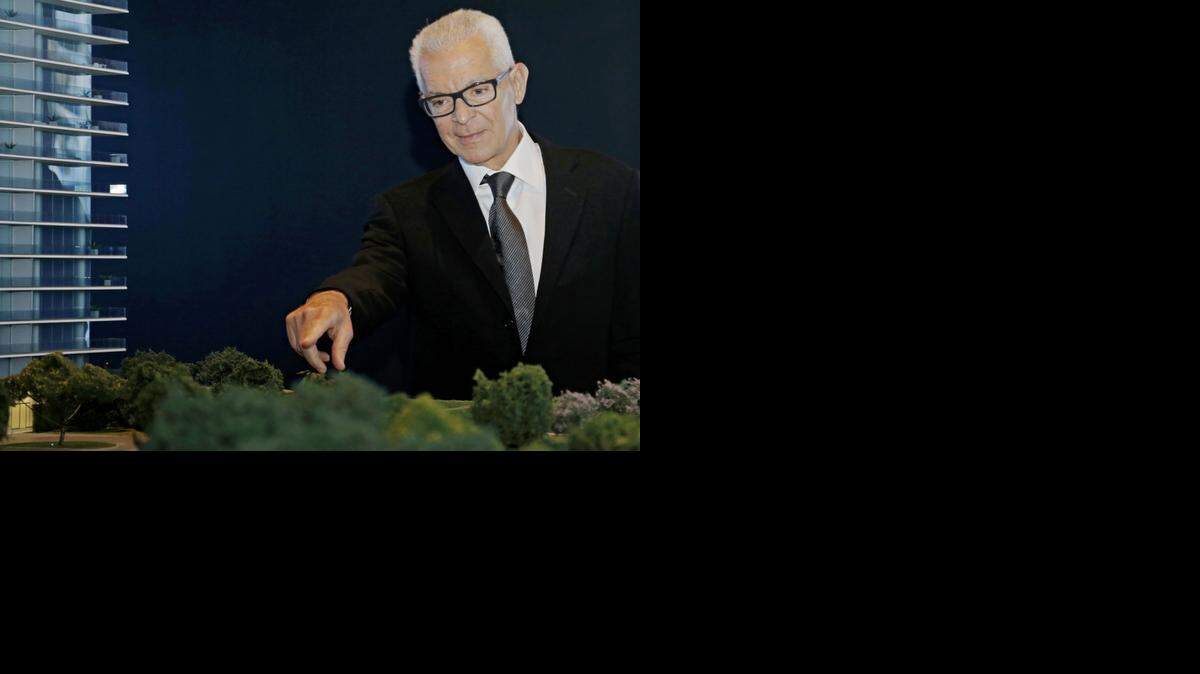
In Buenos Aires, Eduardo Costantini has built a community from swampland and founded a contemporary art museum, MALBA. Now, the successful Argentine real estate developer and art aficionado has zeroed in on luxury condominium projects in South Florida.
Dubbed the “Guru” on the cover of Forbes in Argentina in 2013 for his ability to predict art and financial trends, Costantini is the force behind Oceana Key Biscayne and Oceana Bal Harbour — where units sell for $ million to $30 million.
As founder of the firm Consultatio Real Estate in Buenos Aires, Costantini’s residential and commercial developments have ranged from master-planned cities to high-end residential towers and luxury office buildings, with a total value of more than $3 billion.
Costantini has a home in Miami, which he visits several times a year. We reached him in Buenos Aires by telephone, and then emailed him these questions, to which he responded.
Q. Please tell me about your experience growing up in Argentina and how you first got involved in business.
A. I grew up in a house with 13 brothers and sisters (and a cousin) in a town just outside Buenos Aires. My father held three different jobs and was always a strong supporter of education. I completed my undergraduate degree in economics in Argentina and when I was 28, I saved enough money to go to London to achieve a master’s degree in quantitative economics at the University of East Anglia, England.
When I returned to Argentina, I went into the banking field and became a stockbroker. Later on, I invested in and acquired an important equity holding in a prestigious bank, BBVA Banco Frances, of which I became the vice chairman.
Q. How did you then turn to real estate and what was your first real estate investment in Argentina?
A. I was always interested in the real estate market from a young age, but my connection with it was always as an investor. Then, in the 1970’s I started playing with the idea of developing instead of investing, because I like the idea of creating and bringing value to the world around me. My first real estate investment in Argentina was a plot of land I purchased in 1976, which I purchased for $240,000. In just a few months, I was able to sell the same plot for $1 million.
Q. Please tell me more about your projects in Argentina.
A. To date I have developed over $3 billion in residential and commercial real estate projects in Argentina, including master-planned cities, high-end residential towers and luxury office buildings.
I am currently developing what will be the largest per-square-foot office building in Argentina, Catalinas Norte. The glass office building is 33 floors, 800,000 square feet and includes an underground parking garage.
My other projects in Argentina include twin luxury office towers in the Catalinas Norte office park, three residential projects and two master-planned communities.
Q. Please tell me about the master planned communities you are developing.
A. My largest project to date has been Nordelta in Buenos Aires, a city within a city, built from swamp land. After 15 years, Nordelta is Argentina’s first “city-ville” and has over 30,000 residents. The community has more than 10 neighborhoods, five schools, a medical center, shopping malls, five cinemas, four banks, 20 restaurants, sports clubs, and five-star hotels to name a few.
In 2010, I started developing a second master-planned community north of Nordelta called Puertos de Lago that will be 2,700 acres. The project will feature a mix of lots, townhouses, condominiums and offices. We are also building out schools, health care services, a shopping center, restaurants, marinas, golf courses, a lake and more. So far we have sold 1,500 units for 6,000 people and have already completed the first two schools.
These communities are much more than construction projects to me; I always think of each one as a social proposition. I think about how these projects serve the best interest of society as a whole. What is the best solution for the community?
The quality of the site is most important, as well as its sustainability. In the end, a project is a social proposition that adds value and integrates a community.
Q. Besides real estate, you also founded the MALBA museum in Buenos Aires. Please tell me about that.
A. I have always had an appreciation for art and began collecting early on. In 2001, I founded and opened MALBA, a nonprofit museum to which I donated my entire personal art collection of over 200 pieces to (save for two pieces that were furniture). Today MALBA has over 500 works by leading modern and contemporary artists from Latin America.
I wanted to create something that elevates and adds value to the community, improving the world around us by exposing art in public places.
Q. Why did you decide to turn your attention to development outside of Argentina and why did you choose Uruguay and Miami?
A. In 2008, we decided to undertake projects outside of Argentina to expand Consultatio’s portfolio and reach. Being abroad gives us a greater opportunity to create masterful projects because you get to learn from a roster of international interior designers, architects, landscapers and even other developers. We started looking for metropolitan cities and looked into Rio de Janeiro, Sao Paolo and Paris, but in the end we found the perfect spot in Key Biscayne.
Q. Please tell me more about Oceana Key Biscayne and what your sales experience has been there. What is the price range of units?
A. Oceana Key Biscayne was my first project in the U.S. and one of the first residential buildings in Miami to come out from the recession. The project, which we recently completed this September, reached its 75 percent sold milestone in just eight weeks and is now 96 percent sold. The 142-unit building (with 12 villas) was the first new residential building in 15 years in Key Biscayne.
Demand was so high that Oceana Key Biscayne sold out before we were even able to build a sales center or complete additional renderings. The building still has a waiting list today.
We launched sales in March 2012. The project was 90 percent sold in less than a year and 72 percent closed in just 30 days. The price range of units is $1.4 million to $21 million.
Q. You are now developing Oceana Bal Harbour. Please tell me about that
A. Oceana Bal Harbour is one of the best sites in Miami, in part because of its location, scale and width. When I saw the site, I remember thinking “WOW.”
Anytime I’ve traveled to Miami in the past 25 years, I always visited Bal Harbour. I love the access to the beautiful shopping, the open spaces and the landscaping of Bal Harbour. I always knew that if I ever planned to develop in Miami, I would do so in Bal Harbour.
Oceana Bal Harbour is a masterpiece. The only project completely parallel to the ocean, the building is set back against Collins Avenue with a massive 60-foot outdoor breezeway that connects Miami’s bay on the west to the Atlantic Ocean on the east. Oceana Bal Harbour is the only residential building where you can see the ocean (and one of Jeff Koons’ larger-than-life sculptures) from the street.
The building is a creation by an international star team, including museum-worthy artwork by Jeff Koons, landscaping by Enzo Enea, interior design by Pierro Lissoni and architecture by Bernardo Fort Brescia of Arquitectonica.
It is also the first building in Bal Harbour to be LEED-certified and one of the first new buildings to have underground parking. The project received the largest residential loan since the recession for $332 million earlier this year.
Q. Art is an important component of each of your projects here. Please tell me about that.
A. Art transforms, surrounds and educates a community, very much like museums do.
We spent countless hours thinking about the art programs at each of our properties. Art transforms a space, and homeowners end up loving their home more because of its ability to move them and enhance their quality of life.
For example, at Oceana Bal Harbour, which appeals to what I like to refer to as the “citizens of the world,” I felt the artists needed to be international artists. That is why Jeff Koons, whose work speaks to a global audience, was my first choice. We wanted the artwork at Oceana Bal Harbour to match the caliber of its location.
Today’s affluent homeowners are well-traveled, cultured and appreciate fine art more than ever – many of them are art collectors in their own right. Not only does museum-worthy art speak to the quality, value and longevity of our residences, but it helps give the building a unique identity.
Q. You have an apartment in Miami Beach. How long have you had it and how often do you visit? What is your impression of Miami?
A. I purchased my home in South Beach in 2008 and visit about every other month. I’ve been visiting Miami for the past 25 years and love how it has matured into a true international and cultural metropolis. To me, it is on par with global cities like London, New York and Sao Paulo.
Q. What is next for you?
A. Now that Oceana Key Biscayne is completed and Oceana Bal Harbour is coming along, I have my sights set on new projects in Miami or New York.
Eduardo Costantini
Title: Founder, Consultatio Real Estate
Age: 68
Education: Undergraduate degree in economics, Universidad Catolica de Argentina; M.A in quantitative economics, from the University of East Anglia, Norwich, England
Interests: art collecting, kitesurfing, golf
Philanthrophic involvements: Founded Fundacion Nordelta, which promotes health, education and community development in Argentina.
Philosophy: Always maintaining a macro-perspective, taking into account the best interests of the community as a whole, in keeping with sustainability and urban aesthetics.
This story was originally published December 7, 2014 at 2:00 PM.