There’s a $30 billion company in South Florida. It wants to take over the pet world.
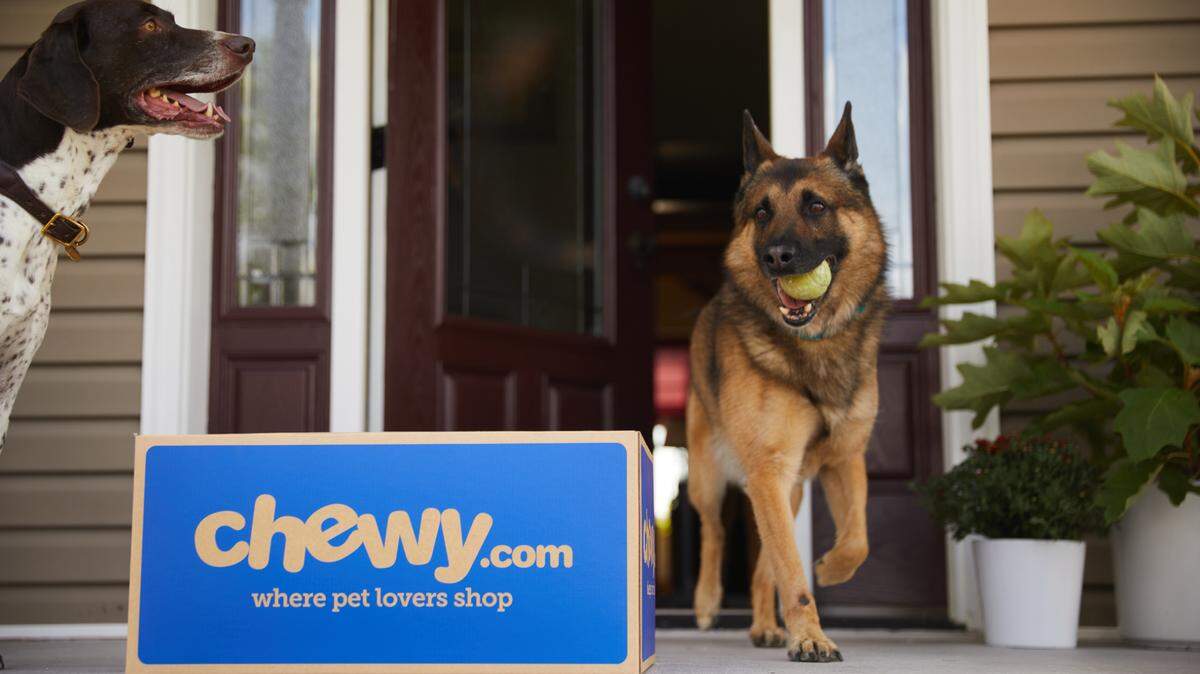
If you haven’t yet heard of Chewy, you may need more furry friends in your life.
Thanks to pet lovers who’d rather take delivery than head to the store, the online pet superstore founded in Dania Beach nearly a decade ago is now worth nearly $30 billion. Unlike so many companies that have been slammed in the COVID age, Chewy has seen its stock price soar as consumers have shifted more heavily to an online existence. Since the start of 2020, Chewy shares have jumped from about $30 to more than $67. For the quarter ending Aug. 2, the company saw net sales of $1.7 billion, a 47% increase over the same period in 2019.
“Clearly we’ve been one of the benefactors of this [online] trend,” Chewy CEO Sumit Singh said in an interview. “The pandemic has hit the country, and the world, tremendously hard, but it’s been good from a business standpoint and tremendous for growth. We’re not happy about the pandemic, but we’re proud to be able to serve pet parents.”
Chewy now employs some 17,000 people nationwide. About 3,000 are located throughout South Florida, making it one of the largest locally based employers in the region. Most of them work in customer service and marketing — central to Chewy’s success.
While pet owners can purchase food, toys and supplies a la carte, they can also subscribe for regular deliveries of items they use repeatedly. And that, said Mark Mahaney, a managing director at RBC Capital Markets and an e-commerce analyst, is key. This year, Chewy saw two quarters of record active user growth — and now gets more than two-thirds of its net sales from subscribers.
The company is now “in that beautiful position whereby they can get customers, but not spend a lot more on [acquiring] them,” he said, crediting homebound pet owners who stumble on the site as they search for products online.
“It’s free traffic,” he added.
Despite the growth, Chewy is not yet profitable. In its most recent earnings release, covering the quarter ended Aug. 2, the company reported a net loss of $32.8 million — substantially less than its $82.9 million loss in the same quarter one year ago.
Mahaney said there’s still some room for skepticism about the company’s growth — but not much.
“Nobody knows if it’s sustainable,” he said. But thanks to COVID, he said, a company “generally good at execution” now has 3 million more active users it can work on keeping.
THE FIRST BITE
Chewy was founded in 2011, when friends Ryan Cohen, Michael Day and Alan Attal, who’d known each other since their teens, decided they’d start a web business. Nostalgia for summers spent visiting his grandparents in Florida led Cohen, who never graduated from college, to Dania Beach.
Cohen told the Miami Herald in 2017 that the friends initially tried their hand at marketing jewelry but pivoted to pets after Cohen was inspired by a shopping trip for his teacup poodle, Tylee.
“I always wanted to do something with pets, but I couldn’t figure out how to monetize it,” Cohen said. “So I was going to the pet store and realized the market online was really under-penetrated. I said, ‘This jewelry idea, we’re not passionate about what we’re doing. This is a much better opportunity.’ I understand the customer — because it’s myself. So we built the company.”
Cohen became CEO of the new company, originally called Mr. Chewy; Day, chief technology officer; and Attal, chief operating officer. Having worked with computers and online marketing since their youth, the trio were able to design a site that immediately took off. Within a year, it had earned $26 million in sales.
Cohen often recounts that he was turned down by nearly 100 investors in Silicon Valley in Chewy’s earliest days. In 2013, the company finally garnered interest from Boston-based Volition Capital, which invested $15 million. That same year, Chewy signed a five-year lease at the Design Center for the Americas in Dania Beach for 48,000 square feet; it remains there to this day, now filling out some 100,000 square feet.
Another key milestone came with the hiring of Kelli Durkin. It was Durkin who helped Chewy distance itself from competitors’ customer service offerings by creating handwritten “welcome to the family” and holiday Chewy postcards — a practice that continues to this day.
“Many customers would call us and let us know we were the only person who sent them a holiday card,” Durkin said in an email. She left the company last year.
Customers would also email photos of their pets, and one day a Chewy employee painted a dog and surprised the customer.
“It was a hit and the customers loved it,” Durkin said. The team began randomly choosing pets to paint, leaning on in-house artists and freelancers. This continues, too.
“When I left in October, we were surprising at least 1,000 customers a week all over the country,” Durkin said.
PETSMART ACQUISITION
By 2017, Chewy was racking up nearly $900 million in annual sales. That January, an analyst told Forbes that Chewy should be valued at $4 billion, having taken over 43% of the online pet food sales in the U.S. (Amazon still controlled 48 percent).
The analyst was on track: In April 2017, big-box retailer PetSmart and its parent company, New York- and London-based private equity firm BC Partners, acquired Chewy for $3.35 billion. It was the largest reported e-commerce acquisition in history.
Besides raising eyebrows for its size, the acquisition also struck observers as unusual because Chewy wasn’t profitable. The purchase also added to PetSmart’s already heavy debt load by an additional $2 billion.
In an interview two years after the sale, BC Partners chairman Raymond Svider told the Wall Street Journal that the ailing PetSmart had no choice but to hitch itself to the rising star in Dania Beach.
“Chewy was already on a path to being 10 to 15 times the size of PetSmart’s online business, and the gap was accelerating every day that went by,” he said.
The acquisition brought changes. In the spring of 2018, Cohen, Day and Attal left. The three have since laid low. Cohen declined to comment on what he’s doing next; Day and Attal could not be reached for comment. Singh was appointed CEO after having served for a year as Chewy’s chief operating officer.
The acquisition also sparked a legal fight that ultimately led to public ownership. Soon after the purchase agreement, a group of creditors sued PetSmart after it sought to transfer minority stakes in Chewy beyond the reach of creditors. As part of a settlement, PetSmart agreed to use the sale from an initial public offering to pay down its debt load.
That IPO happened in 2019. PetSmart minted $10 billion from the sale; today, PetSmart enjoys a “stable” credit rating from Moody’s thanks in part to its ongoing 63.8% ownership of Chewy.
“Chewy continues to grow exponentially as consumers have increasingly embraced shopping for pet food and products online and we expect this growth trajectory to continue,” Moody’s wrote.
COVID BOOST
While going public may have been a boon for Chewy’s early shareholders, it struggled in its first year on the stock market. After debuting at $36, its share price stagnated for a year, as profitability seemed increasingly out of reach.
Then came COVID.
In a note to investors Sept. 10, Bank of America analyst Nathaniel Schindler noted pet adoption was up 60% in the first quarter alone.
“We believe Chewy’s subscription-driven model is appealing vs. others that likely saw more one-time purchasing activity, and the recession-resistant pet sector is attractive in uncertain macro environments,” Schindler wrote.
Singh, who came to Chewy from Amazon, where he worked on its Amazon Fresh grocery service, has been lauded for capitalizing on the opportunity.
“He has been the mastermind behind developing a logistics network and making it extremely efficient,” said Seth Basham, managing director of equity research at Wedbush Securities. “He brought a number of lessons from Amazon.”
Specifically, Singh has opened new fulfillment centers, including ones outfitted with robotics, that have made shipping more cost-effective, Basham said.
When he took over as CEO, Singh said, the company was primarily focused on food and pet supplies. While Chewy had experienced tremendous growth, the trick was to figure out how to get even bigger. There is plenty of runway left: Singh estimates there are 100 million pet households in the U.S.
Under his leadership, Chewy has begun selling pet healthcare products — including prescriptions; health products are now Chewy’s fastest-growing vertical, Singh said. He has also expanded private-label goods offerings.
Mahaney, of RBC, said his research has shown Chewy enjoys high customer satisfaction, so it should be able to keep many of the customers it has gained.
Like Chewy, Amazon has also seen parabolic growth during COVID. Amazon doesn’t break out numbers on pet goods, but RBC’s Mahaney believes the market is currently evenly split.
“[Chewy] is competitive on price, selection and convenience,” Mahaney said. “I think Chewy tries to differentiate by focusing on customer service...and our research shows consumers are noticing that.”
While Chewy has opened a second headquarters in Boston focused on technology and product development, Singh says Florida remains Chewy’s home base. That includes Chewy’s in-house marketing team — something Singh says sets it apart from competitors who use third parties. The firm’s South Florida headcount has more than doubled since Singh took over. And the company is planning a recruiting partnership with Florida A&M University in Tallahassee in addition to existing relationships with the University of Miami and University of Florida.
Growth is likely to continue: Chewy has plans to start selling internationally within the next five years.
Singh has global ambitions: “We want to be the most trusted and convenient destination for pet parents everywhere.”
Correction: This story originally misstated the year of former Chewy COO Alan Attal’s departure; current CEO Sumit Singh’s title during his time with Amazon; and the year Chewy private-label goods were launched. It also originally referred to its South Florida footprint, not headcount, as having increased during Singh’s tenure as CEO.
CHEWY AT A GLANCE
Headquarters: Dania Beach
Website: chewy.com
Founded: 2011
CEO: Sumit Singh
Employees: 17,000, with 3,000 in South Florida
IPO: 2019
Traded on: New York Stock Exchange
Current share price: $67.24
Market capitalization: $27.68 billion
This story was originally published October 19, 2020 at 12:00 AM.