
Small company plays big role in avionics industry
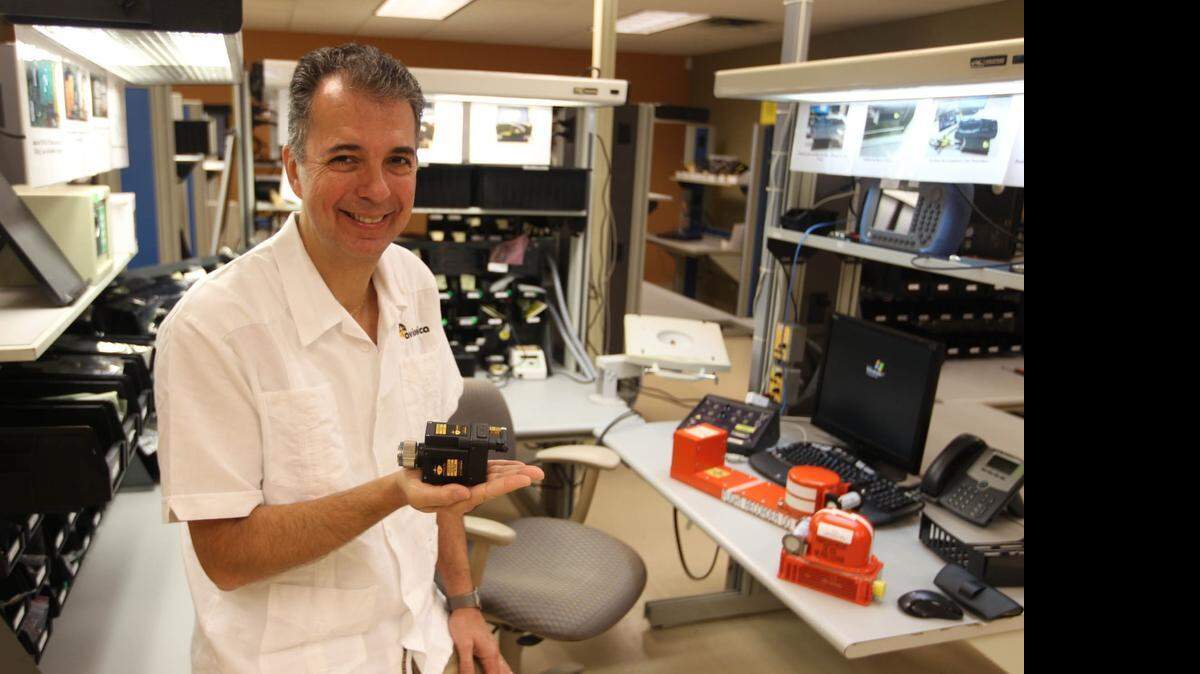
Avionica Inc. has only 60 employees — 25 of them engineers — at its plain, one-story building in Perrine, located between Miami and Homestead.
Yet this tiny high-tech enterprise is an important player in the design and manufacture of avionics — the electronic equipment vital to aviation and aerospace.
Founded in 1992 by two engineers with $500 in capital, Avionica today makes a range of innovative electronic devices for voice and data communication via satellite, and for the collection and transmission of flight data for detecting equipment problems and ensuring proper aircraft maintenance.
Its high-tech equipment is used on the ground and in more than 7,000 aircraft worldwide operated by such commercial airlines as United, Lufthansa, Emirates, Panama’s Copa, Brazil’s Gol, as well as the fleets of UPS and FedEx, air charter companies and military aircraft, the company said.
“We’re the world’s smallest avionics company,” said Raul Segredo, an engineer and pilot who is Avionica’s president, CEO and co-founder. “This small group supports the needs of airlines around the world.”
Avionica competes with a wide range of concerns, including much larger firms like L-3 (with 45,000 employees, for example), Rockwell Collins (20,000), Honeywell and Boeing.
Its business is essentially retrofitting existing aircraft and ground stations with more advanced, innovative systems and equipment. Other companies in the field manufacture original equipment and, like Avionica, produce devices to upgrade existing data and communication systems.
Avionica’s first products were smaller, lighter and more versatile versions of testing equipment used in the early 1990s, and they quickly became popular with customers.
“What we do is make airline operations safer and more efficient,” the CEO said.
“We started with ground equipment for testing cockpit controls — the things with buttons and lights,” Segredo said.
Testing equipment at the time came in big racks that were heavy and hard to manage. “We developed a smaller, lighter, portable device that was cheaper,” he said. They also designed a “Swiss Army knife device” to test flight data recorders.
The company has been able to carve out a niche in the aviation industry by continuing its knack for improving electronic equipment, typically offering smaller, lighter and more versatile versions of data and communications devices.
For example, Avionica developed a satellite communications system for aircraft that uses the Iridium satellite system. Iridium’s 66 satellites provide global voice and data communications, a major improvement over coverage by radio.
Avionica is currently working on an Iridium-based system for planes that constantly communicates with ground stations anywhere and can’t be turned off by pilots or hijackers.
The company has annual revenues of about $15 million and is growing about 15 percent a year. To continue developing and improving its products, Avionica invests 20 percent of its revenues in R&D annually.
Avionica was set up by Segredo, who earned a B.S. degree in computer systems engineering from the University of Miami, and Stylian Cocalides, who graduated from the University of Miami with a B.S. in electrical engineering. Cocalides retired from Avionica in 2013.
The two, who had worked at another avionics company, began their own business working from home in Miami and developed their first products the early 1990s.
The partners promoted their devices by mailing information to potential buyers, and made their first sale to a testing lab in England.
More sales came as they went to trade shows, traveled to meet potential customers and eventually bought advertising in trade journals.
Avionica today makes three lines of equipment using components from about 80 suppliers in the U.S. and overseas, said Edward Wolf, an electrical engineer who is vice president of operations. The company has electrical, avionics, software and mechanical engineers on its staff, and technicians skilled at working to assemble electronic components, added Wolf, who has a degree in electrical engineering from the State University of New York, Institute of Technology.
In Avionica’s quiet, well-lit production center, engineers and technicians sit at work tables before a variety of electronic boxes and computers, testing assembled equipment.
Nearby, a technician looks like the captain of a starship, surrounded on three sides by stacks of trays filled with different components, tools and electronic equipment. He sits in the middle of this elaborate array, picking parts from different levels as he carefully assembles each item.
In offices next to the production center, the cubicles all have models of jets from manufacturers and airlines all over the world.
Avionica’s plant is an approved Federal Aviation Administration production facility, and receives regular government inspections.
One of Avionica’s three product lines consists of quick access recorders. These devices are installed in aircraft and can record over 2,000 types of raw flight data (called parameters), such as the performance of the engines and other systems, as well as how the pilots are handling the plane. The data are used by airlines to increase flight safety and operational efficiency. (QARs are not the “black box” flight data recorders or cockpit voice recorders.)
Another key product line is satellite communications. Products like Avionica’s satLINK provide airlines with a satellite communications system using the Iridium satellite network, which has global coverage and real-time voice and data service.
Segredo said that the Iridium network offers better coverage than high-frequency and very high-frequency radios or the Inmarsat satellite network.
The third set of products is used on the ground. Sophisticated data ground replay systems download vast quantities of flight data to analyze aircraft performance and identify potential problems.
Avionica applies strict quality and performance tests on all its products. On top of that, its products are tested by customers and are subject to FAA norms and those of regulators in foreign countries.
Most of Avionica’s airborne products are designed and built to replace or improve existing electronic equipment on aircraft. Refitting an aircraft with newer, better and safer technology would seem to be a no-brainer.
But safety and reliability are prime concerns, so the process of obtaining initial FAA approval and ultimately final certification is Byzantine and data-driven.
Simone Drakes, who earned her degree in avionics engineering from Embry-Riddle Aeronautical University, is one of the key executives who moves Avionica’s products from the production floor to customers’ aircraft. She also is a systems and equipment engineer.
“I’m a DER — a designated engineering representative,” said Drakes, the vice president of engineering. She can represent her employer and approve or recommend approval of technical data on a new product to the FAA. In some cases, Drakes cannot act as an employee of Avionica, but must be a delegate for the FAA.
The FAA frequently uses highly qualified, specialized engineers like Drakes as inspectors.
Obtaining DER status requires rigorous FAA review and certification, and professionals of this type play a critical role in determining whether a new device will safely and consistently perform according to design specifications. And whether a manufacturer like Avionica will be able to make the sale.
For example, when Avionica and a customer wanted to obtain approval for installation of Iridium satellite communications on a Boeing 777 and the removal of the old satellite system, “We first tested the new system here,” Drakes said. “But it also needed to be tested in a 777 on the ground and in the air.”
Drakes and a team from Avionica and other independent DERs traveled to the client’s maintenance center in Hong Kong. “It was a 26-hour trip and we spent 11 days going through the tests,” she said. Due to congestion problems at the Hong Kong airport, the flight test almost was canceled.
But the tests finally resulted in FAA approval, which means the system can be installed on all of the customer’s 777s.
“If the test had failed, it would have been very costly for Avionica,” Segredo said.
FAA approval for upgrading a system or adding a new one to a certain aircraft requires a Supplemental Type Certificate.
Drakes so far has obtained 16 of the highly coveted STCs. They cover the use Avionica’s satellite communications system on the entire fleet of Boeing commercial planes and the use of QARs on planes made by five other major aircraft manufacturers.
Two Avionica customers have been using the Miami company’s equipment and services for years.
“We first began working with Avionica in 2005,” said Kurt Kamrad, vice president of flight operations for Miami Air International, an air charter company that operates a fleet of six Boeing 737s and provides charters for the Miami Heat and other professional and college sports teams.
Using Avionica expertise, Miami Air purchased and installed new equipment Kamrad described as “an electronic flight bag,” a Windows device that replaced the heavy, black rectangular cases pilots used to carry that were packed with charts, operating information and other documents. “We fly around the globe — except to Antarctica — and on these very long flights, pilots would need to carry four or five of these big bags in the aircraft.”
Avionica’s equipment allowed Miami Air to simplify pilot operations, provided greater flexibility and easily updated digital data bases.
Avionica also supplies equipment to United Airlines’ fleet, a significant achievement for a small company. Continental Airlines (which later was taken over by United) began using Avionica’s satellite communications system (satLINK) on its 737 fleet based in Guam more than eight years ago, said Alfred Pang, who manages avionics project engineering for United, in an email.
Subsequently, United expanded the satLINK product line across its fleet. It also uses Avionica’s service for validating flight parameters, as well as engineering support services.
One of the reasons Avionica’s 60 employees have been successful competing against industry giants is the quality and dedication of its employees, said Simone Segredo, the vice president of finance (and wife of the CEO).
The company has been able to find the best creative people, often hiring young engineers from UM, said Segredo. The multicultural workforce includes men and women in management positions who are Hispanic, African-American, European, Caribbean and Asian.
“To foster teamwork and retain the best people, we share profits with employees, and we have been profitable every year,” said the director of finance, who has a bachelor’s degree in accounting from Florida International University and master’s degree in taxation science from UM. “And there are no limits” on this program.
Innovation is also a quality that has attracted customers from all over the world and given the company an advantage over its much larger competitors, she said. “Like our Iridium satellite communications system.”
“We’re small, so we have to keep ahead of them.”
Avionica Inc.
▪ Business: Designs, builds, sells and supports a range of high-tech data collection and transmission equipment for the aviation industry. For example, it manufactures quick access recorders that monitor aircraft and engine systems for maintenance and operational evaluation, and Iridium satellite voice and data systems that permit real-time communication between planes in the air and ground stations, as well as plane-to-plane communication.
▪ Headquarters: 9941 W. Jessamine St., Perrine.
▪ Founded: 1992 by Raul Segredo and Stylian Cocalides. Segredo said he liked the name of Miami’s Arquitectonica, and played off avionics to get the name, Avionica.
▪ President and CEO: Segredo
▪ Ownership: Segredo and Cocalides, who retired from the company in 2013.
▪ Employees: 60, of whom 25 are engineers.
▪ Customers: More than 900 worldwide, including commercial airlines like United, Lufthansa, Emirates, Copa and Gol; Miami Air International, a global charter service, as well as courier companies UPS and FedEx and the military.
▪ Plant: 30,000 square feet in the Cutler Ridge/Perrine Enterprise Zone.
▪ Revenues: About $15 million per year.
▪ Website: www.avionica.com
Source: Avionica
This story was originally published April 17, 2015 at 6:19 PM with the headline "Small company plays big role in avionics industry."