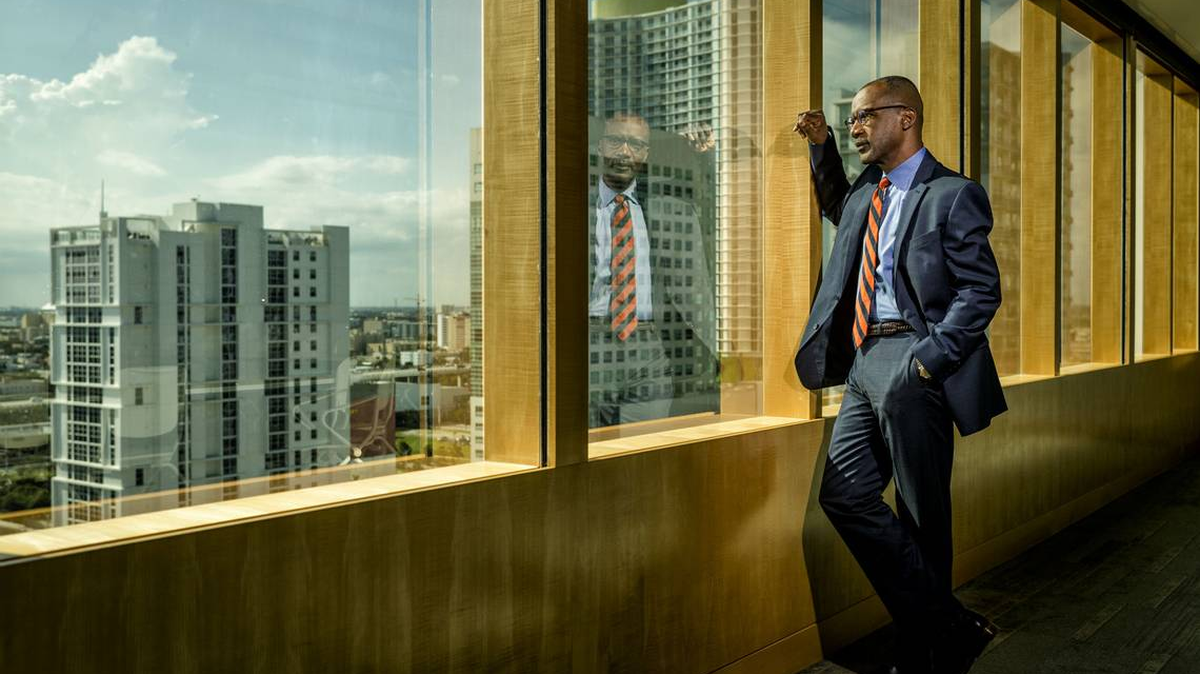
Jaret Davis, power lawyer and ‘large black man:’ Admitting mutual pain is first step
READ MORE
Calls for action
We asked 10 black South Florida business leaders to share their views on race, community and business, and the path forward. Here’s what they had to say.
Expand All
While many of us felt soul-shredding pain as we watched the video of George Floyd having the life choked out of him by a knee of authority, for myself and other African-Americans the pain touched us at a much more personal and deeper level.
As a large black man – 6’8” and with a somewhat athletic build – I regularly have people stop me on the street asking me for which team I played football or basketball. But with equal and likely greater frequency, I am used to the looks of fear that a stranger’s eyes can’t hide when I cross paths with someone on the sidewalk on a dark night or step into an elevator. Yes, I am co-managing shareholder of one of the largest law offices in the state of Florida and I have negotiated billions of dollars’ worth of corporate deals, but when I enter that elevator I am still someone to be dreaded by many. As any large black man will tell you, over the decades I have developed, in part out of courtesy and in part out of survival, several techniques to reduce the fear and put others at ease. Distance, demeanor and even diction – we all have tricks we can share.
The stares and the uncomfortable silences are an irritant to be sure, but I’ve always chosen not to dwell on the behavior of others. I’m certainly not alone. My Muslim friends certainly share this experience. My women friends have shared with me the borderline-painful steps they take to similarly control perceptions. At some point each of us has come to terms with the painful realization that through social assumptions we are all to some extent rendered prisoners within our own bodies.
However, while each of us may live within that prison and combat it from within, death is a penalty that is simply too great to be forced upon any of us.
We can throw around theories of race, gender, nationality, religion, or sexuality. But in the end, each of those masks what’s truly missing in our modern society: a commitment to empathy and appreciating the common humanity within us all. The notion that a man may be killed due to allegations that he used a counterfeit $20 bill or that looting, while horrendous, is the primary challenge, shows an inability to see common humanity and a lack of focus on the underlying societal problem.
Although this last week may have highlighted the need for us as individuals and a community to better appreciate our common threads, it’s also highlighted the best of us. We saw the leadership of the Coral Gables Police Department all “taking a knee” in a show of solidarity with protesters. We have seen leadership of other police departments and civic leaders across America — and even abroad — follow suit. We have seen that the crowds at these protests include a sea of black, brown, and white faces — a true reflection of the mosaic that is America.
And in that mosaic, we realize increasingly that we can no longer operate in silos of race, gender, and nationality. We owe to one another a sense of ownership of each other’s pain and plight. This doesn’t mean we will readily agree on solutions. But acknowledging the mutual pain and committing to the promise that something must be done, is the first step in moving toward change.
I stand ready to help be part of that change in Miami. To create a better future, we must bring together business, civic and community leaders who will no longer settle for the status quo. I am proud of my colleague Ernest Greer, Greenberg Traurig’s president, who has vowed to do the same in Atlanta.
For the good of our society, I would issue a plea that we all join in this dialogue. The NAACP has already brought some proposals to the table. And while this plea obviously includes the leadership of law enforcement, more importantly it must include the police unions such as the Policemen’s Benevolent Association and the Fraternal Order of Police. This dialogue cannot be had in a meaningful fashion without their involvement.
My greatest hope is, while there is great discord now, through communication, common humanity, and empathy, we can see a path forward to grow closer as individuals and as a community.
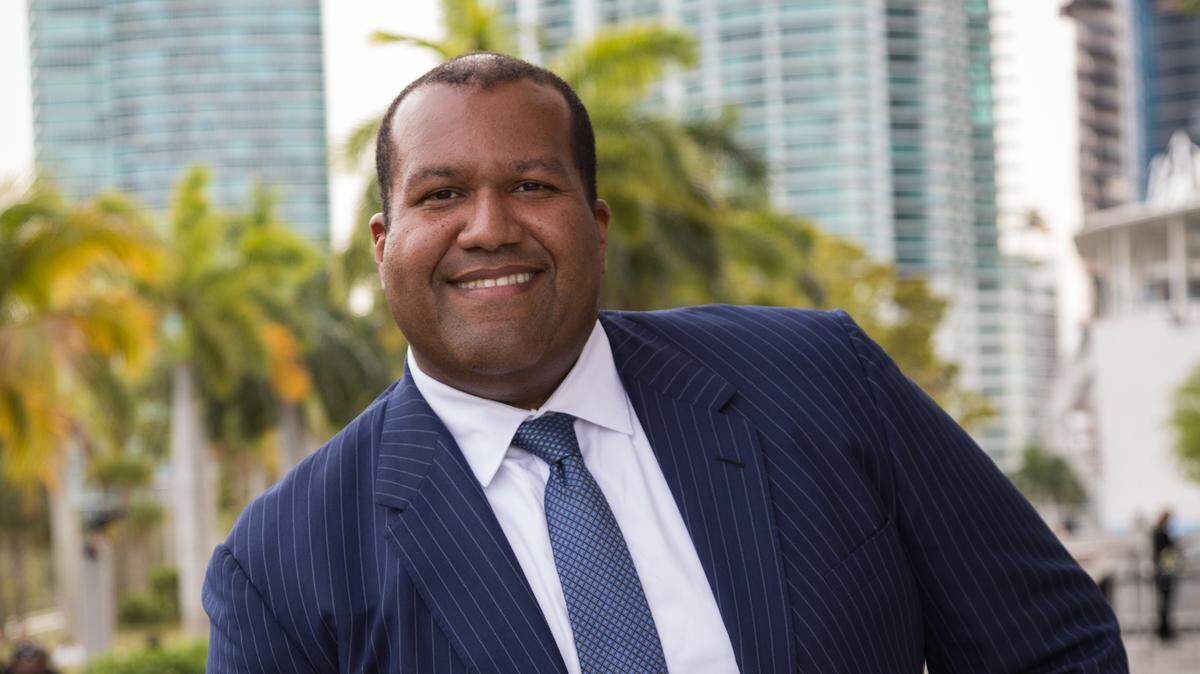
Jaret L. Davis is co-managing shareholder of Greenberg Traurig’s Miami Office and a Miami native. He currently chairs the board of Nicklaus Children’s Hospital and is a former chair of the Miami-Dade Beacon Council.
This story was originally published June 3, 2020 at 11:44 AM.

.jpg)