Scientists Discover One of the World's Largest Bee Colonies Under a New York Cemetery
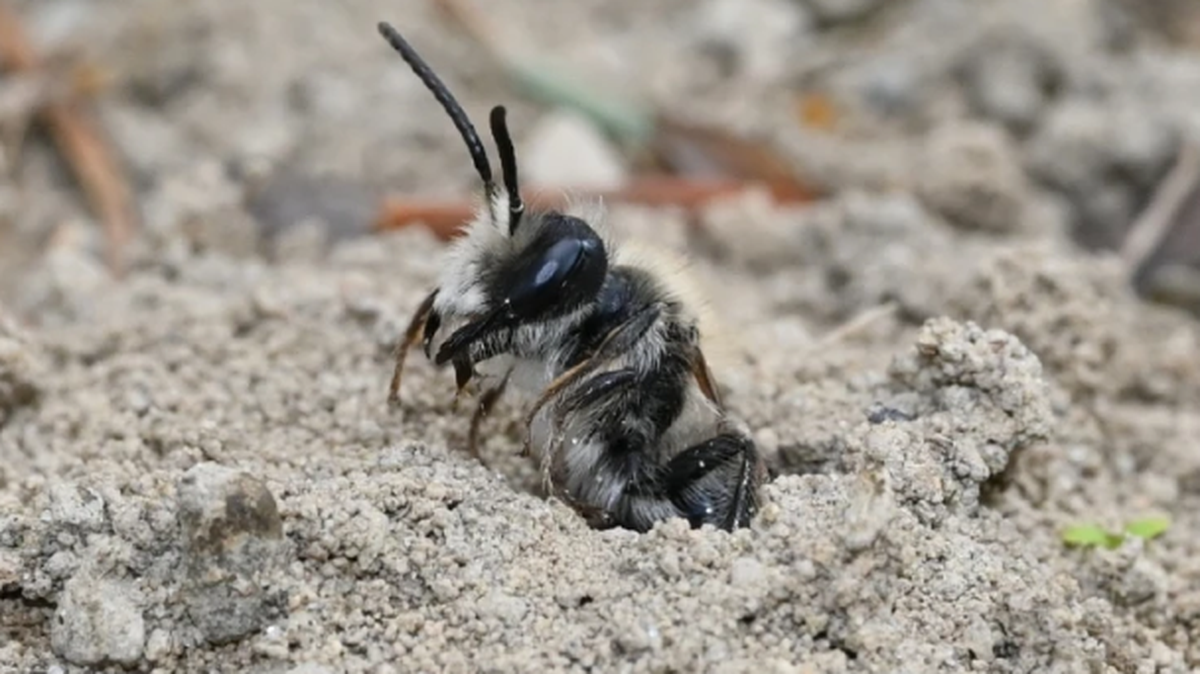
When most people stumble across a large population of bees, their first instinct is to back away and find another route. Rachel Fordyce did the opposite — and it led to a remarkable discovery.
Fordyce, a technician at an entomology lab at Cornell University, was walking through the East Lawn Cemetery in Ithaca, New York, when she noticed an abnormal number of bees in the area.
Rather than retreat, she captured some in a jar and brought them to her boss, Bryan Danforth, a professor of entomology in the College of Agriculture and Life Sciences.
Together, they identified the specimens as Andrena regularis, commonly called the regular mining bee.
A Staggering Number of Bees Beneath the Surface
The mere presence of the bees wasn’t that surprising. Roughly 75% of all bee species are solitary ground nesters, and the cemetery, established in 1878, served as an ideal home.
What was surprising was just how many of the bees called the cemetery home.
In a new study published April 13 in the journal Apidologie, a group of researchers at Cornell University — including Fordyce and Danforth — collected bees in an effort to estimate the cemetery’s population.
That estimate came to around 5.5 million bees in the 1.5-acre cemetery, making it one of the largest and oldest recorded aggregations of ground-nesting bees in the world.
“I was completely floored when we did the calculations,” Danforth told Scientific American.
“I have seen published estimates of bee aggregations in the hundreds of thousands. But I never really imagined that it would be 5.56 million bees,” Danforth added.
Steve Hoge, the lead author of the study, said there might be other larger aggregations that have yet to be identified, but this was one of the largest ever recorded in literature.
How the Researchers Counted Millions of Bees
The study introduced a fresh methodology for studying bee biology. Researchers deployed emergence traps — small mesh tents covering less than a square meter of ground. Each trap includes a funnel directing insects into a glass collection jar.
The team deployed 10 traps between March 30 and May 16, 2023.
The traps collected 3,251 specimens representing 16 species including bees, flies and beetles, with A. regularis being the most abundant species captured.
From there, researchers determined the average number of bees emerging per square meter and scaled that figure across the cemetery’s total area of approximately 6,000 square meters (1.5 acres).
Population estimates ranged between 3 million and 8 million bees, and the average calculation settled at 5.5 million total bees.
What Are Ground Nesting Bees?
Ground-nesting bees are essential native pollinators that, unlike honey bees, nest in underground tunnels rather than hives. They are non-aggressive, beneficial for soil aeration and rarely sting.
Despite their abundance, these species have received limited scientific attention.
According to Hoge, records of A. regularis specimens collected at the site stretch back to the early 1900s, but the most thorough source on A. regularis was from 1978.
The new study is expected to bring a wave of interest to the species and help spur more research in the future.
Why a Cemetery Makes a Perfect Bee Habitat
The study also helps highlight cemeteries as good habitat for bees and biodiversity in general. Cemeteries offer quiet environments with minimal ground disturbance and typically lack pesticide use.
The East Lawn Cemetery was especially important due to its proximity to Cornell Orchards, which provides a large resource of blooming flowers in early spring. Cornell Orchards sits approximately one-third of a mile from the cemetery.
A. regularis typically emerges around April in New York when midday temperatures consistently reach 70 degrees. Their emergence aligns with apple bloom and other fruit trees plus early wildflowers — making the nearby orchards a critical food source.
Why This Giant Bee Discovery Matters
The study was groundbreaking for several reasons. Aside from the sheer size of the aggregation, the paper collected data for ground-nesting bees that are vastly understudied.
“The research elevates the value of solitary ground-nesting bees and shows just how abundant these bees are, how important they are as crop pollinators, and that we need to be aware of these nest sites and preserve them,” Danforth told the Cornell Chronicle.
Danforth emphasized the urgency of protecting these sites.
“These populations [of ground-nesting bees] are huge, and they need protection,” Danforth added. “If we don’t preserve nest sites and someone paves over them, we could lose—in an instant—5.5 million bees that are important pollinators.”
The message is clear: what lies beneath the surface of a quiet cemetery in upstate New York could be far more valuable than anyone previously imagined.
This article was created by content specialists using various tools, including AI.