Parrot Missing Half His Beak Jousts With Other Members of His Group. Here’s How He Does It.
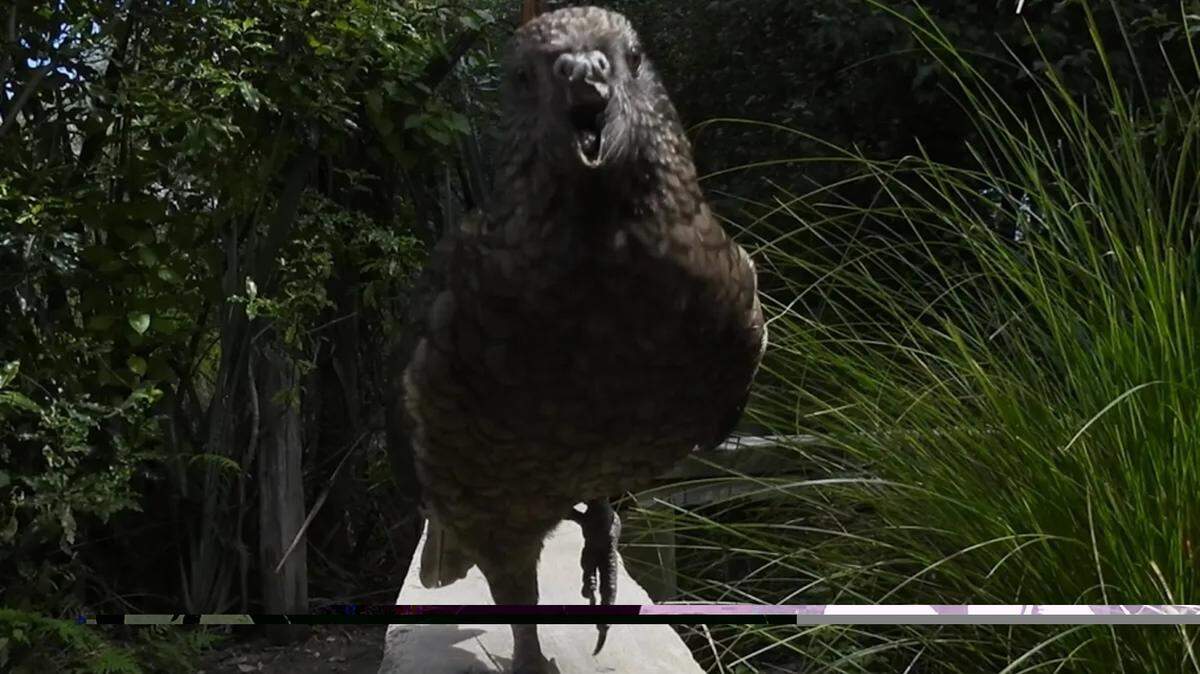
No one knows how Bruce lost the entire upper half of his beak. What researchers do know is that the endangered kea parrot didn’t just survive the devastating injury — he climbed to the very top of his social group, becoming the undisputed alpha male through a fighting technique no other kea has ever been observed using.
A report published on Monday, April 20, in Current Biology documents what scientists say is the first case of a physically disabled animal of any species individually achieving and maintaining alpha male status through behavioral innovation alone.
The Hooligan Who Rewrote the Rules
Kea parrots are already famous for being troublemakers. “They’re often called hooligans and rightly so,” says study coauthor Ximena Nelson, a professor of animal behavior at the University of Canterbury in New Zealand. The birds make snowballs, sled on their backs, joyfully deface tourists’ cars and use their beak to fling rocks at passing people, she says.
But Bruce stands apart from his fellow hooligans. Without his upper beak, he can’t bite like other kea. So he invented something else entirely — a jousting attack.
“Bruce deployed his exposed lower beak in jousting thrusts, both at close range, with an extension of his neck, and from afar, with a run or jump that left him overbalanced forward with the force of motion,” the report says. “During further behavioral observations, this jousting targeted opponents using motions intact kea do not replicate.”
In other words, Bruce charges at rivals, striking them with his lower beak and the full force of his body. No other kea does this. It’s a move born entirely from necessity — and it works.
“Because of his disability, he has had to innovate behaviors. He’s found a way to make himself more dangerous,” says Nelson.
How Bruce Dominates Feeding Time
Bruce’s dominance wasn’t just symbolic. The study tracked measurable, concrete advantages that came with his alpha status at Willowbank Wildlife Reserve.
“Despite these feeders being deliberately distributed to prevent monopolization, Bruce was first to arrive on any feeder on 83 percent of recorded days, was never challenged while feeding, and on four days maintained sole access to all four feeders for at least 15 minutes before subordinates visited stations he had vacated,” the report says.
In addition, the report says, “He also received a privilege no other kea in the group enjoyed. “Bruce’s alpha position was reflected not only in combat, but also in measurable benefits across social interactions, feeder priority and physiology. He was the only individual to receive allopreening from a non-mate, directed at the inside of his lower beak to remove debris, his head and neck, or all three areas.”
Subordinate birds groomed the inside of his damaged beak, cleaning out debris he couldn’t remove himself. His stress hormone levels were also lower than the other birds in the group — a physiological signature of his secure position at the top.
No Allies Needed for Bruce
What makes Bruce’s case extraordinary, even among the rare examples of disabled animals holding high rank, is that he did it alone.
The report draws comparisons to only two similar cases in scientific literature. A chimpanzee named Faben lost the use of his arm to polio and reached beta rank — but only by developing novel displays and forming an alliance with his brother, the new alpha male. An old male Japanese macaque maintained alpha status as his ability to walk deteriorated, but only through an alliance with the alpha female.
Bruce needed no such coalition. He exerted dominance over every other kea in the group during all his aggressive interactions, entirely on his own.
What Bruce Means for Science
Christina Riehl, an evolutionary biologist at Princeton University who wasn’t involved in the new work, called the findings impressive. “This bird is using behavioral flexibility to compensate for a disability, which is really cool,” she says. The findings, she adds, help illustrate how “ingenious” these alpine parrots can be.
Still, Riehl isn’t entirely convinced Bruce’s disability gave him an edge. “Maybe Bruce would be even better off if he had his upper beak intact,” she says. “Who knows?”
The researchers, however, see broader implications. Their report states that Bruce “demonstrates that, in captive environments, innovative compensation for impairment is possible outside of primates, and without coalition networks.” The findings, they write, even raise questions about “whether well-intentioned prosthetic assistance for physically impaired animals will always improve positive animal welfare.”
Bruce was found in 2013 by bird expert Raoul Schwing in mountainous Arthur’s Pass, New Zealand. How he lost his upper beak remains a mystery. But the bird who should have been at the bottom of his social hierarchy instead fought his way to the top with a weapon he built from scratch.
As the study puts it: “The bird missing his upper beak has rewritten what disability means for behaviorally complex species.”
This article was created by content specialists using various tools, including AI.