Outnumbered Chimpanzees Launch Brutal Civil War Against Larger Rival Faction in Uganda
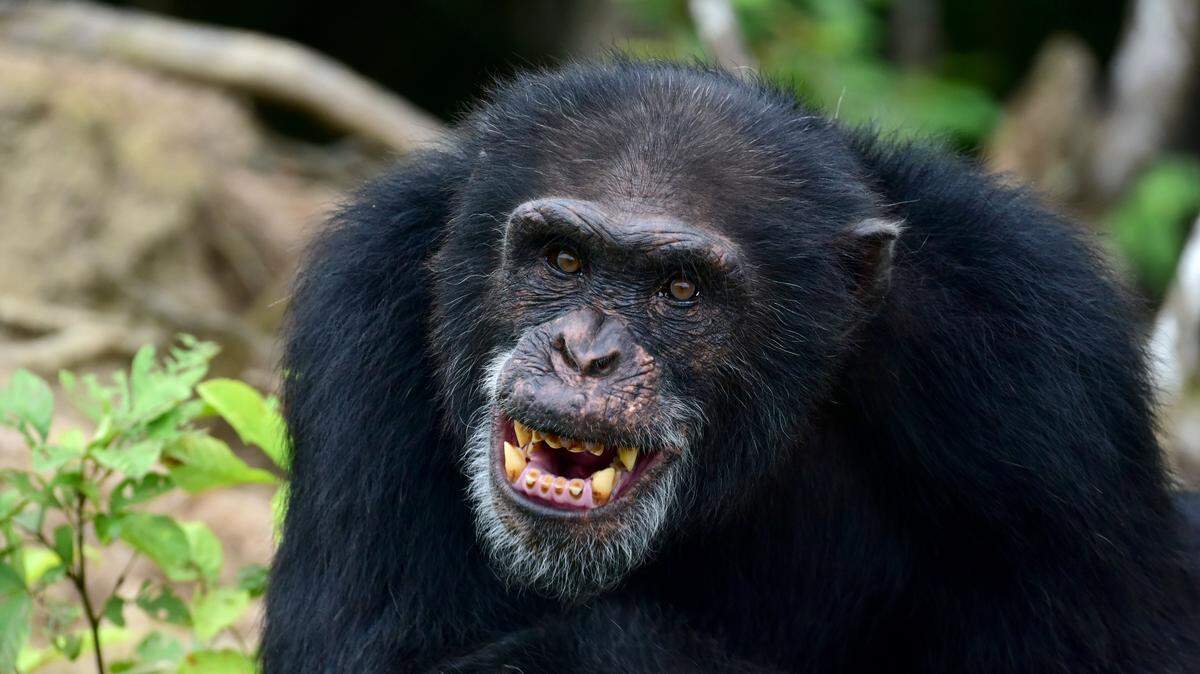
Deep in Uganda’s Kibale National Park, the largest known group of wild chimpanzees is tearing itself apart.
But this isn’t a balanced conflict. In the Ngogo chimpanzee community’s ongoing civil war, every attack has been launched by one faction — and every victim has belonged to the other.
The Ngogo community, numbering roughly 200 individuals, fractured into rival clusters that researchers identify as Western and Central. A third cluster, Eastern, has stayed out of the fighting, but is believed to be allied with the Central group.
What makes this conflict so unusual is the math.
The Central cluster is the larger of the two warring factions. The Western cluster is significantly smaller. And yet it is the Western chimps — outnumbered — who became the aggressors and have dominated every encounter.
The research findings were published by Aaron Sandel in the journal Science on April 9.
A Community of Chimpanzees Unravels
Early signs of tension appeared in 2014, when five adult males died — possibly from disease — removing key individuals who served as social bridges between the clusters. A new alpha male was crowned shortly before the split deepened.
On June 24, 2015, Sandel witnessed an abnormal encounter near the center of Ngogo territory. Instead of mingling, the Western chimps ran away and the Central chimps chased them. An unprecedented six-week period of avoidance followed.
By 2017, the two clusters held entirely separate territories. The former center of the community became a patrolled border. That same year, Western chimps attacked and severely injured the alpha male of the larger Central cluster.
By 2018, the rupture was permanent — socially, spatially and reproductively. Females and offspring would no longer even feed at the same fig tree. Young chimps became visibly nervous just hearing distant calls of mature males.
In 2021, the aggression expanded to include infants. Researchers directly observed Western chimps stealing and killing 14 Central infants. At least two more attacks on Central males have been documented since data analysis ended in 2024.
Between 2018 and 2024, the toll reached staggering numbers: seven adult males and 17 infants from the Central cluster were killed by Western chimps. That averages out to about one adult male and two infants per year.
During the same period, 14 additional Central adolescent and adult males disappeared — their bodies never recovered, with no signs of illness. Researchers believe they were likely also killed.
The smaller Western faction has initiated every single attack. Every casualty has come from the Central cluster’s ranks.
Why Is the Chimpanzee Civil War So One-Sided?
Researchers don’t fully know why the smaller faction has so thoroughly dominated the larger one.
Possible factors include a leadership vacuum after the 2017 attack on the Central alpha male, the loss of “social bridge” males who once held the group together and escalating boldness among Western males.
The imbalance is so extreme that researchers say it is conceivable the Western cluster could ultimately wipe out the Central cluster entirely.
Sandel, the lead author of the research, has compared documenting the conflict to being a war correspondent.
John Mitani of the University of Michigan, who has two decades of chimpanzee research experience, was stunned when the first violent encounter occurred in 2015.
Their observations have upended long-held assumptions about how chimpanzee conflicts unfold. Chimpanzee wars were assumed to be relatively balanced affairs of territorial defense.
The Ngogo conflict shows they can be as ruthlessly asymmetrical as anything in human history — a small, aggressive faction methodically dismantling a larger one.
With the conflict still ongoing and the Central cluster continuing to lose members, the question now is whether the larger group can survive at all — or whether this lopsided war will end with one side simply ceasing to exist.
This article was created by content specialists using various tools, including AI.