Rare Pink Fungus Called the ‘Fairy Club’ Found in Mainland Britain for the First Time
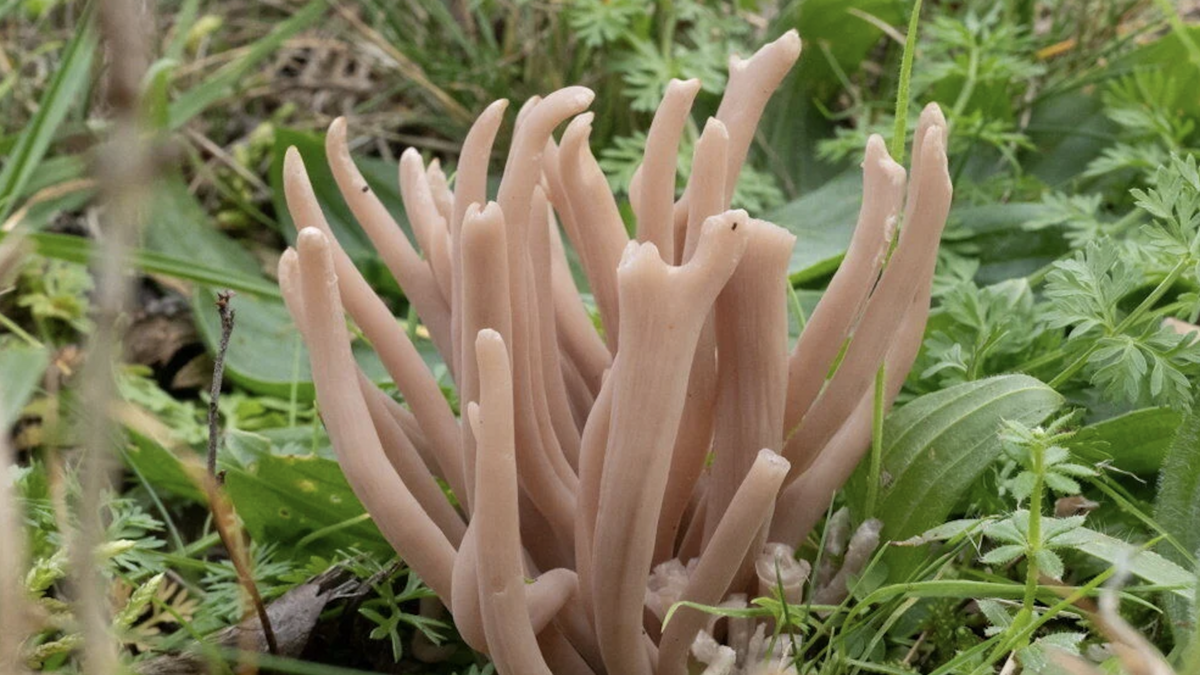
A group of volunteers surveying grassland near a small English town made a find that stunned them: a vibrantly pink fungus, roughly the size of a tennis ball, growing quietly in a field where no one had ever recorded it before. DNA analysis later confirmed the specimen was Clavaria calabrica, a species never previously documented in mainland Great Britain.
Its common name? The “fairy club.”
What the Volunteers Found at Haydon Batch
The fungus was discovered in autumn 2025 at Haydon Batch, a grassland site near the town of Radstock in southwest England. The people who spotted it weren’t professional scientists working in a lab. They were everyday volunteers conducting a biodiversity survey with Somer Valley Rediscovered, a regional project focused on improving biodiversity and connecting communities to local landscapes.
Their task that day was to catalog the organisms living in the grassland. What they found — a small, strikingly pink fungus — turned a routine outing into something far more consequential.
Clavaria calabrica had been recorded previously in Northern Ireland, but never before confirmed on the British mainland.
How DNA Confirmed the Discovery
Confirming the identity of the fairy club fungus required a cross-country scientific relay. DNA from the specimen was extracted in Scotland and then sent to Aberystwyth University in Wales for sequencing.
The results matched what the volunteers had hoped: the sample was Clavaria calabrica.
Consider the context. The United Kingdom has centuries of natural history tradition and is home to some of the world’s most famous botanical gardens and research institutions. Yet this species was growing in a grassland, unrecognized, until a group of curious volunteers decided to go looking.
‘Nature’s Calendar Right on our Doorstep’
Dan Nicholas, a local enthusiast who led the mushroom survey, told South West News Service, “This discovery further demonstrates that the South West is home to some of the most spectacular and diverse examples of these unique grassland fungi communities anywhere on the planet.”
Nicholas added, “We are truly blessed to have such a colorful spectacle of nature’s calendar right on our doorstep, something we need to cherish and protect at all costs.”
His comments carried both awe and urgency. Something this rare — this pink, this whimsically named — had been thriving just steps away from a local community, entirely unrecognized until the survey team went out to look.
Where Fairy Clubs Grow
The fairy club fungus is described as about the size of a tennis ball, with a distinctive pink color that sets it apart from the muted tones of typical grassland organisms. Clavaria calabrica typically grows in grasslands that have been gently managed over long periods and support diverse wildlife.
These aren’t intensively farmed fields or manicured lawns. They are landscapes that have been allowed to develop slowly, with a light human touch — habitats that reward patience and careful stewardship.
The fairy club, it seems, flourishes where nature is given room to do its work.
Citizen Science Behind the Find
The discovery at Haydon Batch was part of a larger effort by the Somer Valley Rediscovered partnership, which includes local town and parish councils and focuses on biodiversity conservation and community engagement with regional landscapes.
The finding has also been highlighted in connection with the West of England Nature Partnership and a citizen science initiative known as the West of England Wildlife Index, which tracks wildlife across 20 sites in the region. These programs are built on the idea that ordinary people have a real role to play in understanding and protecting the natural world.
The fairy club discovery offers concrete proof of what citizen science can produce.
Helen Godwin, mayor of the West of England Combined Authority, expressed pride in the finding. She said in a statement, “Finding a species never before recorded in Great Britain here in the West is something we can all be proud of. This shows again just how rich and unique landscapes across our region can be.”
Godwin added, “The work of the West of England Nature Partnership helps make sure these habitats are understood and protected. I encourage everyone to get involved in the West of England Wildlife Index, helping us record and safeguard the nature that makes our region so special.”
Production of this article included the use of AI. It was reviewed and edited by a team of content specialists.