Scientists Found a New Scorpion Species Hiding Under a Rock at Their Campsite in Thailand
%20krachan.jpg "Natural habitat of Scorpiops (Euscorpiops) krachan sp. nov. in Kaeng Krachan National Park, Phetchaburi Province, Thailand.")
A team of researchers in one of Thailand’s most biodiverse national parks lifted a single rock near their campsite and found a scorpion no one had ever formally described. It was barely an inch long, armed with slender speed-snap claws, covered in sensory hairs that detect the faintest shift in the air, and equipped with a full set of eight eyes.
The species, Scorpiops krachana, may exist nowhere else on Earth.
The Discovery Happened Right Next to Camp
Zoologist Wasin Nawanetiwong and colleagues from Chulalongkorn University and partner institutions were surveying rocks near their campsite inside Kaeng Krachan National Park when they spotted the tiny arachnids. They weren’t deep in an unreachable cave system or hacking through uncharted jungle. They were right by where they were sleeping.
From beneath that single rock, the team collected four specimens: three males and one female. All four were tucked into moist leaf litter near a seasonal stream in a transitional forest zone, where secondary forest meets older growth. That same habitat supports frogs, crickets and beetles — creatures that may serve as prey for the little scorpion.
The team formally described the new species in a study published in the journal ZooKeys on March 6, 2024.
Paperclip-Sized But Surprisingly Well Armed
In the study’s species description, Nawanetiwong wrote that the scorpions are among the smallest members of their subgenus, noting that “Males reach just over one inch from head to tail.” Adults measure between 0.85 and 1.06 inches from head to stinger, according to the paper. That’s roughly the length of a paperclip.
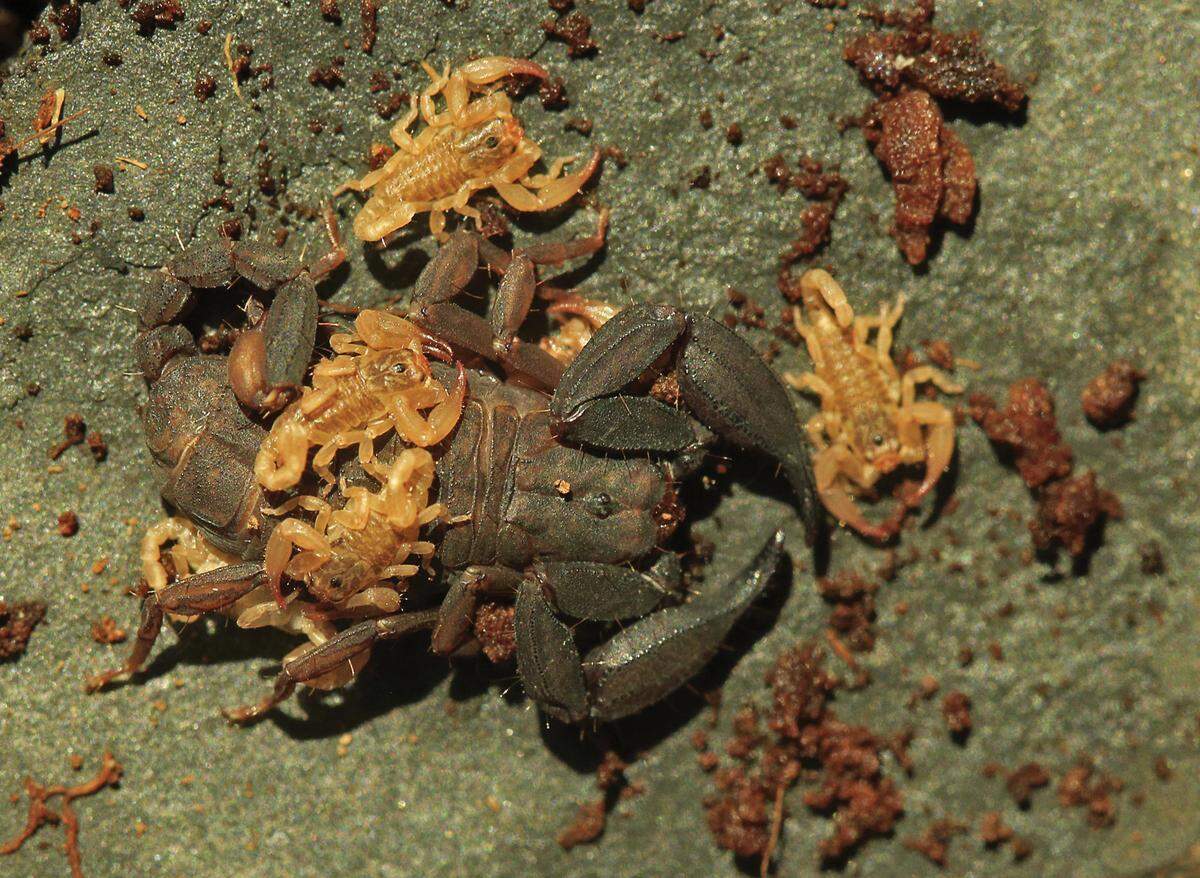
But field measurements reported in the study indicate the scorpion’s slender claws can close quickly enough to capture prey larger than its body. This is a pint-sized predator with the tools to take down meals bigger than itself.
The researchers also documented physical differences between the sexes. According to co-author Natapot Warrit, females have a darker chocolate-colored shell, while males appear more tan.
Eight Eyes, UV Glow and Built-In Motion Detectors
The biological details of Scorpiops krachana get wild fast.
The researchers noted the species has eight eyes — the maximum number typically found in scorpions. Scorpion heads normally contain a pair of median eyes along with multiple lateral eye pairs. The study suggests that having eight eyes may improve depth perception during stationary hunting. This scorpion can sit perfectly still and judge exactly how far away its next meal is before striking.
Then there’s the exoskeleton. Scientists referenced research suggesting that scorpion exoskeletons can fluoresce under ultraviolet light and may function as a light-sensing surface. Shine a blacklight on one of these creatures and it glows — a real phenomenon that generally makes scorpions some of the most visually striking creatures under UV light.
The sensory equipment goes further. The scorpion has elongated pedipalps — arm-like appendages ending in pincers — tipped with straight claws and lined with sensory hairs known as trichobothria. According to the researchers, these hairs allow the scorpion to detect air movement and locate prey in low-light environments. Even in the dark, damp understory of a Thai forest, this scorpion knows what’s moving around it.
It May Be Found In Only One Place on Earth
“This new taxon may represent one endemic element for the scorpion fauna of Thailand,” Nawanetiwong wrote in the paper.
The species was found in Kaeng Krachan National Park, which lies along the Tenasserim Range near Thailand’s western border. The park is part of the Kaeng Krachan Forest Complex, designated a UNESCO World Heritage Site in 2021. According to UNESCO, the forest complex contains at least 459 animal species, including 48 endemic species and 81 species classified as rare.
The formal description of Scorpiops krachana adds to those numbers. According to the study, the discovery increases the number of described Euscorpiops species in Thailand to 13 and raises the total number of known Scorpiops species worldwide to more than 115.
DNA Work Is Underway, But Habitat Threats Loom
Researchers are conducting genetic sequencing of a specific mitochondrial gene — reading the scorpion’s DNA — to better determine the species’ evolutionary relationships with other Asian scorpions. That work could reveal where this tiny predator sits on the broader family tree and how it’s related to other scorpions across the continent.
But the study carries a note of concern. The authors note that land-use changes near the discovery site could affect the scorpion’s habitat, as areas outside the park transition into farmland. If the species truly is endemic to this one region, habitat loss could pose a real threat to its survival.
For now, Scorpiops krachana sits under a rock in a Thai national park — a reminder that the natural world still has surprises to offer, sometimes right at your feet.
Production of this article included the use of AI. It was reviewed and edited by a team of content specialists.