
The Allergy-Smart Cleaning Swap: 5 Expert-Backed Products That Reduce Indoor Allergens
AI-generated summary reviewed by our newsroom.
- Use HEPA vacuums that capture particles down to about 0.1 microns.
- Choose fragrance-free cleaners, vinegar+hot-water mixes, and free-and-clear detergents.
- Dust with damp microfiber cloths; keep a 5% bleach solution for kitchen disinfection.
Your cleaning routine might be working against you. The same products you reach for to scrub countertops, mop floors, and freshen laundry could be triggering the very allergic reactions you’re trying to avoid. A growing number of allergists are steering patients toward a specific set of hypoallergenic cleaning tools, and the logic behind each recommendation is worth a closer look.
Here’s what allergists and immunologists are telling their own patients to use at home.
According to the Asthma and Allergy Foundation of America, eight out of 10 people in the United States are exposed to dust mites. Six out of 10 are exposed to cat or dog dander. Additionally, cockroaches cause allergic reactions in people who live in the inner cities or southern parts of the United States.
The Environmental Protection Agency recommends three ways to improve indoor air quality: control your contact with indoor airborne allergens, ventilate your indoor areas well, and use air cleaners to clean indoor air.
“Better air quality in your home, office, school and car can reduce allergy and asthma triggers,” according to the Asthma and Allergy Foundation of America.
That’s where your product choices come in.
HEPA filtered vacuums: the single biggest upgrade
If you change one thing about how you clean, allergists say it should be your vacuum. Not all vacuums are created equal when it comes to trapping microscopic allergens, and the difference between a standard filter and a HEPA filter determines whether you’re actually removing particles from your space or just redistributing them into the air you breathe.
Sima Mithani, MD, an allergist and immunologist at ENT and Allergy Associates LLP in Hackensack, New Jersey, told Reader’s Digest, “The HEPA filter traps incoming particles so they don’t disperse back into the air.” Her favorite brands are Dyson and Shark, specifically the Dyson Multifloor 2 Upright Vacuum. “It works great for picking up dust mites and pet allergens and has an effective dirt-bin emptying system that allows avoidance of contact with the debris,” she says.
That dirt-bin detail matters. If emptying your vacuum puts you right back in contact with the allergens you just collected, the whole exercise becomes less effective.
In an article written by Trisha Sprouse for Apartment Therapy, she swears by a HEPA vacuum with a specific edge: “Its greatest attribute is its five-stage HEPA filtration system that can capture 99.99 percent of dust particles as small as 0.1 microns in size. However, I also love that it’s a lightweight stick vacuum with multiple attachment heads, and it’s cordless, so I can use it anywhere without being tethered to a cord. It has excellent suction power, and I use it to vacuum wood floors, area rugs, stairs, furniture, blinds, ceiling lights, windows, baseboards, and even my car.”
That 0.1 micron figure is the detail to pay attention to. The smaller the particle your vacuum can capture, the more allergens it’s actually pulling out of your environment rather than cycling through it.
Fragrance-free cleaners: why “fresh scent” is a red flag
The instinct to associate a strong scent with cleanliness is deeply ingrained, but allergists push back on it hard.
Sara Axelrod, MD, an allergist with ENT & Allergy Associates in East Brunswick, New Jersey, told Reader’s Digest not to use cleaners that have strong scents. She recommends making your own cleaning solution using vinegar and hot water with mild soap or purchasing fragrance-free all-purpose cleaners or anything that’s labeled as “free and clear.”
The vinegar-and-hot-water approach is about as low-cost as cleaning gets. And the “free and clear” label on store-bought products has become the shorthand allergists use to point patients toward safer options.
Unscented laundry detergent: same clean, fewer reactions
The same “free and clear” principle applies to your laundry. Dr. Mithani told Reader’s Digest, “Although we may equate a scent with better cleaning, this is often not the case. ‘Free and clear’ laundry detergents are just as effective in cleaning and tend not to cause the added adverse effects that fragrance products may cause.”
The fragrance in your detergent isn’t doing any of the cleaning work. It’s just making your clothes smell a certain way, and for a lot of people, that smell comes with a cost.
Microfiber cloths: the reusable allergen trap
Dusting with a dry rag tends to kick particles into the air rather than collect them. The fix is straightforward.
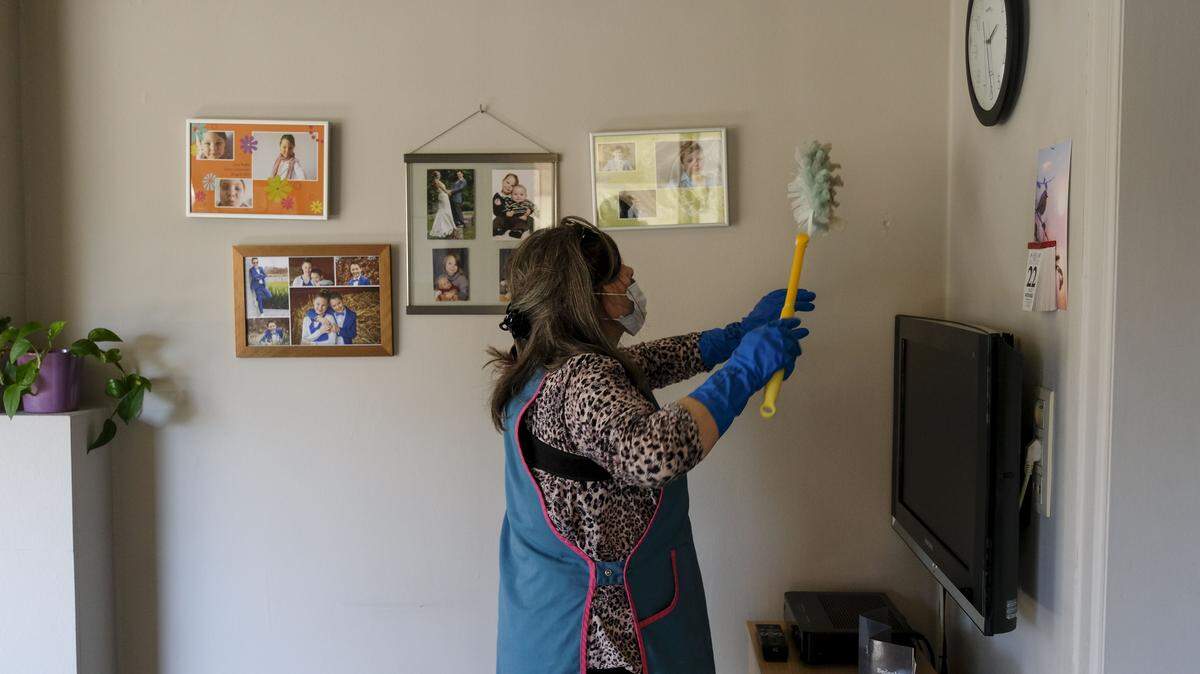
Dr. Mithani says using a damp or moist microfiber cloth, along with wearing a mask, gloves, and long clothing, forms a barrier between your nose, mouth, and skin and allergens in the environment.
“Purchase microfiber cleaning cloths, which are soft, non-abrasive, and extra absorbent for retaining water, which works great when collecting dust,” she says. “They’re also better for the environment since they are machine washable and therefore can be reused.”
The damp cloth is the key part. Moisture holds dust particles against the cloth instead of letting them float back into your breathing space.
Bleach solution: the mold and food allergen weapon
This one comes with a specific use case most people don’t think about. Tania Elliott, MD, an allergist and spokesperson for Flonase, says a 5 percent bleach solution helps in disinfecting surfaces and removes mold and food particles that are attractors for allergens like cockroaches and mice.
“It also can break down stubborn food allergens; remember, alcohol-based products will not get rid of food allergens,” she says. “If you are sensitive to cleaning products, also purchase a mask or nasal filters and latex-free gloves.”
That distinction between bleach and alcohol-based cleaners is one many people miss entirely. If you’re wiping down a kitchen counter with an alcohol-based spray after preparing food that someone in your household is allergic to, you may not be removing the allergen at all.
How to put this into practice
The shift doesn’t require replacing everything at once. Start with the product you use most often. For most people, that’s either the vacuum or the all-purpose cleaner.
Swap your current vacuum for one with HEPA filtration that captures particles down to at least 0.1 microns. Replace scented cleaners with fragrance-free versions or mix vinegar and hot water with mild soap. Switch to “free and clear” laundry detergent. Pick up a pack of microfiber cloths and dampen them before dusting. Keep a 5 percent bleach solution on hand for kitchen surfaces, especially after preparing meals.
Most of these swaps costs roughly the same as (or less than) what you’re already buying. The difference is that these products are specifically designed to reduce allergen exposure rather than add to it.
Production of this article included the use of AI. It was reviewed and edited by a team of content specialists.