
5,300-Year-Old Bow Drill Proves Ancient Egypt Had Advanced Tech Far Earlier Than Expected
Production of this article included the use of AI. It was reviewed and edited by a team of content specialists.
For an entire century, this tiny drill bit was just a curious little pin tucked away in a museum collection. A slender copper tool barely longer than your thumb, weighing less than a paperclip.
Cataloged in the 1920s as nothing more than “a little awl of copper, with some leather thong wound round it,” the artifact was noted, filed away, and largely forgotten.
Now, a fresh look at this overlooked relic has rewritten a significant chapter of ancient Egyptian history. Researchers say the humble object is almost certainly the earliest known metal drill from ancient Egypt.
The 5,300-year-old tool reveals that Egyptian craftspeople mastered sophisticated rotary drilling technology more than two millennia earlier than previously believed.
It is a reminder that some of the most dramatic ancient discoveries don’t come from new digs in the desert. Sometimes, they’ve been sitting in plain sight all along.
From a Forgotten Grave to a Landmark Discovery
The artifact was originally excavated about 100 years ago from a cemetery at Badari in Upper Egypt, found in Grave 3932 — the burial of an adult man.
It dates to the Predynastic period, specifically the phase archaeologists call Naqada IID, placing it in the late 4th millennium BCE.
At roughly 63 mm long and weighing about 1.5 grams, the object is astonishingly small.
When it was first documented in the 1920s, no one recognized its true significance. It was cataloged with a brief, matter-of-fact description, and for decades, its importance went entirely overlooked.
That changed when researchers from Newcastle University and the Academy of Fine Arts, Vienna decided to take another look.
.jpg "5300-year-old-bow-drill-proves-ancient-egypt-had-advanced-tech-far-earlier-than-expected (2).jpg")
The study, titled “The Earliest Metal Drill of Naqada IID Dating,” was published in the journal Egypt and the Levant, an international, peer-reviewed publication focused on Egyptian and Near Eastern archaeology, on Jan. 23.
Using microscopic analysis and portable X-ray fluorescence (pXRF) — a modern technique that can reveal the chemical makeup of an object without damaging it — they examined the tool with fresh eyes and far more advanced technology than was available a century ago.
What they found was remarkable.
The Telltale Signs of Rotary Motion
The re-examination revealed unmistakable evidence that this was no simple awl meant for poking holes.
The tool shows clear signs of rotary motion, including fine circular wear patterns known as striations, rounded edges, and a distinctive curvature at the working end. Remnants of six coils of fragile leather thong were also preserved on the shaft.
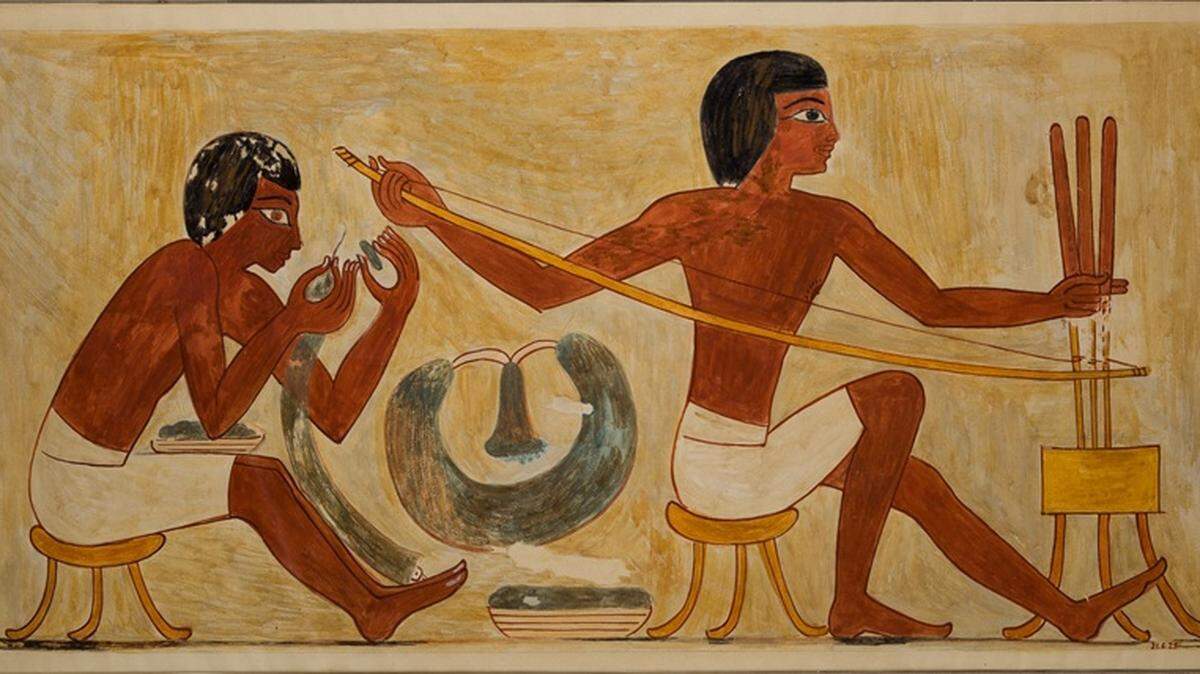
Taken together, these features strongly suggest the object was part of a bow drill — a device that spins a shaft using a bow and string to create rapid back-and-forth rotation.
In a bow drill, a bow moves a string wrapped around the drill shaft, generating faster and more controlled drilling than pushing or twisting by hand.
Bow drills were used to drill wood, stone, beads and other craft materials — the essential, everyday work behind so many of ancient Egypt’s celebrated achievements.
Dr. Martin Odler, Visiting Fellow in Newcastle University’s School of History, Classics and Archaeology and lead author of the study, put the finding into perspective in a Feb. 9 press release.
“The ancient Egyptians are famous for stone temples, painted tombs, and dazzling jewellery, but behind those achievements lay practical, everyday technologies that rarely survive in the archaeological record,” Odler said.
“One of the most important was the drill: a tool used to pierce wood, stone, and beads, enabling everything from furniture-making to ornament production,” he added.
A Surprisingly Sophisticated Metal
The chemical analysis yielded another surprise. The drill is made from an unusual copper alloy containing arsenic, nickel, lead and silver.
This composition would have made ancient tools harder and more durable than standard copper — a significant advantage for a drill bit that needed to bore through resistant materials.
The metal mixture carries broader implications as well. It may indicate deliberate alloying techniques, access to advanced metallurgical knowledge, or possible long-distance trade networks or specialized ore sources.
For a tool dating back 5,300 years, that level of material science is striking. It speaks to a community of craftspeople who were not just skilled with their hands but deeply knowledgeable about the properties of the metals they worked with.
Why Two Millennia Matters
The most dramatic takeaway from the study is the timeline shift.
The tool shows Egyptians mastered reliable rotary drilling more than two millennia earlier than some previously known drill sets. That is not a minor adjustment — it is a fundamental rethinking of when this technology emerged in the Nile Valley.
The bow drill, it turns out, remained a core technology for nearly two thousand years after this tool was made, a testament to the long-term effectiveness of the design.
What this small copper artifact from Grave 3932 suggests is that the roots of that enduring technology stretch far deeper into Egypt’s past than scholars had recognized.
“This re-analysis has provided strong evidence that this object was used as a bow drill – which would have produced a faster, more controlled drilling action than simply pushing or twisting an awl-like tool by hand,” Odler said in the press release.
The findings also reinforce that ancient Egyptian innovation extended beyond monumental architecture to practical craftsmanship and toolmaking.
The pyramids, the temples, the stunning gold jewelry found in royal tombs — all of these marvels depended on practical, everyday tools wielded by skilled hands. The drill was one of those indispensable ancient Egyptian tools.
The Lesson Hiding in Museum Storage Rooms
Perhaps the most compelling thread running through this story is one that should give any lover of history a thrill. After all, museum collections can still yield ancient discoveries, even from artifacts studied decades ago.
This drill bit was not buried under sand waiting for an archaeological expedition. It was sitting in a museum, already excavated, already cataloged — just misunderstood.
It took modern analytical tools and a willingness to look again at old materials with new questions for its true identity to emerge.
How many other objects, one wonders, are sitting in drawers and display cases around the world, their real stories still waiting to be told?
For anyone who has ever lingered over a museum display, fascinated by the lives of people who lived thousands of years ago, this discovery is a powerful reminder that the past is never quite finished revealing itself.