
Scientists Found a 4-Foot Vine Snake in India With a Long Snout. It’s a New Species
Production of this article included the use of AI. It was reviewed and edited by a team of content specialists.
A chance encounter on the outskirts of a village in northeastern India has yielded something rare: a previously undocumented vine snake species with a distinctively elongated snout that sets it apart from its relatives.
The discovery began in 2021 when scientists Sourabh Verma and Soham Pattekar were surveying the area around Valmiki Tiger Reserve in Bihar, India.
The region’s amphibians and reptiles were under-surveyed and poorly documented, making it prime territory for biodiversity research.
What they found lying dead near the boundaries of Gonauli village would take years to confirm.
A Vine Snake With a Snout Like No Other
The snake they stumbled upon measured roughly 4 feet long.
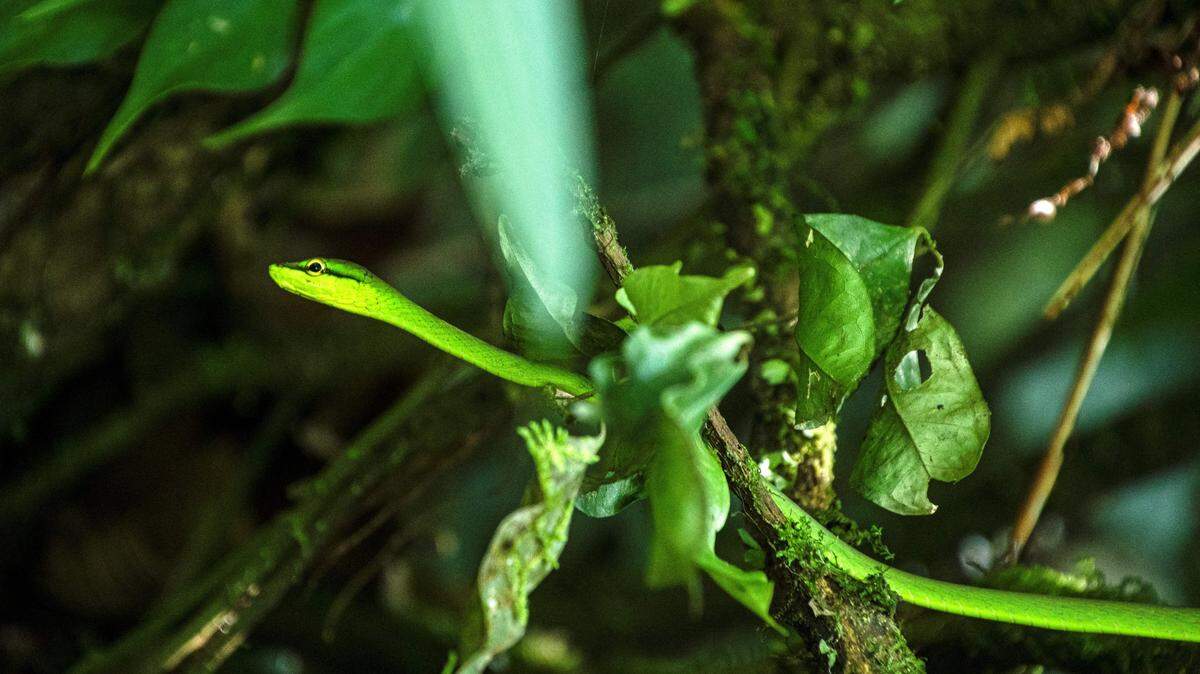
The creature’s most striking feature was its head and snout shape: triangular, tapering into what researchers describe as a “very long” snout that takes up approximately 18% of the total head length.
That proportion proved unusual enough to warrant deeper investigation.
Unable to determine how the snake had died, the scientists collected the specimen for analysis. Something about it didn’t match any known species in their reference materials.
DNA testing revealed an intriguing connection: genetic matches to a pair of snakes found almost 700 miles away. Follow-up surveys and detailed morphological analysis confirmed what the researchers suspected.
They had found something new.
The findings were published in September in the peer-reviewed Journal of Asia-Pacific Biodiversity, formally introducing Ahaetulla longirostris—the long-snouted vine snake—to science.
What Makes This Vine Snake Species Distinct?
The naming tells you what matters most about this snake.
Researchers named the snake from the Latin words “longus,” meaning “long,” and “rostrum,” meaning “snout.” That elongated rostral appendage is the defining characteristic that separates this species from its closest relatives.
Long-snouted vine snakes are considered medium-sized, reaching up to 4 feet in length.
The new species differs from related snakes in several ways, outside of its snout: its green or ochre-colored back, orange-brown belly, and moderately keeled vertebral dorsal scale row.
Researchers used a combination of snout shape, scale pattern, texture, coloring, and DNA analysis to confirm it as a distinct species.
Taxonomically, the long-snouted vine snake belongs to the A. fusca clade and is a sister species to A. laudankia.
Where Does the Long-Snouted Vine Snake Live?
The discovery location offers clues about this species’ habitat preferences.
Long-snouted vine snakes occupy both forests and what researchers call “human-dominated” areas—cities and villages where people live and work.
So far, specimens have been documented in Bihar and Meghalaya, two states in northeastern India near the borders with Bangladesh, Bhutan, and Nepal.
The research team suspects the species is more widespread than current records indicate, which often happens with newly described species. Limited surveying in a region means limited documentation.
The fact that the original specimen turned up on a village outskirts rather than deep in protected forest suggests these snakes may be more common in human-adjacent habitats than previously recognized.
Why Under-Surveyed Regions Matter for Science
This discovery highlights a pattern familiar to biodiversity researchers: some of the most biologically rich areas remain the least studied.
The researchers specifically chose to survey near Valmiki Tiger Reserve because its amphibians and reptiles were poorly documented.
That gap in scientific knowledge creates opportunities for exactly this kind of find. When scientists finally turn their attention to overlooked regions, new species often emerge from the data.
The research team behind this discovery included Zeeshan Mirza, Soham Pattekar, Sourabh Verma, Bryan Stuart, Jayaditya Purkayastha, Pratyush Mohapatra, and Harshil Patel.
For anyone tracking biodiversity discoveries, this find represents a familiar trajectory. A dead specimen, an unusual feature, years of analysis, and eventually a formal description in a peer-reviewed journal. The process is slow and methodical.
What remains unknown is how many other undocumented species occupy these under-surveyed corners of northeastern India. The long-snouted vine snake likely has neighbors that science hasn’t met yet.