
Scientists Just Found a ‘Spiny Dragon’ Dinosaur With Features Never Seen Before
Production of this article included the use of AI. It was reviewed and edited by a team of content specialists.
A juvenile dinosaur unearthed in northeastern China preserved something paleontologists have never encountered before.
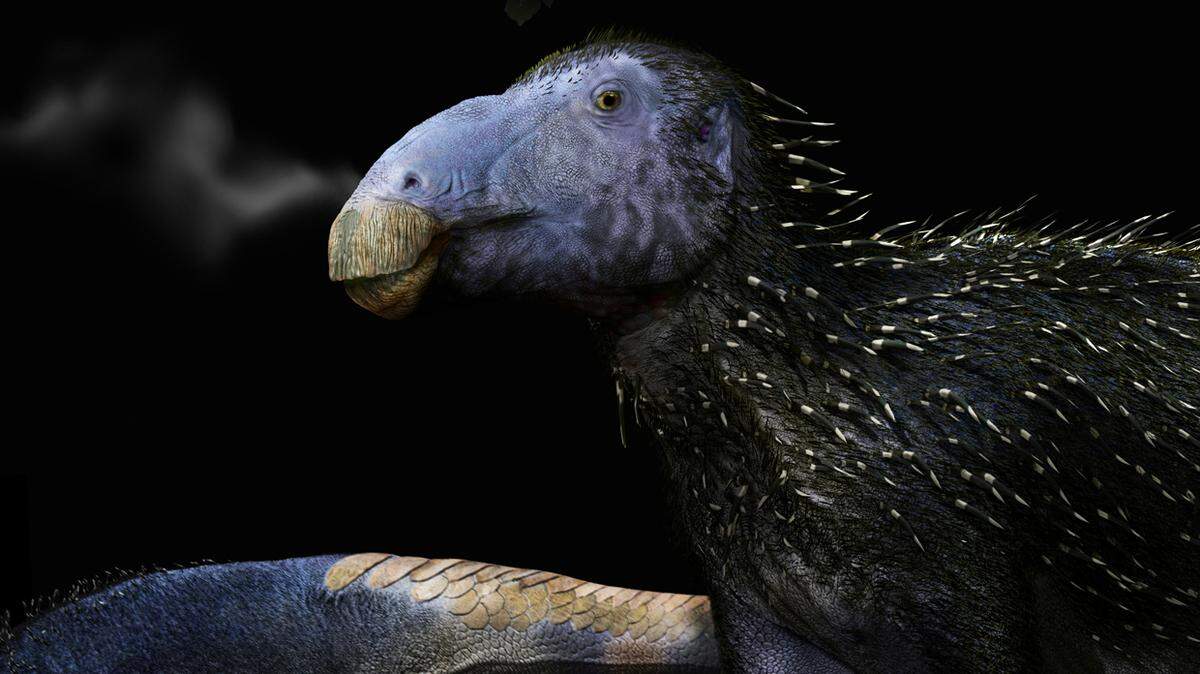
The hollow, cylindrical spikes scattered across its body were made of hardened skin and intact down to individual cell nuclei.
The find is rewriting assumptions about how diverse dinosaur body coverings actually were.
The new species, called Haolong dongi (“spiny dragon” in Chinese), was described in a study published in Nature Ecology & Evolution on Feb. 6.
The species name honors Dong Zhiming, an influential Chinese dinosaur expert who died in 2024.
The fossil dates to the Early Cretaceous period, roughly 125 million years ago, and was recovered from the Yixian Formation, a geological site in northeastern China already famous for yielding exceptionally preserved specimens.
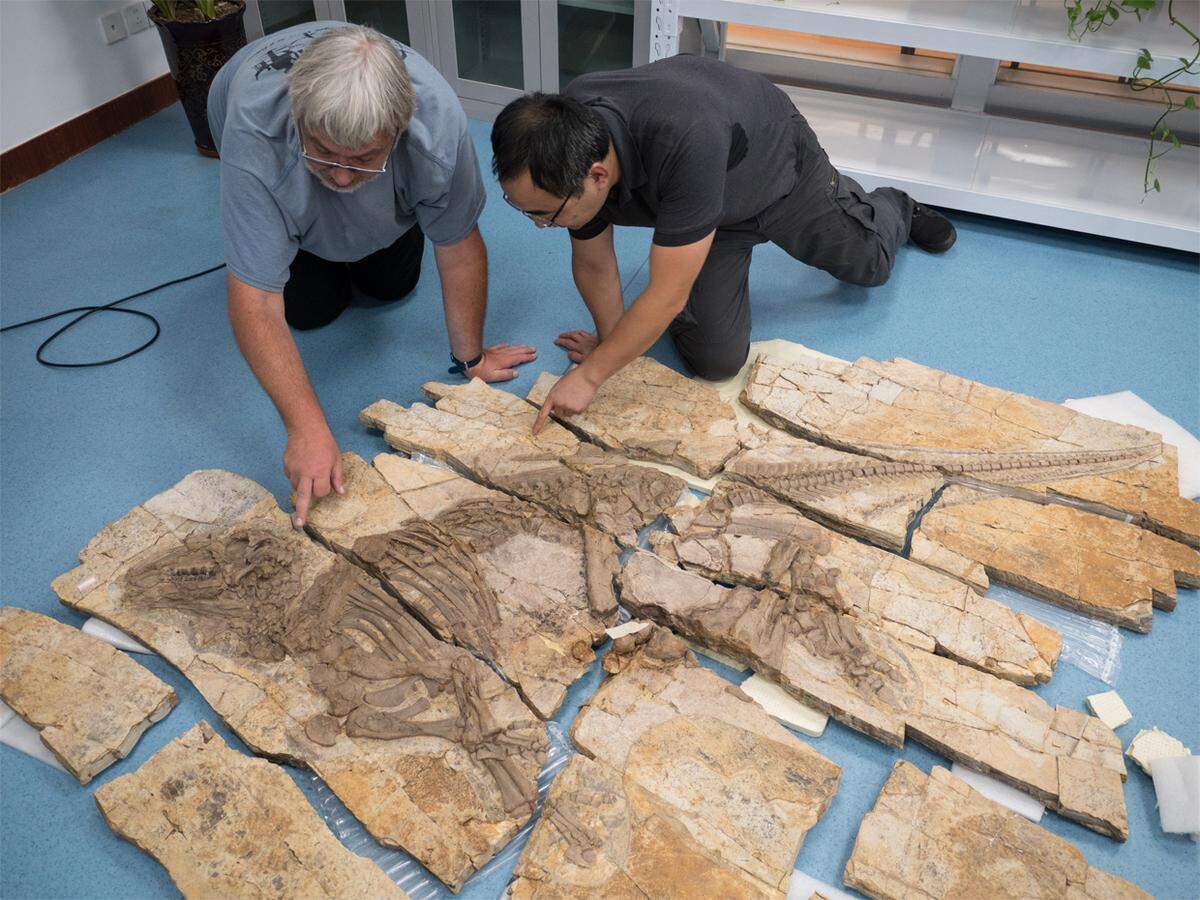
What makes this one different: researchers uncovered a nearly complete skeleton of a juvenile dinosaur measuring about 2.4–2.45 meters (around 8 feet) long, with soft tissue and skin still intact.
That level of preservation is rare for any dinosaur fossil. But the skin itself held the real surprise.
The Dinosaur Fossil Had Never-Before-Seen Features
Using advanced imaging and microscopic analysis, the research team cataloged a layered system of skin structures across the specimen.
Small scales covered much of the body. Large overlapping scales ran along the tail. And mixed among all of it were hollow, cylindrical spikes — structures unlike anything previously documented in non-avian dinosaurs.
Most of the spines measured just 2-3 millimeters (0.08-0.12 inches), easy to miss without close examination. But they were interspersed with longer ones. The longest preserved spike reached 44.2 millimeters (1.7 inches) long and 7.8 millimeters (0.3 inches) wide at the base.
These weren’t simple bumps or raised scales. The spikes were composed of multi-layered, hardened skin and were preserved to the cellular level, including keratinocyte nuclei.
That degree of microscopic detail in a 125-million-year-old fossil is exceptional and gave researchers an unusually clear window into the structures’ composition.
The spikes appear to have evolved independently. They are not related to feathers or to the spines found on modern reptiles, which makes them a genuinely novel structure in the fossil record.
What Purpose Did the Spikes Serve?
Haolong dongi was a herbivorous dinosaur belonging to the iguanodontia group, an important lineage of ornithopods.
Evolutionarily, iguanodontians sit between early small plant-eaters and the later duck-billed dinosaurs known as hadrosaurs. They were among the dominant herbivores during the Cretaceous period.
So what were the spikes for?
The researchers point to several possible functions: protection against predators (like a porcupine or hedgehog), possible thermoregulation and possibly sensory functions. Given that this juvenile lived in an ecosystem alongside small carnivorous dinosaurs, the defensive explanation carries particular weight.
“These defenses did not necessarily provide impenetrable protection against theropod teeth and claws, but they made the prey more difficult and time-consuming to kill and ingest and consequently reduced the likelihood of successful ingestion,” the authors wrote, per IFL Science.
Because the fossil belongs to a young individual, scientists don’t yet know whether adults of the species also carried these spikes.
Did they grow more pronounced with age? Disappear? Change function? Those questions remain open until adult specimens surface.
That gap is worth sitting with. A single juvenile fossil reshaped the understanding of an entire group of dinosaurs. If an adult Haolong dongi turns up with even more elaborate skin structures, the implications could stretch further.
Why This Discovery Matters Beyond Paleontology
This discovery shifts the picture of what dinosaur skin could look like and do. For decades, the conversation about dinosaur body coverings focused heavily on two categories: scales and feathers.
Haolong dongi introduces a structure that falls neatly into neither camp.
“This discovery provides unprecedented insight into the microanatomy of non-avian dinosaur skin and highlights the complexity of skin evolution in ornithischian dinosaurs,” the researchers concluded, per Sci News.
The broader takeaway: dinosaur body coverings were more varied than scientists previously thought.
The binary of “scaly or feathered” was already being questioned, but Haolong dongi provides concrete physical evidence of a third type of integumentary structure that evolved on its own path.
For anyone tracking how new fossil discoveries reshape long-held scientific models, this is one to watch.
A single well-preserved juvenile from a 125-million-year-old lakebed just added an entirely new category to the catalog of dinosaur body coverings. The next find from the Yixian Formation could push the story even further.