
Majority of Americans think aliens exist, and one pre-dawn walk made me consider the possibility
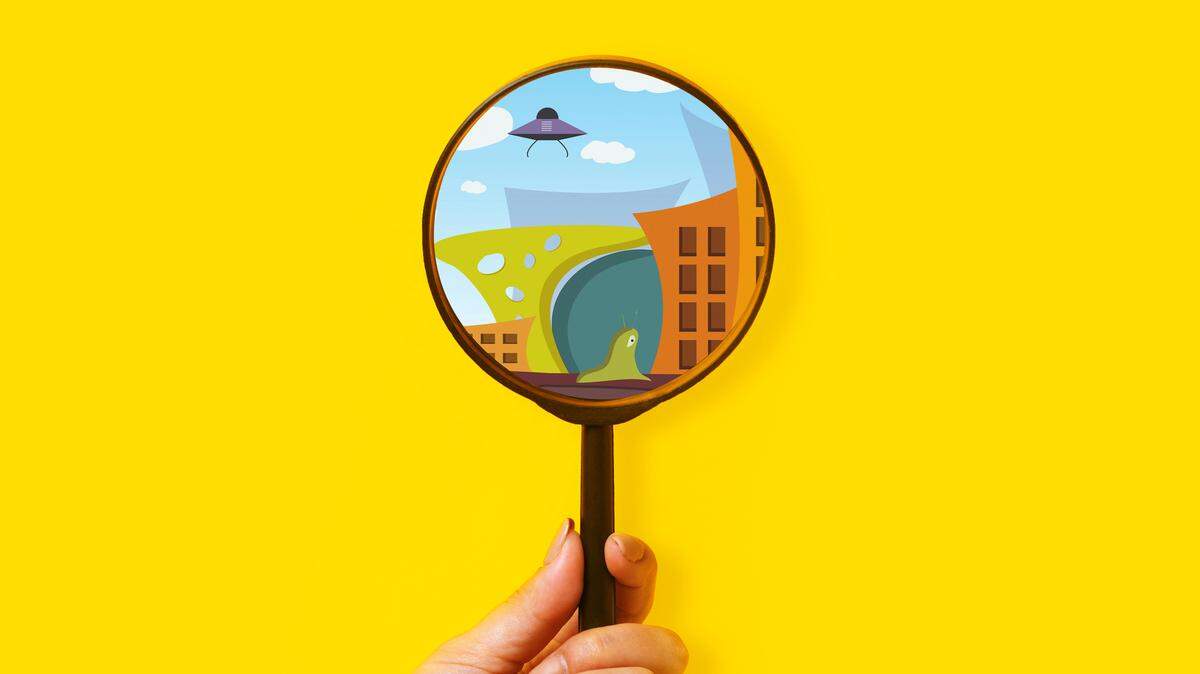
One of the benefits of pre-dawns walks — aside from the serenity of solitude — is the fauna you encounter along the way.
Raccoons. Owls. Possums. Foxes. And … UFOs.
Several years ago during one of those walks, I spotted an unidentified flying object in the starlit skies of my neighborhood. By the time I recovered enough to consider snapping a photo with my smartphone, the aircraft had disappeared. But I rushed home to tell The Hubby. He was not impressed.
A couple of days later I mentioned the sighting to a friend. He’s a scientist, even-keeled and not prone to hasty conclusions. I knew he wouldn’t tease me, and he didn’t. However, he provided perspective. That week, he explained, Homestead Air Reserve Base had been conducting some training flights.
He asked if I could have spotted one of those planes.
I reluctantly conceded this was possible, and just like that the mysterious turned to the logical. (I live about a dozen miles north of the base, a straight shot up the Florida Turnpike.) Nevertheless, I clung to the idea that I might’ve spotted a craft from an alien world — a hope I associate with my youthful fascination with “Star Trek.”
I had pretty much forgotten that sighting until a few weeks back, when the U.S. government released a nine-page preliminary report on UFOs. The researchers don’t call them UFOs, though, nor are they referred to as flying saucers. The proper term now is Unidentified Aerial Phenomena, or UAPs. Of course, the name doesn’t matter much, only the facts uncovered, if any.
In a nutshell: The report didn’t give explicit confirmation to the public sightings. But it didn’t dismiss them, either. Of the 144 examined sightings, 80 “involved observation with multiple sensors,” meaning people didn’t rely just on their eyes. Only one had an official explanation.
Oh, what to make of this! (Insert excited clapping here, followed by a concerned furrowing of the brow.)
Is there life in other parts of this vast universe? Are these life forms sending reconnaissance aircraft to study us? To spy on us? Can we communicate with them?
The report doesn’t do much to answer these questions, yet it’s notable on many fronts. It’s a clear sign of the growing interest in UFO/UAPs among both the scientific community and the public. And it’s also an acknowledgment that the feds have moved from outright dismissal to taking reported sightings more seriously.
Our interest in extraterrestrials isn’t new, of course. Neanderthals probably looked up at the heavens and wondered who and what was “out there.” Millennia later that same wondering has informed some of our most iconic cultural expressions. Think “E.T.” and “Star Wars.” Consider the current space race between billionaires Richard Branson and Jeff Bezos.
Now, that fascination has left the woo-woo dimension of science fiction and entered the realm of serious inquiry. That’s partly because the discovery of certain planets has led scientists to conclude there may be places beyond our Earth that can support life. Also, some seriously trustworthy people, namely U.S. military personnel, have reported unusual crafts swooping across our skies.
Truth is, many of us want to believe we’re not alone. A study by Pew Research Center, released before the government’s UFO paper, found that 65% of Americans think aliens exist. Separately, a June Gallup Poll revealed a whopping three-fourths of us say that “life of some form” lives elsewhere in the universe. Both percentages seem sizable in an age when even the most obvious facts are rabidly debated.
I saw something strange on my pre-dawn walk years ago — but what exactly? A new prototype of the F-15? A flying machine from another galaxy? My imagination running at full gallop?
I’ll likely never know for sure, but it’s fun to fantasize about the possibilities. I only wish I had waved in greeting.
Ana Veciana-Suarez writes about family and social issues. Email her at avecianasuarez@gmail.com or visit her website anavecianasuarez.com. Follow @AnaVeciana.