
A recovered ‘balsa’ is the center of an art exhibit in Miami’s Design District
A room at the Piero Atchugarry gallery in Miami’s Design District invokes the desperation of a balsero. Night falls and everything is black on all sides. The sea roars. There’s no chance of returning to Cuba, no sign of shore in the distance to offer hope. The viewer can feel their chest tighten.
An empty raft stands resilient on a platform as beams of light shine through holes made by bullets. What happened to the boat’s passengers, the balseros who took off from the coast of Cuba? Did they reach La Yuma, as Cubans call that promised land to the north, or did they die of thirst? Were they eaten by sharks, or did they get off in the Florida Keys, get picked up on the Seven Mile Bridge?
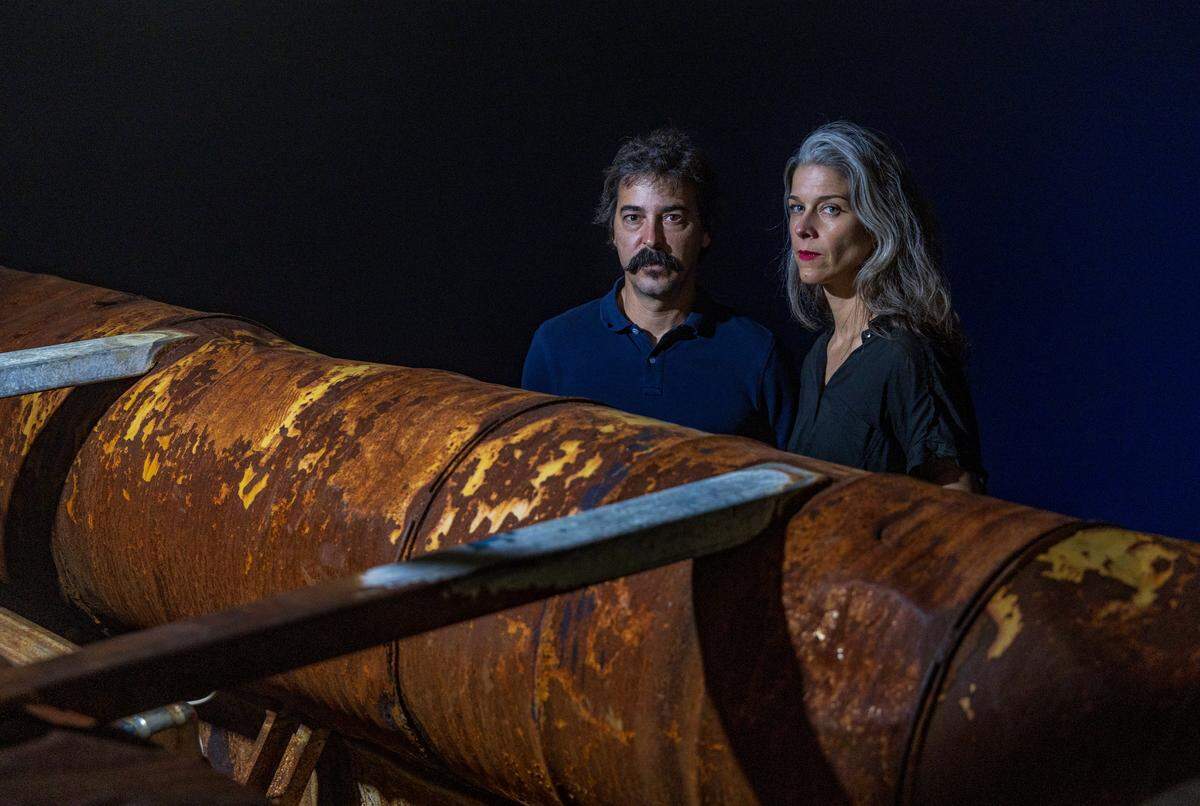
The installation by Cuban-American artists Antonia Wright and Rubén Millares in the exhibition “Exile” lets viewers imagine those scenarios, which can be hopeful and tragic. But the vessel is a real raft recovered from Florida’s shore.
“We don’t know what happened to these balseros; sometimes the Coast Guard rescues them, or maybe they arrived. That’s part of the sensitivity of the piece—you must maintain that respect, we don’t know what happened,” Millares says.
The goal of the balsero — which translates to rafter— is to reach the Florida coast. On the raft they eat canned food, ration water to avoid dying of thirst or being forced to drink their own urine, as some balseros have done. They keep swimming fins in case someone falls overboard, hoping they’ll never need them. No one wants to swim in that immense sea that has swallowed so many rafters since Cubans began emigrating after the arrival of Castroism in 1959.
A ‘monument to courage’
In 2022, Wright and Millares received a call from a friend who works at the Nature Center in Key Biscayne. A vessel that could have carried rafters had been abandoned on the shore of Crandon Beach.
The raft, built with metal barrels, had an engine from a 1942 Chevrolet, as durable as the repeatedly repaired engines of those “antique” cars still running in Havana. A drawing of a bee on the barrels and a sign that reads “Cuban honey” — in English — leads viewers to speculate that these rafters had some contact with Apicuba, Cuba’s beekeeping company. In fact, the company’s logo can be seen on the balsa, near some dramatic words: “S.O.S mami.”
“It’s a monument to the courage of people coming from Cuba, and of immigrants everywhere,” says Wright, whose family emigrated from Cuba to the United States in 1959.
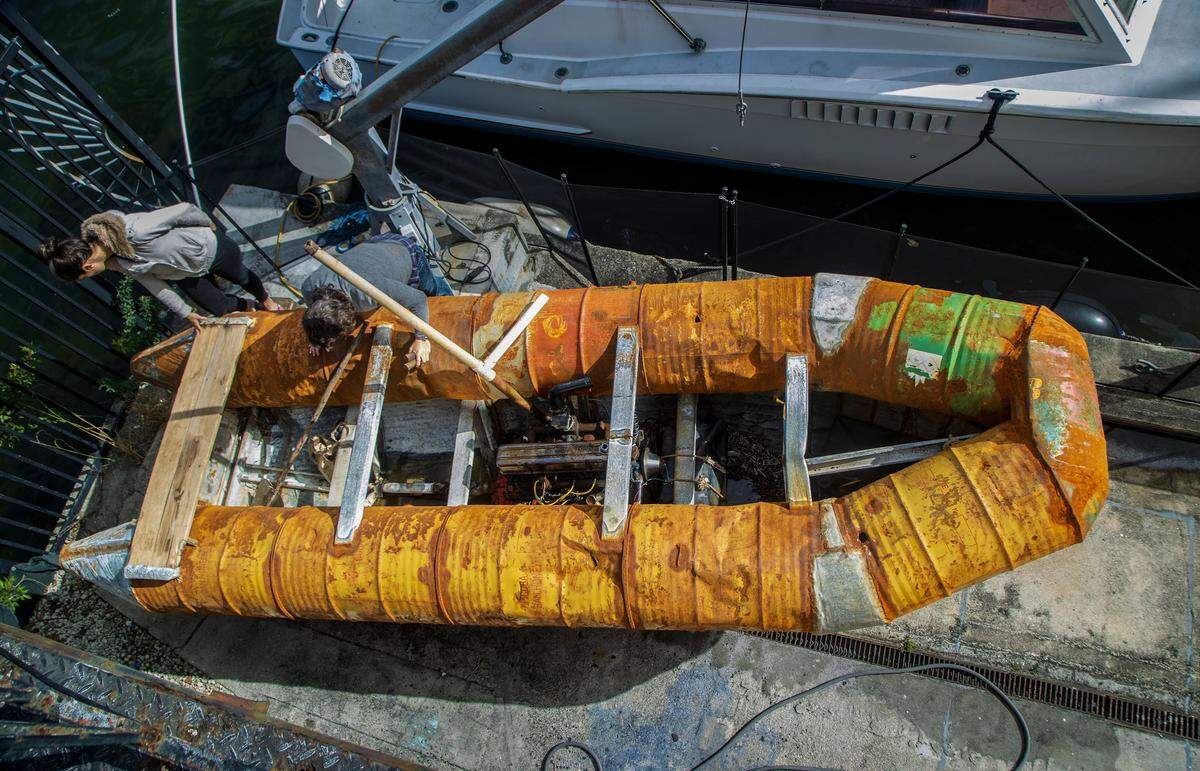
Wright notes that the raft is also an example of Cubans’ creativity when they want to escape.
Millares says “the boat speaks to you,” and is a work of art of the balseros’ conception. Millares and Wright only added a few interior spotlights to highlight several bullet holes, which point the fact that the Coast Guard often shoots at boats to sink them. They also added sound to create the sensation of being in the middle of the sea.
Both artists have created other installations about Cubans’ fight for their rights. After the massive protests in Cuba on July 11, 2021, Wright and Millares created an installation on downtown Miami benches with phrases in support of political prisoners and with a code to add phone credit to cell phones on the island, aiming to help Cubans organize and document what was happening.
They also created the installation Patria y vida (2022), named after the song that became the anthem of the July 11 protests. Metal barricades, like those used to contain crowds, were displayed at the Faena Hotel in Miami Beach as a symbol of any civic protest.
Clandestine rafts
Becoming a rafter has always been a clandestine undertaking in Cuba. You have to gather materials to build the raft in secret, or trust only someone very close. Getting a boat is very difficult unless you own a fishing boat, a luxury few ordinary Cubans have. Rafts are made from found materials, bits and pieces from here and there, with a lot of creativity, as Wright says.
In 1994 a mass exodus sent more than 35,000 Cubans off the island in precarious vessels. Devastated, demoralized and immersed in the economic crisis that followed the Período Especial when the Soviet subsidy ended, Cubans began taking to the sea in whatever vessels they could find or build. It was an exodus that Fidel Castro allowed. Suddenly the island’s shores, always guarded, opened for those who wanted to leave. It was a release valve that Castro once again opened when conditions became very difficult on the island, as he had with the Mariel exodus, by which more than 125,000 Cubans arrived in the United States between April and October 1980.
Journalists, photographers and artists who were able to document the exodus in Cuba remember rafts being carried to the shore on the shoulders of their future passengers. Other times the rafts were loaded onto any vehicle that could take them to the beach. There, those leaving and those staying shared what could be the last embrace.
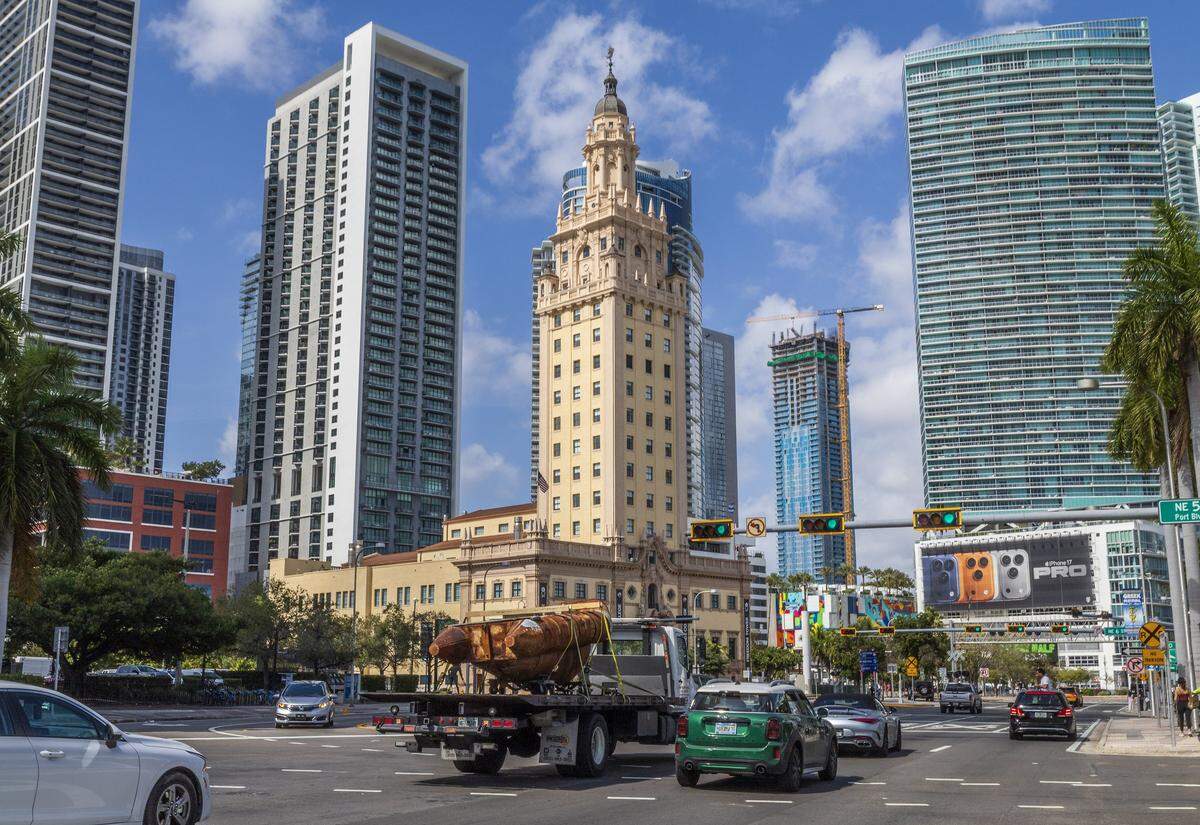
The raft recovered by Wright and Millares spent four years in the couple’s studio in Little River before making the journey by truck to the Piero Atchugarry gallery.
Balseros stop being welcome
After the 1994 exodus, rafters continued to reach Florida’s shores, though in smaller numbers. Their stories were heard on newscasts and in local papers. Some escaped in boats crafted from the inner tubes of car tires.
Another balsero, who was a surfer, escaped the island on a surfboard with a sail. Just before he thought he would drown from exhaustion before being rescued, he said on a Miami television program, he felt the presence of the Virgin of Charity of Cobre. The virgin had saved him, he recounted emotionally.
On another successful sea crossing the vehicle was a 1951 Chevrolet truck mounted on a floating platform. In 2003, it carried 12 Cubans who were rescued by the United States Coast Guard 14 miles from Isla Morada, one of the Florida Keys. The Coast Guard, as is customary, sank the miraculous truck. The balseros’ lives in the United States flourished, to the point that a few years later they told the BBC they were building a truck-boat like the one that brought them to Florida.
In 2017, the administration of President Barack Obama ended the “wet foot, dry foot” policy that since 1995 had allowed rafters who touched land to remain and qualify for the Cuban Adjustment Act and obtain residency in the United States.
From that point on, the exodus was no longer massive, but Cubans continued fleeing the island. The so-called “land balseros” emerged — those who crossed several Latin American countries — and sometimes the dangerous Darién Gap between Colombia and Panama — to cross the border between Mexico and the United States. Between 2021 and 2024, 850,000 Cubans arrived in the United States.
Balsero is a term sometimes used interchangeably to refer to any newly arrived Cuban and can carry a pejorative tone at times. It’s also someone who retains the mythical stature of a brave person, willing to risk their life for freedom.
“Imagine what it’s like to be sitting in a boat leaving your country, and to have the conviction of what lies ahead. The courage, the strength, everything that requires,” Wright said. “Especially now that immigrants are being vilified, we wanted to celebrate that courage.”
If you go:
What: Exile, an exhibition by Antonia Wright and Rubén Millares,
When: through May 2
Where: Piero Atchugarry Gallery, 5520 NE Fourth Ave., Miami
