
‘Miami Vice’ went off the air three decades ago. Here’s how it changed a city and TV
The last episode of “Miami Vice” aired on May 21, 1989. The show made its debut five years earlier on NBC.
And it changed everything.
It changed TV. It changed music. It changed nobodies into stars. It changed the way we viewed a city.
We unearthed two pieces on the show from Steve Sonsky. He was the Miami Herald’s TV writer at the time.
The first is a sneak preview at the pilot and what viewers can expect from the series. The second is an appreciation five years later.
Now, let’s travel back in time to the beginning and end of “Miami Vice” through the Miami Herald archives.
THE SNEAK PREVIEW
Published June 14, 1984
For better or worse, Miami is either going to influence, or be a footnote to, a little piece of television history.
For better or worse, there has never been a show on television quite like Miami Vice.
It is a show that is certain to be talked about. It is a show that contains flashes of brilliance with its cinematic and scoring innovation, but that, at times, can be disturbing in its brutality in the name of realism.
The two-hour pilot for the forthcoming cop show was screened by NBC Wednesday for the nation’s television critics meeting here. All 12 episodes of Miami Vice (a standard network fall season order), its producers say, will be filmed entirely on location in our toddling town.
How is it so different? Let us count the ways.
Using a very stylized film technique, some dazzling cinematography and the Miami backdrop, the pilot, shot here last spring, looks unlike anything currently on the air.
The show makes extensive use of contemporary rock and pop tunes as its score throughout. When the music comes on, the dialogue cuts out, and the imagery gets slicker — the idea is to practically drop a music video into the show in each case.
Bar scenes and car chases, in particular, focusing on the sleek lines of a black Ferarri and the white-lined Miami streets, are stunning.
The characterizations of the cops are meant for adults.
They have real adult problems and relationships, centering on hard-drinking Metro vice cop Sonny Crockett (played by Don Johnson), whose marriage and family life are a shambles, and recently relocated New York detective Ricardo Tubbs (played by Philip Michael Thomas).
And then there’s the sex and violence.
As befits the subject that the show’s title implies it explores, Miami Vice may be the most violent show, and may feature the most graphic depiction of that violence, on American television. And that distinction may not make our local chamber of commerce types very happy.
When people get shot, you see the bullet holes. When a car bomb explodes, you see the bodies fly.
By my count, the body toll was 10 by the end of the 100-minute pilot, and that doesn’t include the flashbacks. This is not a show for children.
Moreover, in one bar scene in a strip joint, there may be more bare female flesh than has been shown before on TV.
“I think it would be difficult to tackle the subject area we’re dealing with without showing what the cops have to deal with on the streets,” said Anthony Yerkovich, the creator and writer of Miami Vice. “I must have 200 pages of clippings from the Miami Herald, and it’s just a question of how graphic you want to make it. You want to have a look of realism that affects the audience. In this case, I think it’s justified. (Network censors) felt it was in context, and substantiated by the genre we were dealing with.”
As to how Miami comes off looking, I’d say pretty well, making a hopeful allowance that people in other cities who see this will be sophisticated enough to realize that normal, everyday life in Miami is not the same life led by a couple of vice cops.
As promised, Miami’s unique look gives the show a unique quality. The pilot has a tropical, almost Art Deco feel to it.
Miami becomes a city of dark nights, light skies and wide boulevards, made to look both gritty and exotic, a 1980s Casablanca -- as befits the show’s exploration into, after all, vice in Miami — principally the burgeoning drug trade, and police pursuit of it.
The show is colored like Miami, painted in pastels, and much of the city is seen, and seen prettily, throughout the show. Sonny Crockett lives on a sailboat at Miamarina with his pet watch-alligator, Elvis, who, like Captain Hook’s nemesis in Peter Pan, has swallowed a ticking clock. (Though sophisticated TV, it is still TV; even a show dedicated to a gritty realism needs its cutesies.)
The scenes over the opening credits could make a Tourism Department travelogue. Interspersed with a recurring shot of the surf (sort of a Miami Five-O kind of thing) we see, in rapid order, flamingos, jai-alai, the greyhounds, a line of Rolls- Royces, Brickell Avenue’s shiny glass towers, Biscayne Bay, the sunset, Miami Beach, sailboats, the Carlyle Hotel in the Art Deco district, the Hassidic Jews of South Beach, breakdancers as part of a vibrant street life, and, finally, the Port of Miami.
The show backs up its different look by marrying it to a different sound. That, in fact, is the whole idea. The show makes extensive use of a contemporary rock soundtrack, and when the music plays — be it the Rolling Stones’ Miss You over the opening scene in New York, or Cindy Lauper’s Girls Just Want to Have Fun set against the sun-bunnies at Haulover Beach — the dialogue cuts out, slow motion and stylized cinematography cut in.
NBC President Brandon Tartikoff explained Wednesday that he thought a straight music video format could never attract a broad enough audience in prime time, he said, “I do think you have to be cognizant that there is a whole generation of younger viewers who are not only watching these videos, but who have been spoiled by the (videos’ high) production values. “So we’re trying,” he said, “to incorporate these devices wherever possible, without destroying the integrity of the show.”
There are times in the Miami Vice pilot where the plot — basically one of the two cops tracking down a Colombian drug kingpin, with some mystery-like wrinkles thrown in along the way — seems muddled.
You wonder if, and fret that, Miami Vice may be a triumph of style over substance. If that proves to be the case — and it is very hard to tell from a single episode — then Miami Vice’s victory will be a short-lived one, and there will have been a terrible waste of talent and opportunity.
It is in a difficult time slot, Friday nights at 10. Tartikoff has implied that he doesn’t expect it to beat CBS’ hit soap Falcon Crest, but that it should be able to best ABC’s Matt Houston, which he called “a paper tiger ... that has really been getting audience by default.”
No one would ever call Matt Houston substantial. Let’s hope we can’t say the same of Miami Vice after it debuts in mid- September.
THE END
Published May 21, 1989
“We take like one-tenth of one percent of the objective reality of Miami and that’s what we render. What we capture is the spirit.”
— Miami Vice executive producer Michael Mann, after the first season. In the end, we find our best metaphor for Miami Vice in its very beginnings.
As the fresh images recede into the eternal loop of Rerunland, perhaps it is the question asked by a confused Crockett in the very first show that we need to be considering again. Maybe you still remember the scene from that September 1984 Sunday premiere, 107 adventures ago — a bookend to tonight’s denouement.
It was the most vivid image in a pilot movie full of stylish visuals, the beginnings of a show that would go on to change the way television looked — and the way Miami looked at itself — forever.
Betrayed by his partner, abandoned by his wife, Crockett was on his way to the final shoot-out with drug lord Calderon when he suddenly pitched the original black Ferrari to the side of the road. A ghostly phone booth glowed in the dark. The skyline was hazy in the distance. The car had kicked up a silvery dust. An ephemeral pink and blue neon sign hung in space over the phone booth. A still-life in celluloid.
Crockett was calling his wife Caroline. He needed to know, he told her, nearly pleading, needing an anchor . . . “It was real — wasn’t it?” he asked. “Yes it was,” she said. It was real — wasn’t it? It was far more real than we perceived it to be at first, back before Michael Mann’s .1 percent solution, his fictionalized essence-of-Miami, became the reality.
Wasn’t it an extraordinary thing to watch?
Art imitated a slice of life. Then life imitated the art. The slice became the whole loaf.
It happened because NBC wanted a TV show that “looked contemporary,” and Miami became the lucky beneficiary of innovation. For as it reinvented the look of television, Miami Vice reinvented the look of Miami, too, reinvented the way Miami was perceived by the world. And we in Miami liked what we saw. And began to replicate it.
Richard Brams, Vice’s co-executive producer who oversaw logistics in Miami, notes how in the early years they had to build sets for the indoor looks they wanted. Later, they were able to do more location-shooting as “Miami began trying to duplicate much of what we designed as discos, or entertainment places,” Brams says.
“We saw people designing their new establishments the way we had dressed our sets.” It wasn’t always that they had created the vision either, Brams points out. “It was here,” he says. “It was the real world of Miami imitating what was already here, but not in such volume. I mean, look at South Beach now. It’s not that they copied us. They responded to those things that we spotted and (put on film). They re-habbed and went back to the original look, the integrity of what was there in the beginning.”
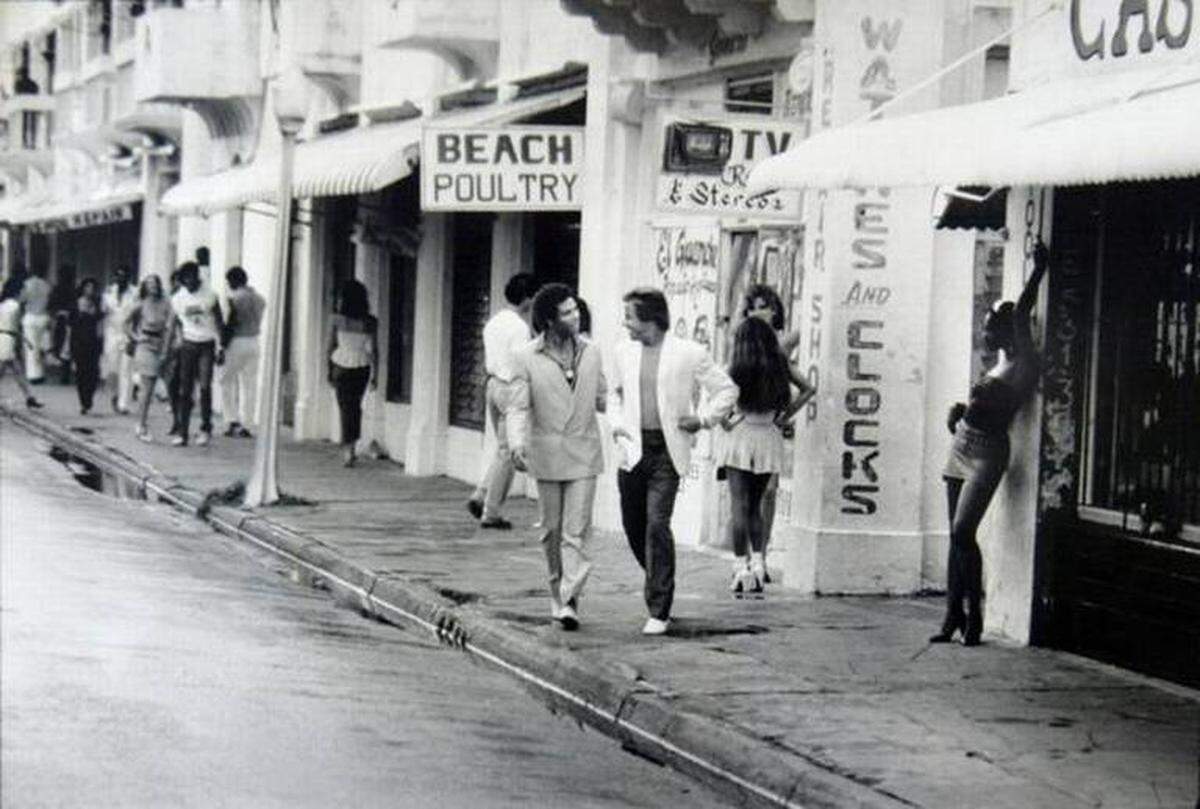
We knew the city was dangerous. We didn’t need Vice to tell us that. But we needed them to show us how we could be cool, and look exotic, as well. Mann had his crew shoot in a style he’d begun to perfect with his cult film Thief. No earth tones. Water down the streets. Slick and shiny. Quick-cut editing. Electronic score. (Tangerine Dream in Thief. Jan Hammer for Vice.)
It was a compressed reality, too — from Arquitectonica’s Pink House in Miami Shores, to the steel and glass towers of Brickell, to a post-modernist dreamhouse on Indian Creek island, to SoBe. (Which in ‘84 was merely South Beach — where folks feared to tread. Nightclubs? Restaurants? You’re dreamin’, pal.) The car-chase in-an-instant was an hour-commute in real life. Mann took the one-tenth kernel of Art Deco/post-modernist truth, and edited it to make it seem the whole burgh looked this way. Eventually, more of it did.
Miami Vice reinvented Miami in the eyes of the world — that was not surprising. TV does that. What was unusual was how Miami then bought into the vision — how a city re-invented itself in the stylized, glamorized image that a TV show had of it.
.JPG "0408301924 (1).JPG")
Vice’s beginnings were humble.
It was the vision first of Anthony Yerkovich, an Emmy-award winner for his writing on Hill Street Blues. Yerkovich had been fascinated by a newspaper clipping reporting that one-third of all the unreported income in the United States either originated in, or was channeled through, South Florida. Guess why. Even while working on Hill Street, he began to accumulate more information about “the drugs, the life style, the immigration influx.”
He began to formulate his own variation of the Miami-as-Casablanca theme, Miami as the epicenter of the drug holocaust. “A sort of Barbary Coast of free enterprise gone berserk,” he once called it.
He pitched the Miami idea as a two-hour series pilot to NBC President Brandon Tartikoff. Tartikoff had an idea of his own, scribbled on a piece of note paper. “MTV Cops,” he had written — a notion of how to give a new twist to an old network standard: Integrate what were essentially music videos into the context of a drama show.
There would be a separate budget of $10,000 an episode to buy the rights to actual tunes — unprecedented for TV. The ideas were merged. A few months of writing and research later — traveling around Miami with undercover cops and dopers — a script by Yerkovich called Gold Coast, later retitled Miami Vice, was born. It’s hard to think back now to all the local hubbub preceding that initial show. In the wake of the Scarface fiasco, local xenophobes were again up in arms over a film project whose violence, they feared, would further reinforce Miami’s image problems.
The county suggested it wanted script-approval powers if it was to cooperate; at the very least, couldn’t they take Vice out of the title? No and no, said Universal, and if the county didn’t want to cooperate, the studio would simply do the show in L.A. They cooperated.
As the show kicked off, much of the early criticism about storylines — beyond the ubiquitous complaints about muddled plotting and style over substance — was directed toward the drug-crime emphasis and crooked cops.
Unrealistic! Overstated! cried the critics. Why is the show about drugs and police corruption every week?
In this era where the phrase “national drug epidemic” is part of the lexicon, it’s easy to forget that just five years ago, this sensibility had not yet matured. Vice was prophetic in yet another way: in Yerkovich’s and Mann’s recognition that drugs were so pervasive, and not just in Miami, but nationally.
That it was where the bulk of vice resources were increasingly being targeted. In the midst of the criticism, Mann was buoyed, he once recounted, by something several real-life Miami vice squadders had told him: “You guys,” they said, “haven’t scratched the surface of what’s actually going on down here.”
By 1986, Miami Police Chief Clarence Dickson was saying that 10 percent of his force was corrupt.
Ratings struggle In that first year, Vice was struggling in the ratings. The turning point was a New York Times piece on Jan. 3, 1985.
“The most talked about dramatic series in the television industry since Hill Street Blues,” the Times gushed. Newsweek followed, then a Rolling Stone cover, then this from New York Magazine, with John Leonard carrying on about “Miami . . . A dream city . . . Seen through filters of psychedelic lollipop, dissolved in montage, piled under by superimpositions of the ghostly and the slick, angled at from stars and sewers —a surreal sandwiching of abstract art and broken mirrors and picture postcards . . . There is no murder; there is only art.”
The public’s curiosity was piqued. The show ended that first season ranked 47th but during summer reruns, it moved into the top 10 — and stayed there through season two, which began with another media blitz: the covers of People, Us, TV Guide, Rolling Stone again, even Time. Thomas and especially Johnson, just a year earlier journeymen actors who graciously allowed themselves to be dumped in vats of chocolate for a local charity function, were now national icons.
A relative snubbing by the Emmys — just four awards from 15 nominations (the only Emmys Vice would ever receive), for art direction, editing, cinematography and to Edward James Olmos for best supporting actor — hardly slowed the rush. Nor did, at first, a succession of indecipherable scripts.
There were parades. Department store chains featured Miami Vice fashion sections. Anyone wearing socks was uncool. Crockett-like stubble was all the rage. The stars’ every move was chronicled in the tabloids — sordid tales of Johnson’s romance with a teen model, of Thomas’ several illegitimate children. Johnson and Thomas were invited to a state dinner at the White House.
“A couple of cops from the most talked-about show on television stormed the White House Tuesday night, nearly upstaging a president and a prime minister,” the Washington Post wrote. The tragedy of Miami Vice, from a creative sense, was that the height of its popularity was never in sync with its best work. It was the ninth most popular show on TV its chaotic second year but in its superior year three, following Don Johnson’s celebrated contract holdout, after NBC committed the strategical blunder of moving it to 9 p.m. to blunt Dallas, it dropped to 16th.
A new white Ferrari, and darker duds for the boys were no match for Dallas’ stratagem of bringing Bobby Ewing back from the dead. There were occasional sparks, but the script quality was never consistent and the public grew further disenchanted. Attempts to develop Crockett and Tubbs as fuller characters seemed like afterthoughts — as did co-stars Saundra Santiago, Olivia Brown and Michael Talbott, whose roles as Gina, Trudy and Switek grew more limited each year. Only Olmos’ Lt. Castillo, a stark triumph of black-garbed minimalism in a sea of cinematic overstatement, was able to escape Johnson’s shadow.
The series never got the credit it was due for some of the timely, politically inspired tales it spun.
One example: The chilling show in October of ‘86 with convicted Watergater G. Gordon Liddy playing a retired right-wing renegade general illegally recruiting American mercenaries to fight alongside the Contras in Nicaragua; it aired a week before Eugene Hasenfus’ plane was shot down.
But those occasional brilliant episodes were lost among the too-frequent missteps.
A parade of big-name guest stars didn’t help. In season four, despite another flurry of publicity over Crockett’s marriage to a character played by singer Sheena Easton, ratings continued to erode. Down to number 44 among network shows. The cliffhanger fourth season ending — Crockett getting amnesia and thinking he was his drug dealer alter ego, Sonny Burnett — did nothing to stem the tide.
Early this season, Mann announced that year five would be Vice’s last. Even Johnson’s uncanny knack for staying on magazine covers — in the fall it was the romance with Barbra Streisand; in the spring it was the reconciliation with former wife Melanie Griffith — didn’t help. Vice’s average rank this year was 65th — NBC’s lowest-rated full-order series.
After the big event “finale” airs tonight, NBC actually still has four more new episodes it’s quietly looking to shoehorn somewhere in the schedule.
So Vice, no matter its reception tonight, is assured of dying not with a bang -- which would have been appropriate — but with a ratings whimper.
So in the end, what will we remember Miami Vice for? In the television world, it’s credited with irrevocably upgrading the quality of TV-filmmaking. It showed that TV viewers do appreciate superior imagery — as well as superior sound. Pop soundtracks, from The Wonder Years, to China Beach, to Tour of Duty to Wiseguy are now de rigeur. It leaves behind a $20-million gap in the local economy — the estimated money it spent here each season.
But it also leaves behind a movie-making infrastructure, and a local corps of expert film professionals, that didn’t exist when it first blew into town. Moreover, as Vice continues to be syndicated abroad — it’s now shown in 136 countries, from Abu Dhabi to Zimbabwe — more foreign filmmakers are drawn here.
Which brings us to the final, big question about Miami Vice’s legacy: As its immediacy recedes, will it be remembered more for the Miami, or more for the Vice in it? Bob Dickinson, treasurer of the Greater Miami Convention and Visitors Bureau, is bullish on the after-shock. Tourism, as measured by resort tax collection, has been up every year since Vice began.
The jury’s already in, he argues.
The cachet Vice has lent the town far overshadows any reinforcement it gave to our shoot-em-up image.
But Mike Collins, vice president of marketing for the tourism bureau, disagrees.
“The steady stream of stories involving drugs and violence have a kind of cumulative effect (after the) beauty of the scenery fades away,” he theorizes.
Maybe the larger issue: Was it real, Crockett asked?
Now that the show is gone, will the Miami panache fade, too, like an illusion? Will the new facades on the old buildings crumble?
Will the SoBe clubs wither and die? With the cameras off, who will define us? Do we cease to be cool when TV stops watching?
Now, the next step in Miami’s evolution: Now, we just have to dress ourselves.
Goodbye, Miami Vice.
And thanks.
Thanks for the memories.
Thanks for lending the vision. In the end, it has been real.
For in this town, you were more than just a TV show. You were life.
This story was originally published April 29, 2019 at 6:30 AM with the headline "‘Miami Vice’ went off the air three decades ago. Here’s how it changed a city and TV."