
Why Some Miami Men Are Considering Turkish Hair Transplant Techniques Without Flying to Istanbul
For years, the path to hair transplant care ran through one city: Istanbul. Turkey has become widely associated with hair restoration, attracting many international patients each year with a combination of providers, procedure volume, and pricing that is often lower than in the United States and Europe.
Some Miami residents also considered this option. Many booked the long flight, arranged a hotel, and spent a week recovering abroad just to access techniques that were difficult to find at home.
That calculation is starting to change.
A growing number of Miami men are now getting similar Turkish-developed techniques much closer to home, and the reasons go beyond convenience.
Why Turkey became associated with hair restoration
Turkey’s role in hair restoration grew over time as clinics performed a high volume of procedures and helped popularize techniques that are now used in many markets. Follicular Unit Extraction, better known as FUE, became the foundation. Variations such as Sapphire FUE followed, and more recently, some clinics have incorporated exosome-assisted approaches as part of the recovery and post-procedure care process.
For many patients, travel remained a key consideration. A hair transplant may be a same-day procedure, but the planning, follow-up, and recovery are not. Flying thousands of miles for an elective medical procedure means taking time off work, covering the cost of international travel, and managing aftercare from another continent.
For some patients, that was a reasonable compromise. For many in Miami, it could be a significant obstacle when considering the procedure.
Bringing the technique to the patient
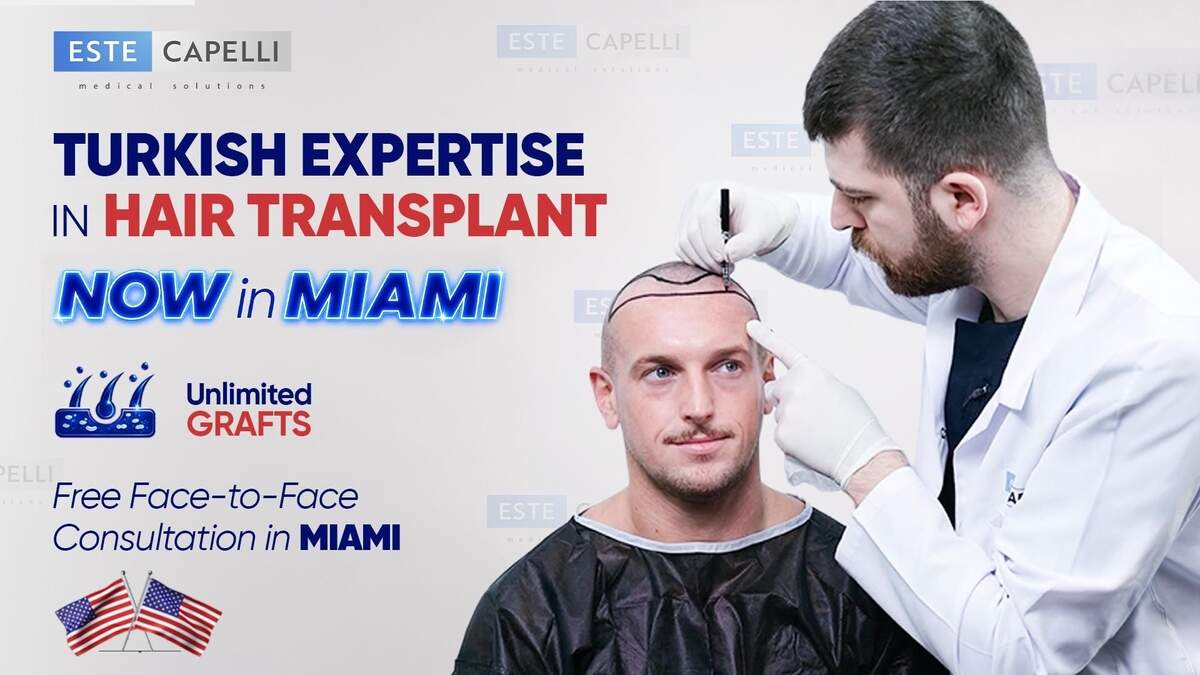
The shift now underway is straightforward. Instead of sending Miami patients to Istanbul, the Istanbul approach is being delivered in Miami. Clinics with Turkish surgical training and roots in the Turkish hair-restoration tradition have opened in the U.S. market. They offer similar Turkish-developed techniques, including FUE, Sapphire FUE, and exosome-assisted FUE, without the international flight.
One example is Estecapelli Miami, a clinic that carries its Istanbul background into the U.S. market. Its surgeons apply the Turkish techniques they trained on to patients who would rather stay in Florida than fly abroad for treatment.
For many patients, the appeal is practical. Consultations, the procedure itself, and just as importantly, the follow-up visits, all happen locally. There is no recovery in a hotel room overseas, no managing complications by email, and no second international trip if a check-in is needed. Techniques that some patients once traveled abroad for are now available closer to home.
The pricing question and why flat-rate matters
Pricing transparency is often an important factor. More specifically, it is the difference between flat-rate and per-graft pricing.
Many hair transplant clinics price by the graft. On the surface, that sounds fair because you pay for what you get. In practice, per-graft pricing is where surprises tend to live. The final number depends entirely on the graft count, and that count is determined during the procedure. A quote that looked reasonable can climb well past the original estimate once the surgeon decides more grafts are needed. Patients often do not learn the true total until the work is already underway. Two patients who were quoted the same starting price can walk out having paid very different amounts.
A flat-rate model works the other way around. The patient agrees to one price for the procedure regardless of how the graft count lands on the day. There is no meter running during surgery and no incentive to inflate the number of grafts to raise the bill. What you are quoted is what you pay.
This is one area where Estecapelli Miami differentiates itself in the local market. Its pricing is flat-rate, a single predictable cost for the procedure, rather than the per-graft billing used by most clinics. For patients, that may reduce one stressful part of the decision: the fear of an open-ended bill. The price is set before anyone enters the operating room and it does not move.
It may be a meaningful consideration in a category where cost uncertainty is one of the biggest reasons people delay treatment. When the comparison is between a per-graft quote that could expand and a fixed number that will not, the flat-rate option is simply easier to plan around.
What Miami patients should keep in mind
A hair transplant is still elective surgery, and the basics of doing homework apply. Patients should ask who is performing the procedure and what their training is. They should understand exactly which technique is being recommended for their pattern of hair loss. Above all, they should get the full cost in writing before agreeing to anything. Patients may want to prioritize clinics that clearly provide the full cost up front.
The broader shift is that Miami patients may have more options than they once did. For some, that means access to similar techniques closer to home, without automatically weighing local care against traveling abroad. The Turkish approach to hair restoration is increasingly available in Miami itself, and for a lot of men, that changes the math entirely. Clinics like Estecapelli are an example of where the market could be heading.
This article is for informational purposes only and does not substitute for professional medical advice. If you are seeking medical advice, diagnosis or treatment, please consult a medical professional or healthcare provider.
Members of the editorial and news staff of miamiherald.com were not involved with the creation of this content. All contributor content is reviewed by miamiherald.com staff.