A “good” GMAT score isn’t the same as it was just a year or two ago. The Graduate Management Admission Council (GMAC) has shortened the exam to 2 hours and 15 minutes, removed the essay section, and restructured the scoring scale from 200–800 to 205–805. These changes have shifted not just how the test is taken but also how business schools perceive scores and how much time you should spend studying before registration.
So, what is a good GMAT test score?
In this article, we’ll explore what constitutes a good GMAT score, the average GMAT score, and strategies to excel in the Graduate Management Admission Test.
Key Takeaways
- Scores above 655 are considered top-tier: A 655+ places you around the 88th percentile, making you competitive for top business schools.
- The Data Insights section now counts toward your Total Score: Unlike the old GMAT, Data Insights is weighted equally with Quantitative Reasoning and Verbal Reasoning, so data literacy is more critical than ever.
- You can revise up to 3 answers per section: This built-in review feature adds a new strategic layer to the test—use it to boost accuracy without rushing.
- Retakes are more flexible: You can retake the GMAT Focus every 16 days (up to 5 times a year), and schools will usually consider your highest score.
- Percentiles have shifted. Know your target: Because of the new scoring scale, a score that looks “lower” numerically may place you in a higher percentile. Always compare your score using updated GMAT Focus percentile charts.
GMAT Exam Score Ranges: What They Mean
The GMAT Focus Edition has a new total score range of 205 to 805, increasing in 10-point increments. While it still reflects overall performance across the Quantitative Reasoning, Verbal Reasoning, and Data Insights sections, the midpoint is no longer 500; it’s now around 555. That shifts how we interpret “good” versus “great” scores.
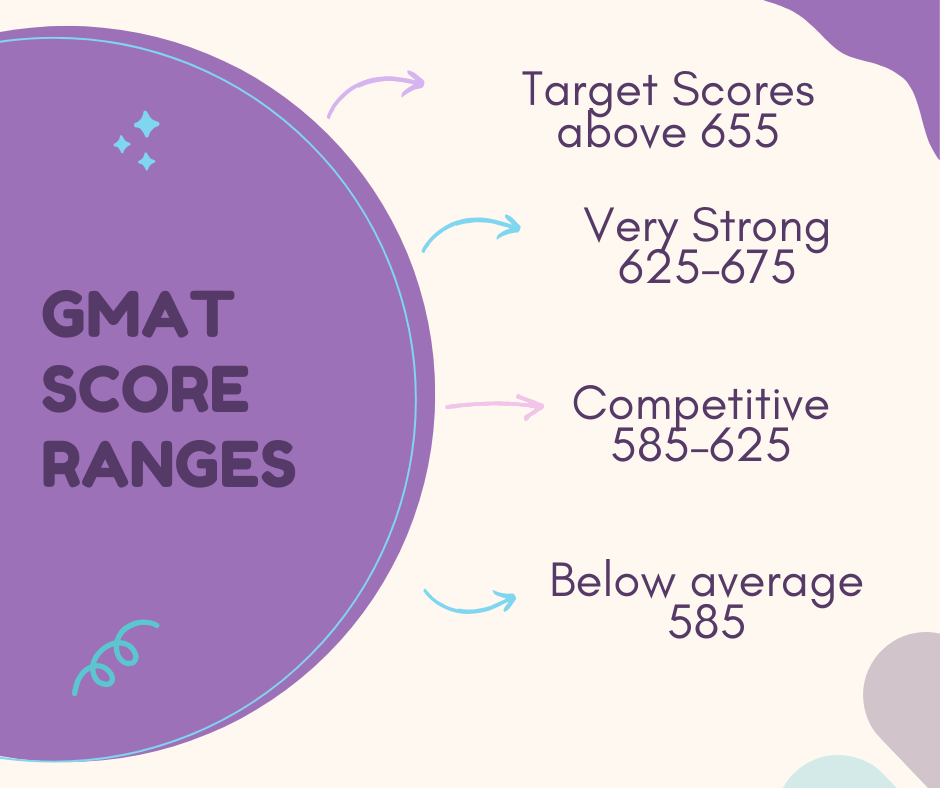
Here’s a general breakdown of how scores translate:
- Above 675 – Excellent: This places you in approximately the top 10% of test takers and is highly competitive for top-tier MBA programs like Stanford, Wharton, or Harvard.
- 625–675 – Very Strong: Solidly above average. Applicants in this range are competitive at many top 25 MBA programs.
- 585–625 – Competitive: This test taker’s score band reflects the 50th to 75th percentile and is acceptable at a broad range of reputable schools, especially when paired with strong work experience or academics.
- Below 585 – Below average: These scores may be limited at selective schools unless supported by an outstanding application. Some schools may recommend retaking the exam to demonstrate stronger academic readiness.
Data Analysis Now Matters More
One of the most important changes in the new GMAT is the increased emphasis on data interpretation and logic-based reasoning. The Data Insights section, replacing the old Integrated Reasoning, now contributes equally to your total GMAT score, alongside Quantitative Reasoning and Verbal Reasoning.
Unlike before, where this section had little impact on your final score, Data Insights scores now carry real weight, making it essential to build skills that blend numerical analysis, reading comprehension, and critical thinking.
Expect to see charts, multi-source tables, complex graphs, and logic puzzles that test not only your ability to extract information but also your efficiency in doing so under time pressure. This shift means your GMAT preparation strategy should include more than just math drills.
Tips to Improve Your Data Insights Score
- Practice interpreting real-world data: Use articles, reports, or infographics to practice identifying key trends and conclusions from dense visuals.
- Master two-part analysis questions: These are common in the Data Insights section and require evaluating how two variables affect each other under changing conditions.
- Sharpen logic and reasoning: Try logic games or LSAT-style reasoning problems to build your analytical thinking and strengthen non-math problem-solving.
- Get comfortable with visual formats: Spend time with tables, charts, and graphs. Learn to quickly extract only the information needed to answer the question.
- Use official GMAT practice tools: Many GMAT test takers overlook this, but the Graduate Management Admission Council (GMAC) offers tools that mirror the actual test format and question types in this section.
- Improve pacing: The section allows you to review up to three answers before submission, but don’t rely too heavily on this feature. Build accuracy without sacrificing speed.
By prioritizing data literacy in your GMAT study prep, you can boost your Data Insights performance and improve your overall GMAT score, making you more competitive at top business schools.
How Schools View GMAT Scores Now
Most business schools still care about your GMAT score, even with some MBA programs adopting test-optional admissions. However, how admissions committees interpret official GMAT scores has evolved with the latest GMAT Focus Edition updates.
For example, top programs aren’t just looking at your total GMAT score; they’re also breaking down section scores, especially in Quantitative Reasoning and Data Insights scores. These components demonstrate your ability to interpret data, solve quantitative problems, and apply logical reasoning skills that signal readiness for the rigors of graduate management admission coursework.
The good news? The new format introduces more flexibility for GMAT test takers. You can now review and revise up to three answers per section before submitting, which can positively impact your final score by boosting both accuracy and pacing. This added control can help you feel more confident on test day.
What Real People Say
Insights from other GMAT test takers on Reddit highlight that a GMAT score in the 645–655 range is often sufficient for admission to top business schools. Here are some perspectives:
A few of the users claimed:
“645 – 655 is sort of the minimum benchmark GMAT score for top schools, about the equivalent of 700 on the classic GMAT. T15 schools’ averages are typically higher than 655, though. So, 665 – 675 makes more sense in many cases, and for Stanford 685. If you are in an overrepresented group, 685+ is safer.”
Reddit User
“I think 655 as a floor is good, although I would shoot for around 675 to be safe.”
Reddit User
“I literally just worked with a student who scored 665 and got into both HEC Paris and INSEAD – with scholarships, and that too in the last Round (Fall ’25 intake)
Reddit User.
These firsthand accounts suggest that while higher scores can enhance your application, a score in the mid-600s range, coupled with a strong overall profile, can be competitive for top programs.
Should You Retake the GMAT?
If your score falls below 585 on your official score report, it may be worth another attempt, especially now that you can change answers within each section and retake the exam every 16 calendar days (up to five times per year).
Retaking the GMAT makes sense if:
- You consistently performed better on practice tests than your GMAT total score reflects.
- You didn’t finish one or more sections due to timing.
- Your target schools have average scores significantly higher than what you earned.
- You plan to use a good GMAT study course to raise your low GMAT score
Remember: with each retake, schools will generally only consider your highest GMAT score, not your full testing history.
Final Thoughts
A good GMAT score helps your application stand out without overshadowing the rest of your profile. If your score shows you’re capable of handling quant-heavy work, analyzing data, and managing time well, you’re already in a strong position.
Ultimately, a great score is less about hitting a magic number and more about aligning with the expectations of your target programs. Know what they’re looking for, and let that guide your GMAT preparation.
FAQs
A score of 645–705 is solid, with 675+ considered competitive for top MBA programs.
It ranges from 205–805, based on your performance in Quant, Verbal, and Data Insights.
Yes, it carries equal weight with Quantitative and Verbal Reasoning.
Yes, you can revise up to 3 answers per section before submitting.
Yes, especially if you scored below 585 or underperformed vs. your practice tests.