23%.
That is approximately how much of the U.S. population is bilingual, according to America the Bilingual.
Rocket Languages promises more than vocabulary drills. Its courses combine full conversations, pronunciation practice, grammar, culture, writing, and review tools. But does all of that actually help you learn the language?
I tested multiple course levels, audio lessons, role-playing, quizzes, flashcards, writing exercises, and progress tools to see whether Rocket actually builds usable language skills or just keeps you busy. Here is what helped and where the course started to lose me.
Could Rocket Languages Actually Work for You?
- Want full conversations instead of random words?
The audio lessons teach vocabulary inside everyday situations. - Need a clear course order?
Levels and modules already show you what comes next. - Want reading, writing, listening, and speaking together?
Most lessons include several ways to practice the same material. - Looking for live tutoring or classes?
Rocket does not include regular lessons with a live instructor. - Want completely open-ended conversations?
The role-playing activities follow prepared lesson scripts. - Planning to learn several languages under one membership?
Rocket sells its language courses separately instead of including everything together.
What Studying With Rocket Languages Was Actually Like

Rocket Languages is not the kind of app that drops you into a five-minute game and calls it a lesson. The course is built around longer audio sessions, followed by separate activities that make you listen, speak, write, remember vocabulary, and check what you understood.
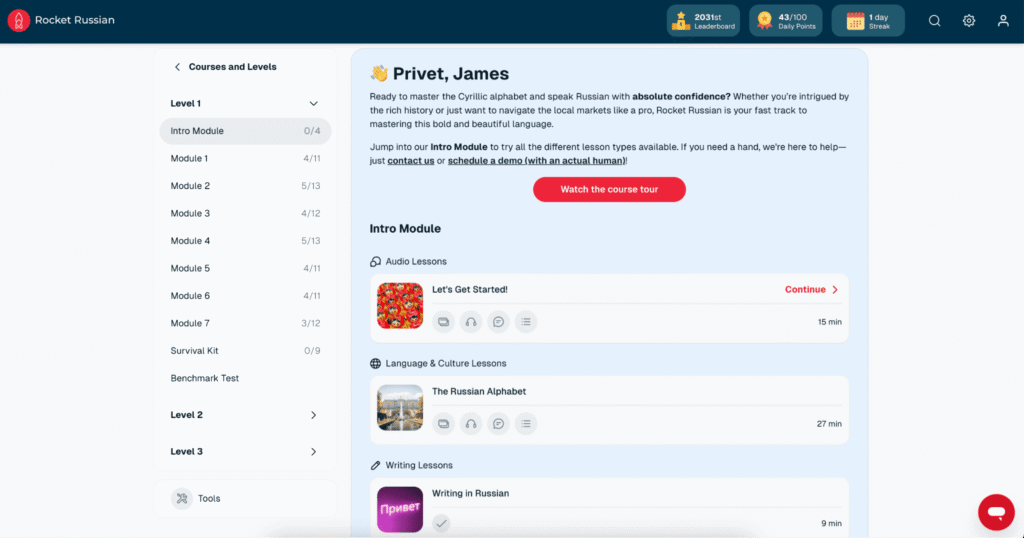
I could see lesson times before opening anything, move between course levels, and use the Benchmark Test when I wanted a better idea of where I stood. There was also a course tour, search tool, favorites, forum, certification test, and a Survival Kit for practical phrases.
What surprised me was how much work sat behind one lesson. That can feel heavy when I only have ten minutes, but it also means I am not paying for a thin app made mostly of streaks and word matching. Rocket gives me an actual course to work through.
Rocket Languages Package Options
| Feature | Level 1 | Levels 1 & 2 | Levels 1, 2 & 3 |
|---|---|---|---|
| Lifetime course access | ✅ | ✅ | ✅ |
| Interactive audio lessons | ✅ | ✅ | ✅ |
| Language and culture lessons | ✅ | ✅ | ✅ |
| Speaking and pronunciation practice | ✅ | ✅ | ✅ |
| Flashcards and review tools | ✅ | ✅ | ✅ |
| Progress tracking | ✅ | ✅ | ✅ |
| Beginner material | ✅ | ✅ | ✅ |
| Intermediate material | ❌ | ✅ | ✅ |
| Advanced material | ❌ | ❌ | ✅ |
| Price | $149.95 | $299.90 | $449.85 |
| Get Started | GET LEVEL 1 | GET LEVELS 1 & 2 | GET ALL LEVELS |
Note: Package availability and price can change by language.
Features That Stood Out
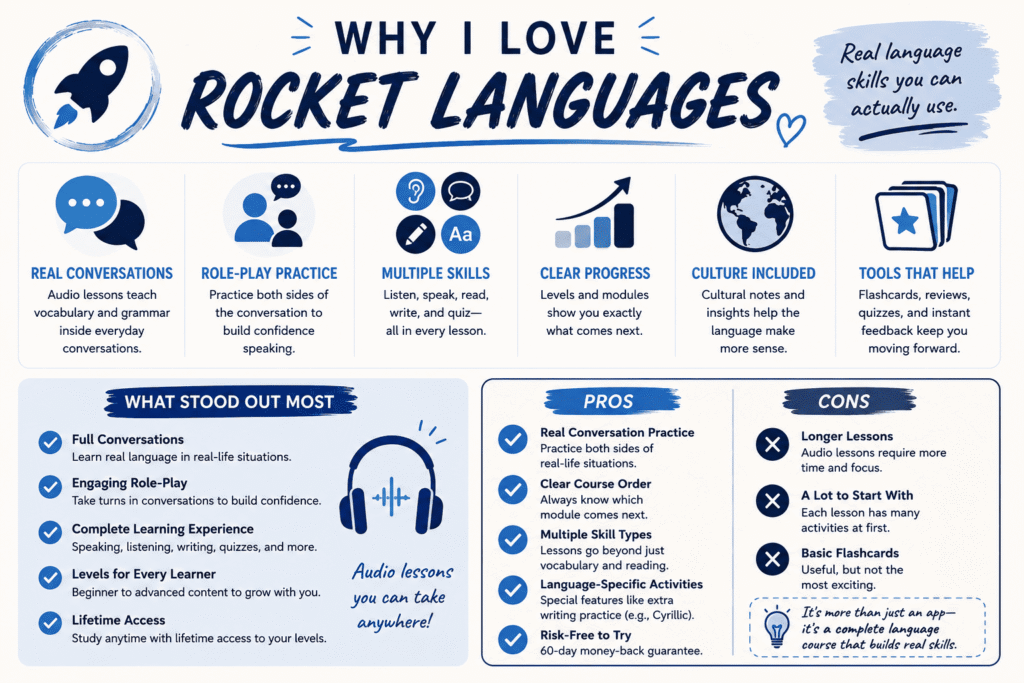
- Full audio conversations instead of isolated vocabulary
- Role-playing as either person in the conversation
- Speaking, listening, writing, and quiz activities
- Beginner through advanced course levels
- Extra alphabet practice in languages that need it
- Immediate quiz feedback and another attempt
- Flashcards connected to the lesson
- Culture lessons mixed into the course
- Points, streaks, and leaderboards
- Lifetime access to purchased levels
Pros
✅ Real Conversation Practice: I practiced both sides of everyday situations
✅ Clear Course Order: I always knew which module came next
✅ Several Skill Types: Lessons covered more than reading and vocabulary
✅ Language-Specific Activities: Cyrillic received its own writing practice
✅ Risk-Free Period: I had 60 days to request a full refund if it was not right for me.
Cons
❌ Longer Lessons: Audio sessions required more focus than quick drills
❌ A lot of Activities to Start With: Each lesson could look overwhelming at first
❌ Basic Flashcards: They worked but were not very interesting
My Honest Take on Rocket Languages’ Main Features
Tech Quality and Ease of Use
Rocket Languages ran smoothly when I switched between different languages, lessons, and practice tools. Pages loaded quickly, audio played without lagging, and my progress stayed saved.
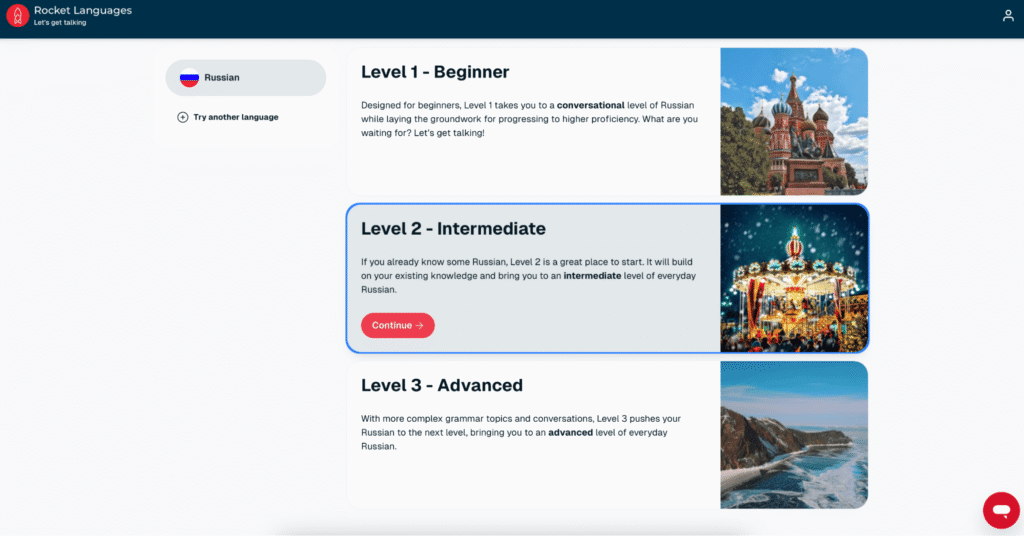
The layout also stayed consistent across each language. I could choose a level, open a module, and see the lesson types and estimated times before starting. Once I understood the icons, though, moving between audio, speaking, writing, quizzes, and review tools was easy.
Audio Lessons and Role-Playing
The audio lessons taught full conversations instead of throwing isolated words at me. I could follow the transcript, pause, change the speed, jump back ten seconds, and practice each line out loud.
One lesson had me work through ordering coffee, then choose either person in the conversation during role-play. Rocket played the other character while I recorded my response. That made the lesson feel closer to an actual conversation, although nearly 20 minutes of audio took more focus than a quick app exercise. The same conversation then connected to vocabulary, listening, speaking, writing, and quiz activities.
Writing and Language-Specific Practice
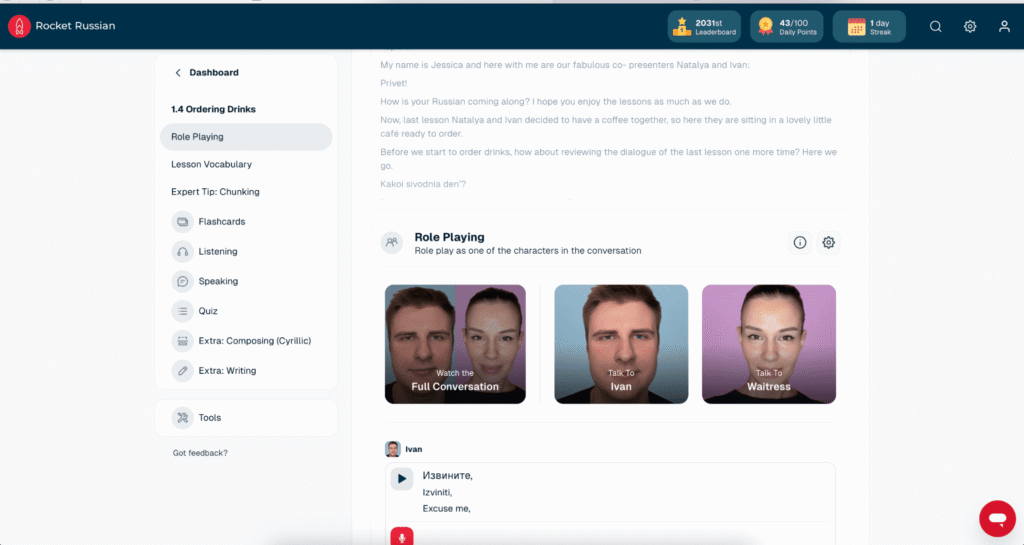
The activities changed when the language needed something extra. While testing Russian, I found separate writing lessons and a composing activity for Cyrillic.
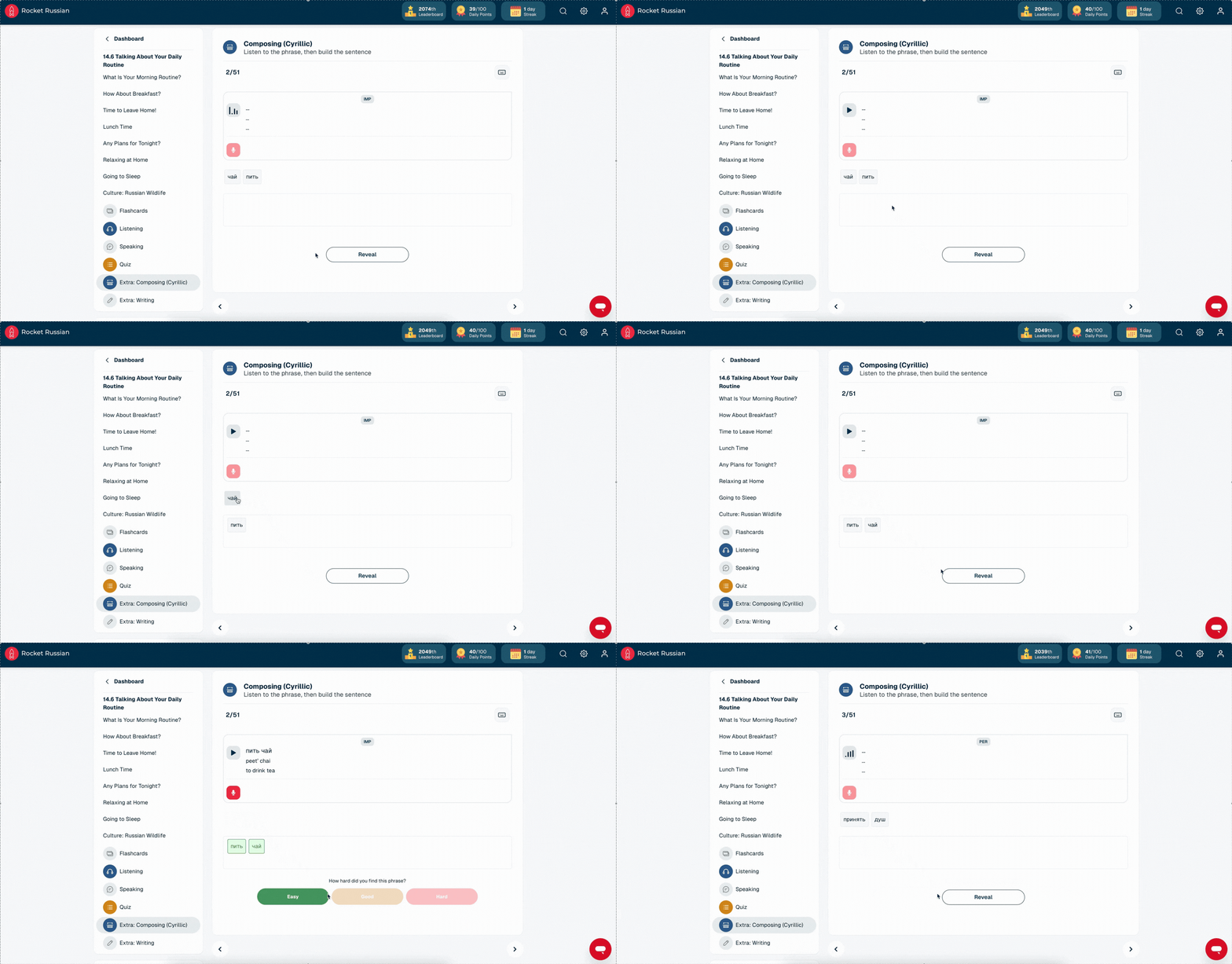
The composing exercise played a phrase, gave me its words separately, and had me arrange them into the correct sentence. After answering, I could reveal the solution and rate how difficult it was. That gave me more practice with word order and the alphabet instead of treating Russian exactly like a language using English letters.
I still would not learn a new writing system from this activity alone, but it added useful practice after the lesson.
Quizzes and Review Activities
Rocket did not stop after the main lesson. I could review the same material with flashcards, listening exercises, speaking practice, writing, and multiple-choice quizzes.
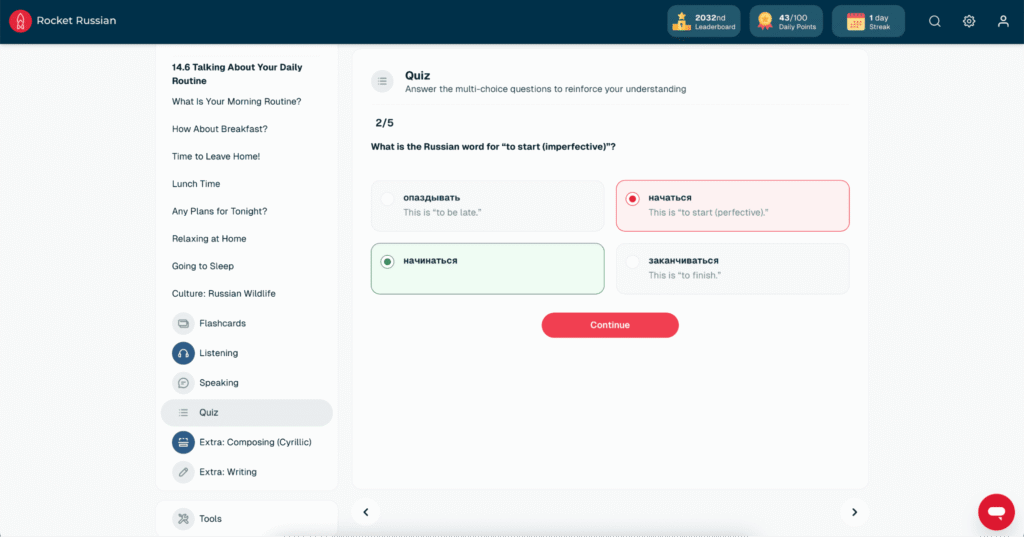
The quizzes immediately showed me what I missed and explained what each answer meant. When my result was bad, I could redo the quiz instead of being stuck with that score. Getting another chance, but repeating the same questions could also make the next score look better without proving I fully understood the topic. The flashcards were more basic, but they were quick for reviewing words I had already seen.
Progress, Points, and Community Tools
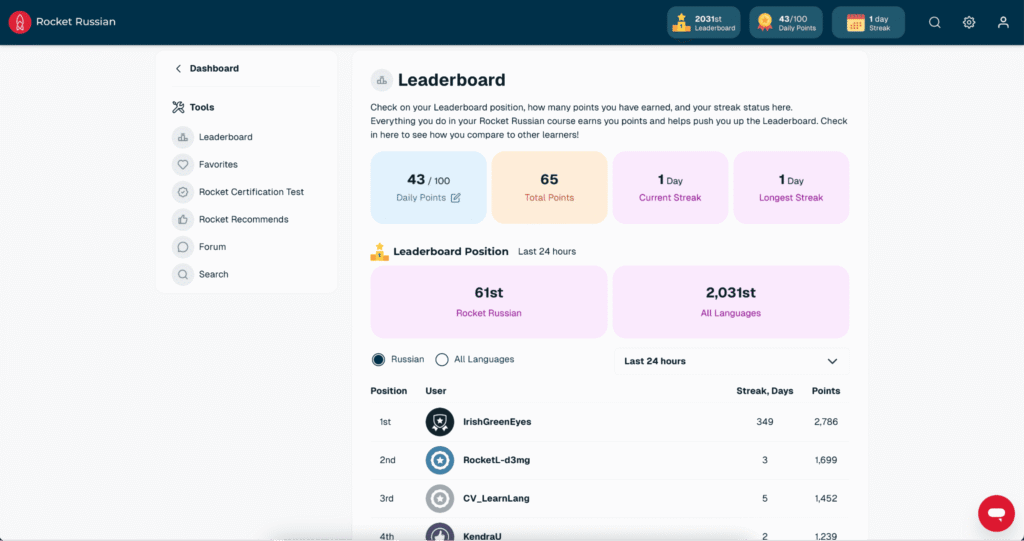
Rocket tracked my points, daily goal, streak, completed activities, and leaderboard position as I moved through different languages. I could compare my ranking within one course or across all languages.
The points gave me a small reason to finish another activity, but they mostly measured how much I clicked and completed, not how well I could speak.
Rocket also had language-specific forums where I could search old conversations or ask tutors and other learners a question. Categories covered grammar, culture, travel, feedback, and other common problems.
Where Rocket Languages Lands Next to Other Apps
Rocket Languages or Rosetta Stone for a Full Course?
Rocket explained the grammar and vocabulary clearly, but one lesson could turn into a long list of audio, flashcards, speaking, writing, and quizzes. Rosetta Stone felt cleaner and more visual from the beginning.
Rosetta Stone’s pictures, pronunciation practice, Chat Missions, and tutoring kept me more involved. It did not explain every rule as directly as Rocket, though, so I sometimes had to learn through context and repetition.
Explanation or Immersion?
→ Rosetta Stone: Visual immersion, tutoring, and real-world missions
→ Rocket Languages: Direct explanations and deeper lesson review
Rocket Languages or Babbel for Daily Studying?
Babbel fit into my day more naturally. Its lessons were shorter, the path stayed clear, and I could finish something without setting aside a full study session.
Rocket gave me longer conversations and more practice after each lesson. That was better when I wanted to study seriously, but it felt heavy when I only had a few minutes. Babbel was easier to return to every day, even with fewer review activities.
Quick Routine or Deeper Session?
→ Babbel: Short lessons with a clear daily flow
→ Rocket Languages: Longer lessons with more practice tools
Rocket Languages or Mango for Language Choice?
Mango gave me more than 70 languages, including choices that were harder to find elsewhere. The simple lesson format was easy to follow, but the visuals and repeated pattern lost my attention.
Rocket had far fewer languages, although its role-playing, quizzes, writing, speaking, and culture lessons gave me more variety after I started. Mango won on selection, while Rocket kept the actual studying more interesting.
More Languages or More Variety?
→ Mango Languages: A much wider selection of languages
→ Rocket Languages: More activity types inside each course
Rocket Languages or Speak for Conversation?
Speak only had six languages and focused much more heavily on conversation. Free Talk and personalized practice got me speaking faster, but reading, writing, grammar, and culture received less attention.
Rocket gave me a fuller course with lessons across all four skills. Its speaking practice felt less natural than Speak’s open conversations, but I had more structure, explanations, and review.
Full Course or Faster Speaking?
→ Speak: Open conversation and personalized speaking practice
→ Rocket Languages: Speaking, writing, grammar, culture, and review
Should You Actually Choose Rocket Languages?
Rocket Languages could help me learn a language, but only if I treated it like a course and kept showing up. I could not finish a lesson by only tapping through random words. I had to listen carefully, speak out loud, remember earlier material, and fix mistakes when I got them wrong.
That also made it less convenient than lighter apps. Still, I came away understanding how the pieces connected. For long-term learning, the effort is worth it.
Before you buy, check our current Rocket Languages discount for verified savings.
FAQs
How many languages does Rocket Languages offer?
Rocket Languages currently offers courses for 14 languages, although the number of levels and activities varies.
Is Rocket Languages good for beginners?
Yes. Beginner courses start with basic conversations and build through clearly ordered modules.
Does Rocket Languages include speaking practice?
Yes. You can record phrases, compare pronunciation, and take either role in lesson conversations.
Can you redo Rocket Languages quizzes?
Yes. Rocket shows missed answers and lets you retake a quiz when you want another attempt.
Does Rocket Languages require a subscription?
Rocket generally sells lifetime access to the language and level package you purchase. Check the current checkout page because packages can vary by language.

![Learn Laugh Speak Promo Code [Verified Coupons]](https://www.miamiherald.com/careers-education/wp-content/uploads/sites/2/2026/10/learn-laugh-speak-promo-code-mh-1024x768.jpg)

![Rocket Languages Promo Code [Verified 2026 Discounts]](https://www.miamiherald.com/careers-education/wp-content/uploads/sites/2/2026/07/rocket-languages-coupon-1-1024x768.jpg)
![Rosetta Stone Discount Promo Code [Verified Coupons]](https://www.miamiherald.com/careers-education/wp-content/uploads/sites/2/2026/07/rosetta-stone-discount-1024x768.jpg)