So, you’ve decided you’d like to keep your event planning skills on the corporate side.
You’re in good company. Whatever brought you here, corporate event planning can be a surprisingly varied career. One week might involve working on a company meeting; another could look like coordinating a conference with hundreds of attendees. The work goes well beyond choosing a venue or putting together a schedule.
According to the U.S. Bureau of Labor Statistics, employment for meeting, convention, and event planners is projected to grow 5% from 2024 to 2034, with about 15,500 openings expected each year.
So, how do you become a corporate event planner? The path can look different from person to person, but there are a few steps that can help you build the right experience, skills, and connections along the way.
Key Takeaways
- Corporate event planning combines creativity and business: Planners may organize conferences, meetings, retreats, product launches, and other events designed around a company’s goals.
- A variety of educational backgrounds can be useful: The BLS says meeting, convention, and event planners typically need a bachelor’s degree, with business, communications, and hospitality among the relevant fields.
- Experience can open doors: Internships, event coordinator positions, hospitality jobs, and volunteer opportunities can help you develop practical planning skills.
- Business skills matter: Budget planning, vendor management, communication, and organization are all useful parts of corporate event management.
- You don’t have to start with a professional certification: Credentials such as the Certified Meeting Professional (CMP) are designed for people who have already gained industry experience.
What Does A Corporate Event Planner Do?
First, it helps to picture what you’re actually signing up for.
Corporate events can cover a lot of ground, including:
- Company meetings
- Conferences and conventions
- Employee retreats
- Networking events
- Product launches
- Trade shows
- Award ceremonies
- Company celebrations
Business event planning can include events that are relatively small and intimate. Others might have hundreds or thousands of attendees.
Always keep the purpose of the event in mind. A company might want employees to learn something new, connect, meet potential clients, or create excitement around a product.
That business focus is part of what makes corporate event planning different from other areas of the industry. You’re not just creating an enjoyable experience; you’re helping a company accomplish a goal.
And that doesn’t mean you have to be a business expert before you start. It’s something you can learn as you go.
Start By Learning The Business Side Of Events
If you’ve always loved planning parties, you already have one piece of the puzzle: You know how to think about an experience from the attendee’s perspective.
Corporate events just have a different angle.
You’ll learn to think about questions like, “What should attendees get out of the event? How much can the company spend? Which vendors can help bring the idea to life?”
One thing I noticed while researching corporate event planning is how closely the job overlaps with other business roles.
The BLS describes meeting, convention, and event planners as professionals who determine an event’s scope, including its timing, location, and cost, and coordinate services such as food, transportation, and meeting spaces.
In other words, there’s plenty of room for creativity, but you’ll also get to see how that creativity fits into a larger business objective.
Build Experience Through Entry-Level Event Roles
You don’t necessarily have to land your dream corporate event planner position right away.
In fact, your first job in the industry might have a different title.
Look for opportunities such as:
- Corporate event coordinator
- Event coordinator
- Meeting coordinator
- Conference coordinator
- Event assistant
- Conference assistant
- Meeting planner
- Event specialist
These roles can give you a closer look at how professional events come together.
And don’t overlook internships. An internship with an event company, hotel, convention center, or organization that regularly hosts meetings can give you a chance to see the planning process from the inside.
The BLS notes that experience in event planning may be helpful and points to opportunities at hotels, convention centers, and convention bureaus, as well as coordinating college or university events, volunteering at events, and shadowing professionals.
One of the more interesting things I found while researching this career was how much experience can matter alongside formal education. BLS data from its 2025 Occupational Requirements Survey shows that prior work experience was required for 80.7% of meeting, convention, and event planner jobs, while a bachelor’s degree was required for 53.9%.
That’s encouraging if you’re worried your résumé doesn’t yet look like a traditional event planner’s. Relevant experience can come from several directions.
Consider Your Educational Options
A bachelor’s degree is the typical entry-level education listed by the BLS for meeting, convention and event planners. Relevant areas of study can include business, communications, social science, hospitality management and meeting or event management.
But you don’t necessarily need a degree specifically called “event planning.”
Someone who studied marketing, for example, may already understand branding and audience engagement. A communications graduate may have experience working with different groups and coordinating projects. A business major may have a head start on budgeting and organizational skills.
If you’re already working or don’t want to pursue another degree, an event planning certificate or continuing education course can also be an option for learning the fundamentals.
The important thing is to look at what the program teaches. A useful course should help you understand the following areas:
- Logistics
- Budgeting
- Contracts
- Vendor relationships
- Event technology
Get Comfortable With Budget Planning
Here’s one part of corporate event planning that might actually appeal to people who enjoy organization: budget planning.
Most events have financial boundaries, and figuring out how to work within them can be a satisfying puzzle.
You might compare venue proposals, estimate food and beverage costs, determine how much the audiovisual setup will cost, or decide where the event budget will have the biggest impact.
You don’t need to become an accountant. But being comfortable with spreadsheets, tracking expenses, and comparing costs can make the planning process much easier.
It can also help you have more productive conversations with the people you’re planning the event for.
Learn Vendor Management
Once you have an idea for an event, someone has to make it happen.
That’s where vendors come in.
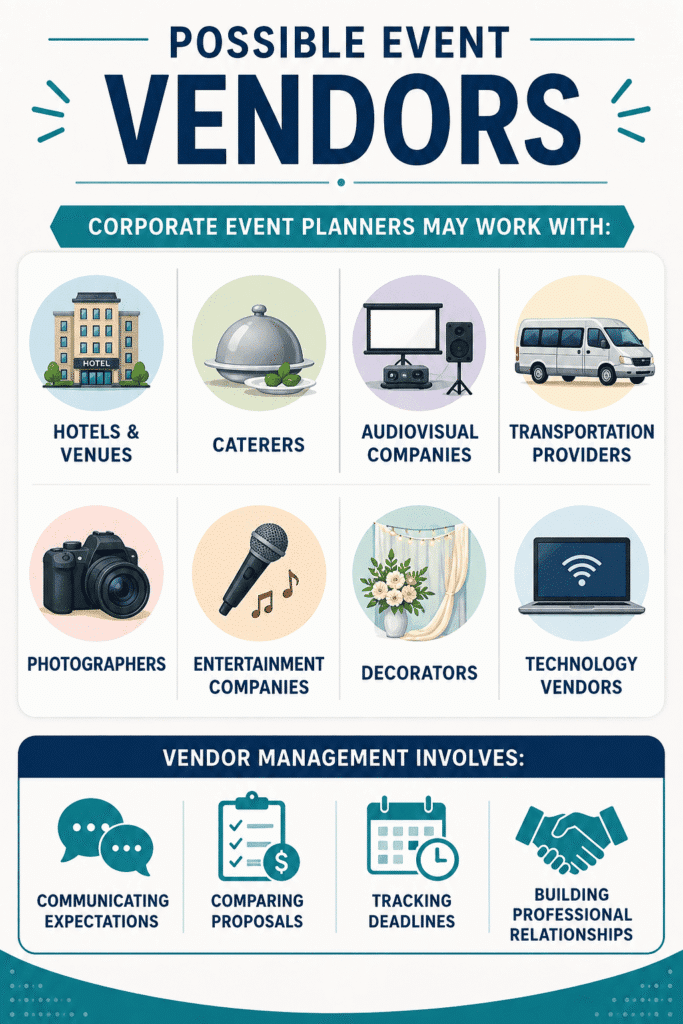
Depending on the event, you might work with:
- Hotels
- Caterers
- Audiovisual companies
- Transportation providers
- Photographers
- Entertainment companies
- Decorators
- Technology vendors
Learning vendor management means getting comfortable communicating expectations, comparing proposals, keeping track of deadlines and maintaining professional relationships.
And there’s something satisfying about this part of the job: You get to take an idea that exists mostly on paper and watch it come to life.
Explore Conference Planning
If the corporate side of events particularly interests you, conference planning could be an area worth exploring.
You don’t have to start by planning a massive industry conference.
Helping with a smaller business meeting or local professional event can teach you many of the same fundamentals. As your experience grows, you can take on larger and more complicated events.
Develop The Skills Employers Value
You might be surprised by how many of the skills needed for corporate event planning have nothing to do with event planning specifically.
Organization is an obvious one. But communication, problem-solving, negotiation and relationship-building are just as important.
The BLS identifies communication, interpersonal, negotiation, organizational, and problem-solving skills as important qualities for event planners.
That means experience from another career isn’t automatically irrelevant.
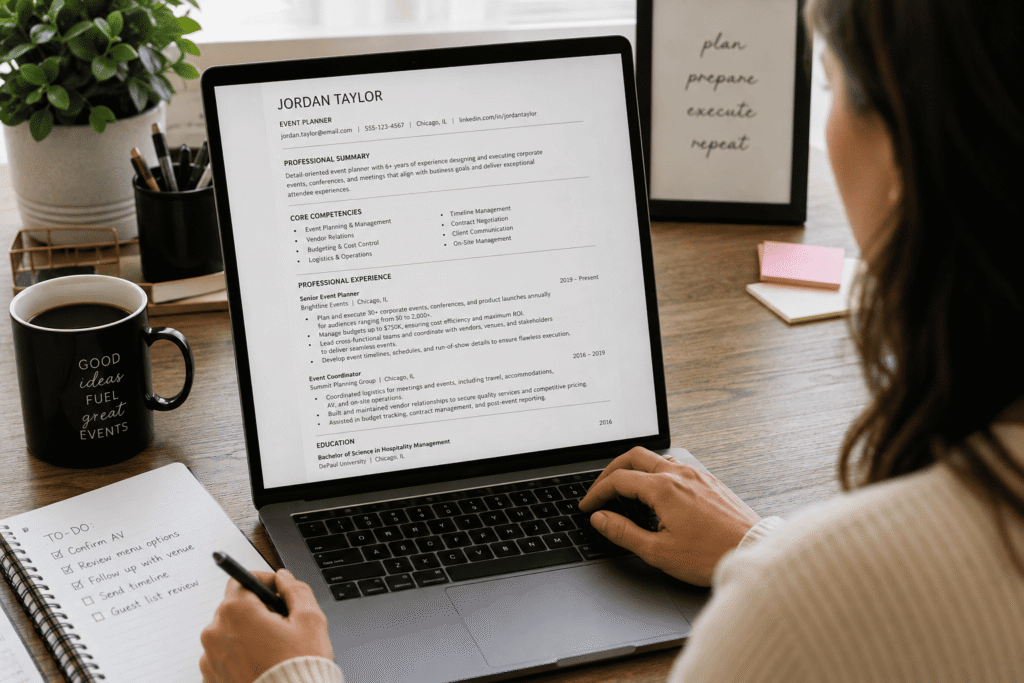
If you’ve coordinated projects, worked with clients, negotiated with vendors, managed schedules or handled multiple priorities at once, you’ve probably already developed skills that can transfer to corporate event planning.
The trick is learning how to translate those skills on your résumé.
Instead of simply saying you “helped organize meetings,” for example, you could describe how you coordinated schedules, communicated with multiple stakeholders, or managed project logistics.
Consider Certification Later In Your Career
You may come across professional certifications while researching how to become a corporate event planner. One of the better-known credentials is the Certified Meeting Professional (CMP) designation from the Events Industry Council.
But don’t feel like you need to rush out and get one.
The CMP is a professional credential for people with experience in the meetings industry. Current eligibility requirements include 36 months of relevant full-time experience, or 24 months of experience with an associate’s degree or higher in hospitality, tourism, or event management. Applicants must also meet the program’s continuing education requirements.
In other words, certification can be something to think about after you’ve started building your career, rather than something you need before you can begin.
For someone just entering corporate event planning, practical experience may be the more useful place to focus.
Look Beyond The Job Title
Once you’re ready to start applying, don’t limit your search to jobs called “corporate event planner.”
Companies use different titles for similar types of work. Searching for a corporate meeting planner, corporate event coordinator, meeting coordinator, conference coordinator, or event specialist can uncover opportunities that someone might otherwise miss.
And read the job description carefully.
One company’s event coordinator might primarily handle administrative tasks, while another might give its coordinator responsibility for vendors, budgets and entire events.
How Much Do Corporate Event Planners Make?
Salary was another area where I found it important to look at the data carefully. There isn’t a separate BLS category specifically for “corporate event planners,” so the closest national comparison is the broader meeting, convention, and event planner occupation. Their median annual wage was $61,160 in 2025.
The actual salary for a corporate event planner can vary based on factors such as location, employer, experience, and responsibilities. Someone coordinating smaller internal meetings may have a very different salary from someone managing large conferences or overseeing an organization’s entire events program.
That’s one reason it can be useful to think of a career as a progression rather than focusing on a single starting salary.
Final Thoughts
Corporate event planning isn’t just about getting people into a room and making sure everything looks good when they arrive. There are budgets to work with, vendors to coordinate, and schedules to build. But that’s also what can make the career exciting.
The events may change from one week to the next, but those fundamentals follow you from one project to the next.
If you’re looking to get into the field, you don’t need to have the entire career mapped out first. Look for opportunities that let you get closer to professional events, pay attention to the business side of the work, and build from there. The title will come later; the experience is what gives you somewhere to go.
Compare the best event planner courses before you choose a training path.
FAQs
1. Do you need a degree to become a corporate event planner?
You don’t always need a degree to become a corporate event planner. However, a bachelor’s degree is the typical entry-level education for meeting, convention, and event planners, according to the BLS.
2. What is the difference between a corporate event planner and other event planners?
The difference between a corporate event planner and other event planners is that a corporate event planner focuses on events for businesses and organizations. These may include conferences, meetings, and product launches.
3. Can I become a corporate event planner without an event planning degree?
Yes, you can become a corporate event planner without an event planning degree. Business, communications, and hospitality are among the relevant fields.
4. Is an event planning certificate required?
No, an event planning certificate is not generally required to work as a corporate event planner. Professional credentials such as the CMP have separate experience and education requirements and are intended for people who have already built experience in the industry.
5. What skills are most important for corporate event planning?
Skills most important for corporate event planning include organization, communication, negotiation, and problem-solving. Budget planning and vendor management are also useful skills to develop.

![Bluehost Promo Codes and Discounts [Verified Coupons]](https://www.miamiherald.com/careers-education/wp-content/uploads/sites/2/2026/10/bluehost-promo-code-mh-1024x768.jpg)
![Incogni Promo Codes [Verified Discounts]](https://www.miamiherald.com/careers-education/wp-content/uploads/sites/2/2026/10/incogni-promo-code-mh-1024x768.jpg)
![Shopify Promo Codes [Verified Discounts]](https://www.miamiherald.com/careers-education/wp-content/uploads/sites/2/2026/10/shopify-promo-code-mh-1024x768.jpg)