If you’re looking at the FMAA because you think it’ll be a quick “starter” certification, this is your friendly reality check. After reviewing the exam structure and sample questions, it’s clear that the FMAA expects more than basic memorization—especially when it comes to applying financial and managerial concepts in practical scenarios.
That’s why a structured option like Gleim FMAA Review stood out to me. The way the course slowed me down, walked me through realistic questions, and explained why an answer works mirrors how the exam is actually written. It’s a good fit for candidates who want to build a strong foundation instead of being surprised by an exam that’s tougher than it looks.
With that in mind, here’s a closer look at Gleim FMAA Review, how the platform works in practice, and who it’s best suited for based on how people actually study and learn.
Gleim FMAA Might Be for You If…
- You are early in your accounting or finance journey and want a structured way to build foundational knowledge
- You are considering the FMAA certification and want guided preparation instead of assembling materials on your own
- You prefer self-study with clear explanations, realistic practice, and performance tracking
- You want a one-time purchase instead of a monthly subscription
- You are exploring long-term careers in accounting, finance, or management accounting, and want a credential that supports that path
Gleim FMAA Overview

Gleim has been around for decades, but what I noticed while reviewing the FMAA course is how intentionally they dial things back for beginners—without dumbing anything down.
As an IMA strategic partner, Gleim brings credibility; more importantly, the course feels like it was built by people who know where learners typically get stuck. The structure is clear, the pacing is realistic, and the explanations focus on understanding instead of shortcuts.
From what I saw, Gleim helps FMAA candidates by:
- Breaking concepts into manageable pieces instead of long info dumps
- Explaining why answers work, not just what’s correct
- Treating mistakes as part of the learning process, not failures
- Building confidence gradually, which matters for early-career learners
Much of the material reflects the work of instructors who have spent their lives training students and early-career professionals, especially those considering paths as management accountants. As a reviewer, that experience shows—not in flashy features, but in how approachable the course feels.
Pros
- Teaches accounting the way people actually get confused: What stood out to me while reviewing Gleim FMAA is that the course doesn’t assume you already “think like an accountant.”
- Written materials are genuinely readable, not just comprehensive: The readings (even in the single-unit demo) are laid out with clarity in mind. Concepts are explained, then immediately reinforced with structured examples and tables that show how the numbers move.
- Answer explanations teach the logic, not just the rule: Instead of simply telling you which option is correct, the explanations walk through why an answer works and why the others don’t.
- Practice tools let you control how you learn, not just what you study: The ability to randomize questions, adjust session size, and review exams after grading makes it easier to practice intentionally.
- Transparent about what’s exam-realistic and what’s for learning: I appreciated how clearly Gleim explains which features mirror the real Prometric testing environment and which are added for learning purposes.
- Feels designed by educators, not marketers: Nothing feels flashy or padded—it’s structured, practical, and clearly built to support understanding over shortcuts.
Con
- Introductory scope by design: Those already deep into advanced certifications, such as a CMA candidate, may find the content intentionally foundational.
Gleim FMAA
Instruction and Learning Style
The first thing that stood out to me while reviewing the Gleim FMAA demo was how readable and practical the written materials are. Even in the demo—which represents just one unit of the course—the layout feels intentionally designed for real learning, not skimming through dense, verbose text.

Aesthetics matter, and I love that the content is presented in a clean, PDF-style format that works well on screen. Concepts are introduced clearly, followed by short explanations, bullet points, and worked examples that show how ideas play out in real accounting scenarios. Instead of long blocks of text, the material breaks information into digestible sections that are easy to pause, reread, or reference later.
I especially liked how examples are handled. Rather than describing accounting rules in the abstract, I could walk through transactions step by step—easily sifting through debits, credits, and the reasoning behind each entry. For visual learners or anyone new to accounting, this makes concepts like the accounting equation feel far more approachable.
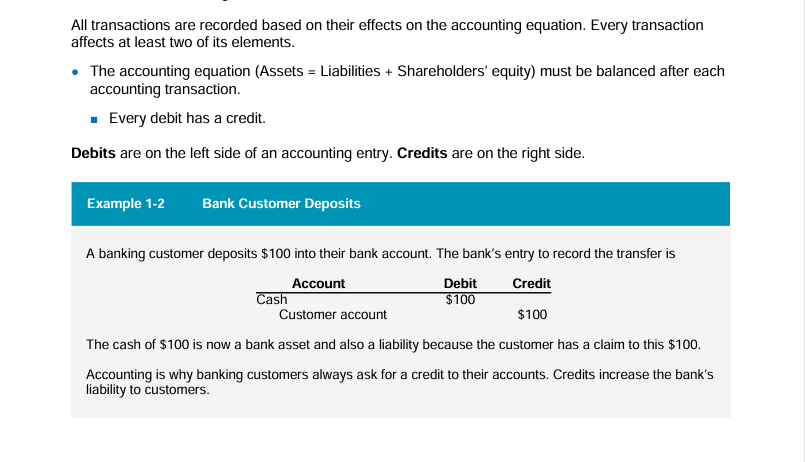
Even though the demo only includes a single unit and doesn’t give you access to all professors or personalized advice, it gives a good sense of how the full course is structured. If the rest of the material follows this same format, it’s easy to see how learners could move through topics without feeling overwhelmed or lost. From a reviewer perspective, the layout supports understanding first, not speed—and that’s exactly what an entry-level certification like the FMAA needs.
Video Instruction: Why Amy’s Teaching Stands Out
One of my favorite parts of the Gleim FMAA course is the video instruction, and a big reason for that is Professor Amy Ford, CPA, CMA, FMAA. Her teaching style feels warm and approachable, not stiff or overly academic. Even though this is an on-demand course, it honestly felt like having a personal teacher guiding me through the material.
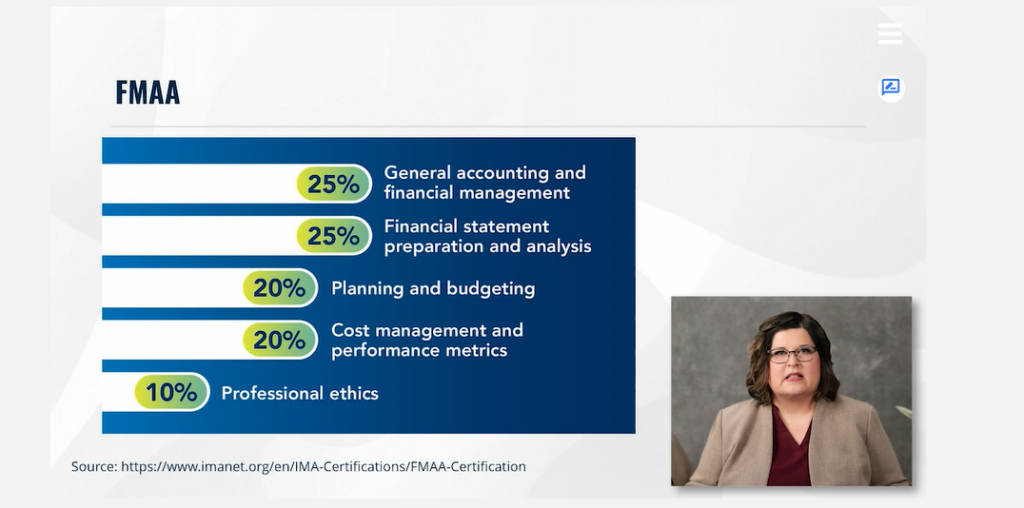
After the first few videos, I found myself thinking of her simply as Amy—not in a dismissive way, but because that’s how personal the instruction felt. Professor Ford earned a perfect score on the FMAA, and that shows in how confidently she explains both the content and the exam itself.
She doesn’t just present information; she tells you what to focus on, what commonly trips people up, and how to think through questions. She even says she’ll walk you through examples and share tips and tricks, which made the experience feel supportive rather than rushed.
Each video starts with a clear introduction that connects the lesson to the exam objectives set by the Institute of Management Accountants. I also appreciated how intentional she is about vocabulary. Key terms are highlighted and reinforced so you’re not just hearing them once and moving on—you’re learning how they’re actually used.
The pacing stood out to me as well. Nothing felt hurried. Concepts are explained, then practiced, then reinforced, and she mixes in fun practice questions throughout the videos to keep you engaged. It made the learning feel active instead of passive.
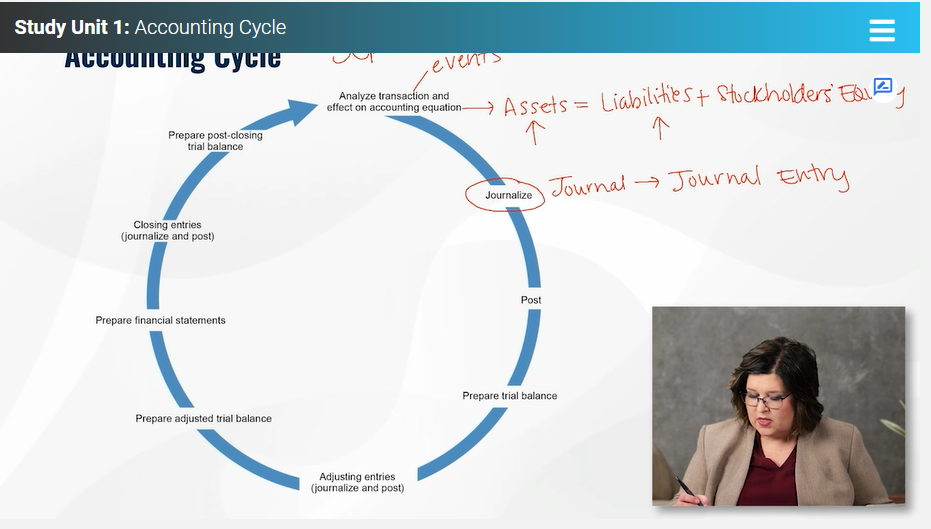
Overall, the videos felt personal in a way most exam prep courses don’t. Even though Amy isn’t physically there, it genuinely felt like she was—checking in, explaining things clearly, and making sure I understood before moving on. That kind of teaching makes a huge difference, especially for an entry-level certification like the FMAA.
What It’s Like Using the Gleim FMAA Platform
When reviewing the platform, it’s clear that Gleim prioritizes clarity and structure. The interface, marked with the Gleim exam prep logo, separates learning, practice, and analysis into distinct modes so users always know what they’re working on.
The test bank is organized into three primary tools.
Practice Exam
Practice Exam mode simulates the full exam experience and provides feedback after completion, allowing candidates to evaluate readiness and review results. From my experience in the prep industry, this helps clarify how the timing, difficulty, and question flow may feel on test day.
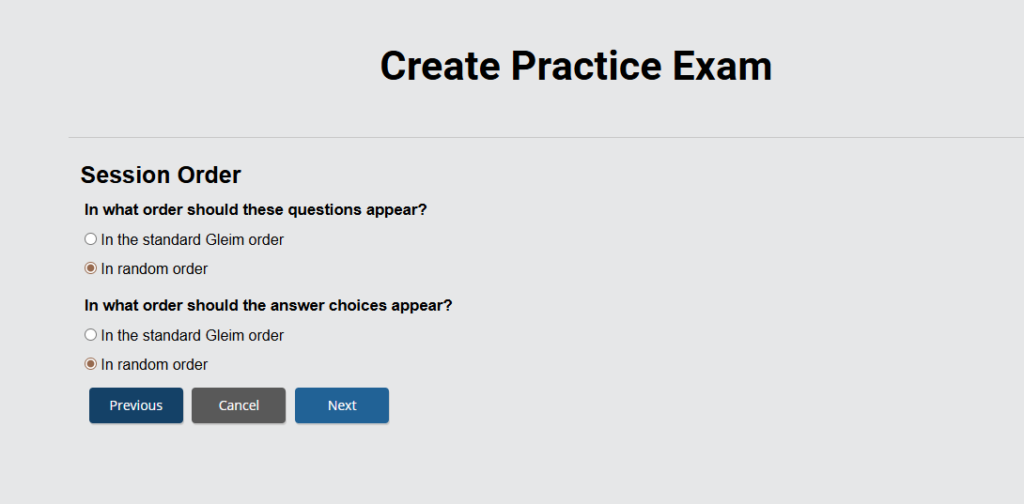
When setting up a practice exam, I noticed that Gleim allows users to choose how questions appear, including whether questions and answer choices follow the standard Gleim order or appear in random order. This flexibility can help reduce pattern recognition and better simulate real testing conditions, so students can focus on understanding the material rather than memorizing it
Gleim also allows users to choose session size. During setup, the platform recommends an optimal session size of 20 questions, which feels realistic for focused practice without becoming overwhelming. Personally, I shortened my test to 15 questions so I could focus on mastering the managerial accounting associate topics, not just cramming questions.
The platform is transparent about exam realism as well. When creating a practice exam, Gleim clearly explains that the exam emulates the Prometric testing environment used for the FMAA. At the same time, it identifies which features are added for learning purposes and are not available for accounting professionals on the actual exam.
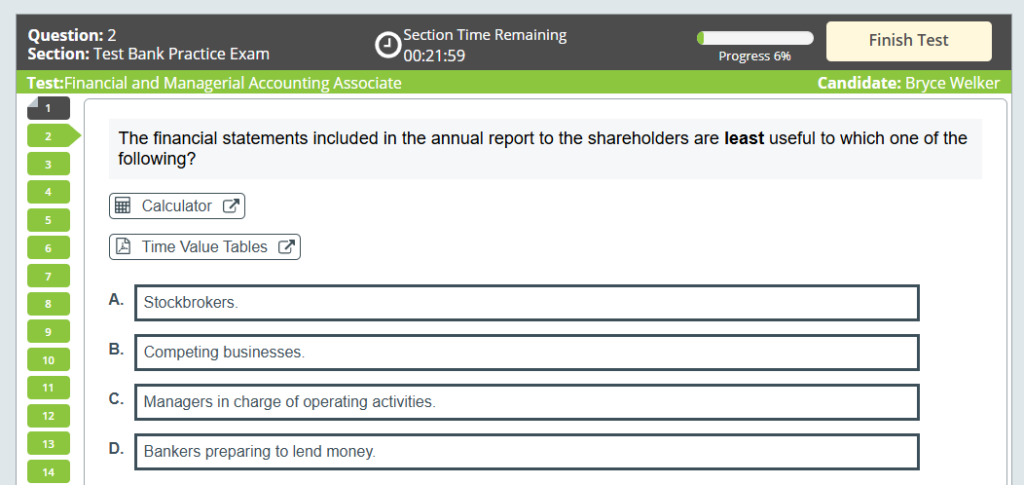
These include the ability to discard an exam without grading it, the ability to run out of time and continue the exam, and the option to review the exam after grading. I feel this transparency helps candidates practice under realistic conditions while still benefiting from tools designed to support learning.
Study Session
Study Session mode is where Gleim’s teaching approach really shows. Instead of waiting until the end of a quiz to see what I missed, the platform gave me immediate feedback after each question—clearly indicating whether an answer is correct or incorrect.
When I reviewed this feature, what stood out was that wrong answers aren’t treated as dead ends. If you miss a question, Gleim tells you what was wrong and why, often pointing out the underlying concept you misunderstood rather than just correcting the math. In the demo, for example, incorrect choices are explained in plain language, reinforcing where that information actually belongs—such as distinguishing balance sheet items from income statement items.
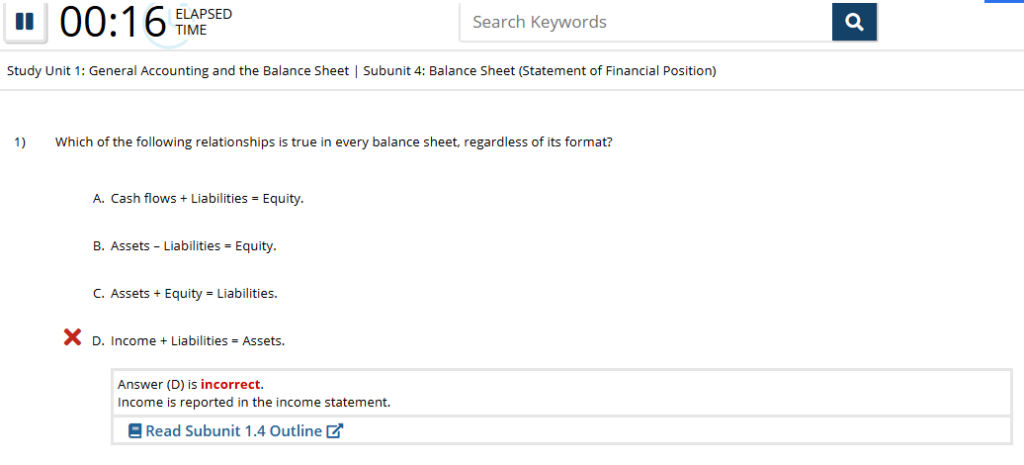
The Study Session also links directly back to the relevant reading material, making it easy to review the concept before moving on. This turns practice questions into active learning moments instead of simple scorekeeping.
For beginners, especially, this approach helps connect accounting rules to how they’re actually used. It teaches you how to think through questions the way the exam expects, rather than just memorizing formulas and hoping for the best.
Performance Stats
The performance dashboard displayed my grade reports, session statistics, and topic-level breakdowns from time spent researching the materials. When reviewing these screens, I noticed how clearly weak areas are highlighted, which would make it easier for learners to adjust their study plan instead of guessing what to review next.
Overall, the platform layout makes the learning process feel intentional rather than cluttered or confusing.
Support: Easy to Find, Easy to Use
Another thing I really appreciated about the Gleim FMAA course is how easy it is to access support—even in demo mode. I didn’t have to dig through menus or guess where to go if I needed help. The options to contact support are clearly visible, and the phone numbers and messaging options are spelled out in a way that feels reassuring, especially for beginners.
For an entry-level certification like the FMAA, that kind of visibility and accessibility goes a long way. It removes a lot of friction and makes the learning experience feel less intimidating, especially if this is your first professional exam.
Value: Reasonable for What You Get
For an entry-level certification, Gleim FMAA feels fairly priced for the depth of preparation it offers.
So, while you may not be getting a massive content library, you probably don’t need one. What you do need is a variety of comprehensive tools, and that’s what makes the value stand out: how much is included in one place. Between the written materials, video instruction, practice exams, study sessions, and performance tracking, it feels like a complete prep experience rather than a collection of add-ons. The one-time purchase model also helps keep costs predictable, which matters for students and early-career professionals.
If you are serious about the FMAA and want preparation that reflects how the exam works, Gleim feels like a reasonable investment, especially compared to piecing together free or generic resources that may leave gaps in your understanding.
Gleim FMAA vs Other Prep Options
Because the FMAA is still a newer, entry-level certification, there aren’t dozens of dedicated prep providers. Most candidates end up choosing between Gleim and a handful of lighter or indirect options.
Gleim FMAA vs IMA Learning Resources
The Institute of Management Accountants offers official learning resources, which makes them appealing at first glance. However, from a preparation standpoint, they tend to function more like instructional materials than a full review system.
Gleim goes further by adding structured practice exams, performance analytics, and detailed answer explanations that actively prepare candidates for exam conditions. If your goal is to learn the material, IMA resources can help—but if your goal is to prepare for the exam, Gleim offers a more complete system.
Winner: Gleim, for exam-focused preparation and practice tools.
Gleim FMAA vs General Accounting Courses (Udemy, Coursera, textbooks)
Many candidates consider general accounting courses as a lower-cost alternative. These can be helpful for learning concepts, but they aren’t built around the FMAA exam structure.
From reviewing Gleim’s platform, the difference is focus. Gleim ties every lesson, question, and example directly back to how concepts are tested. General courses teach accounting broadly, while Gleim teaches accounting with the exam in mind.
Winner: Gleim, for alignment with the actual FMAA exam.
Gleim FMAA vs Self-Study Alone
Some candidates try to prepare using textbooks or notes from school. While that can work for disciplined learners, it leaves a lot of uncertainty around readiness.
What Gleim adds is feedback. The practice exams, study sessions, and performance stats show you where you stand and where to focus next. From my perspective, that structure removes much of the guesswork that comes with self-study alone.
Winner: Gleim, for structure, feedback, and confidence-building.
Why the FMAA?
The Financial and Managerial Accounting Associate (FMAA) is a certification offered by the Institute of Management Accountants, and it’s designed for people who want proof that their accounting fundamentals are solid—not just memorized.
From reviewing the prep materials, what stood out to me is that the FMAA isn’t framed like a pressure-heavy gatekeeping exam. It’s more of a checkpoint. It confirms that you can read financial statements, think through cost decisions, and apply accounting logic before jumping into more advanced certifications or roles.
People usually pursue the FMAA because they:
- Are students or recent grads who want something concrete on their résumé
- Are switching into accounting or finance and want a confidence boost
- Want a foundation before committing to something bigger, like the CMA
It’s entry-level by design, but it still expects you to understand what you’re doing.
Final Verdict
The FMAA may be an entry-level certification, but it still requires real understanding and application. After spending time in the Gleim course, it’s clear the exam isn’t something you can pass by skimming or memorizing a few terms.
Gleim prepares you for that reality. While the materials may feel a bit limited in scope, the course focuses on learning at a steady pace, explaining concepts clearly, and giving you realistic practice that mirrors how the exam is written. If you’re pursuing the FMAA to build confidence in your accounting fundamentals—or to decide what comes next—Gleim offers a structured, approachable way to do it right the first time.
FAQ
This course is best suited for individuals pursuing early roles in accounting, finance, or related business fields.
You receive 12 months of access from the date of purchase.
Yes. Gleim is an IMA strategic partner, which helps ensure alignment with exam standards.
While results vary, the structure, explanations, and practice tools are designed to help candidates prepare confidently.
No. Gleim provides support throughout the study process and encourages learners not to hesitate to reach out with questions.