
Cops took his gun over mental crisis, then returned it. He’s now suspected in Miami murders
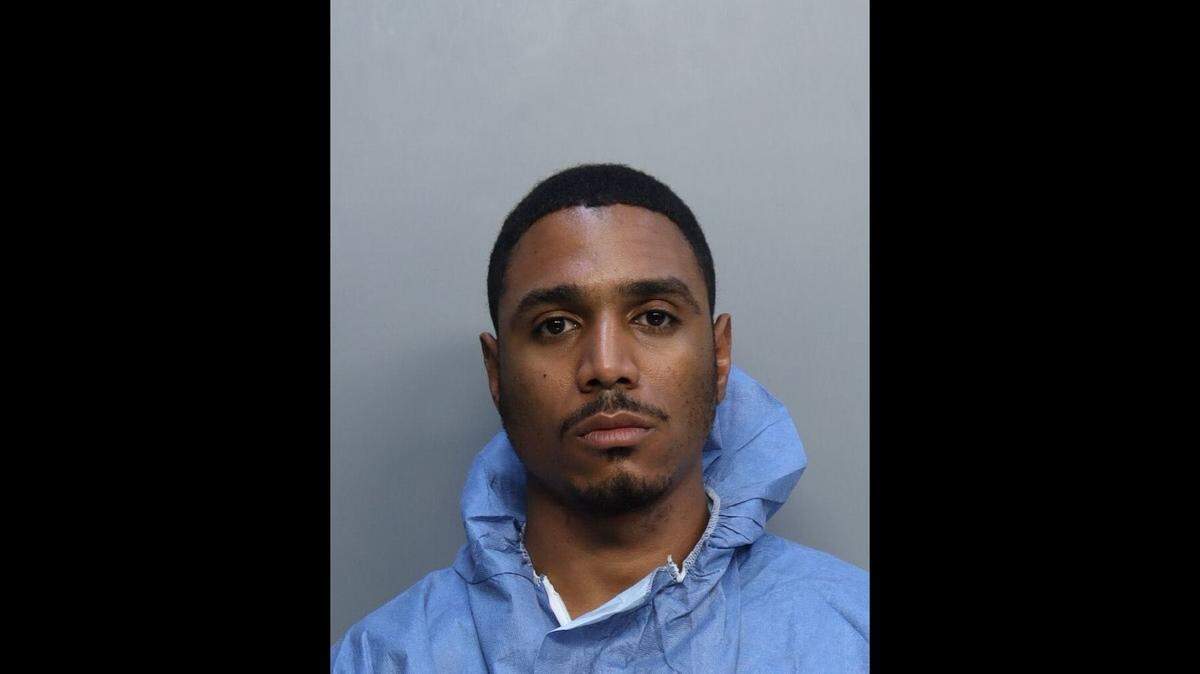
More than a year before Miami police declared Willy Maceo a “suspected serial killer,” his parents dialed 911 to report their bipolar son was acting strangely at their West Kendall home. He refused to take his medication, rambled about conspiracies and appeared to be repeatedly racking the slide of his Glock 9mm pistol.
Citing his potential danger to himself or others, Miami-Dade police officers took him to a hospital for an involuntary psychiatric evaluation. And, according to a police report obtained by the Herald, officers seized his Glock as a precaution.
But the gun was later returned to Maceo — and 18 months later, the same Glock was used to shoot two homeless men in Wynwood, one of whom died, according to police reports.
The previously unreported episode offers a window into the mental state of Maceo, a real estate agent with no previous criminal history whose arrest in December made news across the country. But it also illustrates the difficulties police officers have in trying to prevent future violence, even with Florida’s so-called “red flag” law, which granted authorities considerable leeway to seize weapons from people deemed to be a danger to themselves or others — at least temporarily.
As Maceo’s case illustrates, the use of the red flag law remains inconsistent across Florida, including in Miami-Dade County, where police and courts have utilized it far fewer times than neighboring Broward County.
According to the department, a detective with Miami-Dade Police’s “Threat Management Section” took the Glock, but legally had to return it soon after Maceo was discharged from the hospital within 72 hours under Florida’s “Baker Act.” Still, as is common, the detective consulted with the department’s legal bureau about a “risk protection order,” which would allow a court to keep the gun away from Maceo for up to one year.
The bureau decided there wasn’t enough to go before a judge.
“The case involving Mr. Maceo did not meet the legal criteria to pursue a Risk Protection Order (RPO),” the department said in a statement.
Some experts say Maceo’s case shows the limitations in the system. Even had a judge stripped Maceo of his gun, RPOs expire after one year, and the shootings happened well after he would have been entitled to get his weapon back. And in one of the murder cases of which he is suspected, Maceo didn’t even use a gun — the victim was stabbed to death.
“You’re never going to catch everybody,” said Kendra Parris, an Orlando lawyer who represents gun owners and is critical of the law’s broad scope and criteria. She believes Miami-Dade police probably made the right call, given the facts of Maceo’s case and the sheer amount of Baker Acts that happened in South Florida daily.
“It’s a resources issue. It’s not a bad faith call to say that this doesn’t seem like an RPO situation,” she said. “It wasn’t a bad call.”
Awaiting Arraignment
Maceo, 25, remains in a Miami-Dade jail awaiting trial on one count of attempted murder, as investigators work to build cases to charge him in the two homicides. His arraignment is scheduled for Monday. Maceo’s defense attorney could not be reached for comment. His mother did not return a request for comment.
After his arrest late last month, interim Miami Police Chief Manuel Morales announced at a press conference that Maceo was suspected of the two Wynwood shootings, as well as the October stabbing death of a homeless man near downtown.
According to police, Maceo shot a homeless man in the head on Dec. 21 in the 400 block of Southwest Second Avenue. About two hours later, Maceo is believed to have pulled up in a black Dodge Charger and from the car shot and killed another homeless man, Jerome Antonio Price, 56, as he slept on the sidewalk in Wynwood, a killing caught on surveillance video.
Footage linked Maceo’s Charger to both scenes. When detectives tracked down Maceo in the car, they found the Glock Model 19 9mm handgun — and the bullets matched casings found at both shooting scenes, the chief said.
Investigators then linked Maceo to the murder of a homeless man, Manuel Perez, 59, on Oct. 16 at 27 SE First St. Surveillance footage of the suspected killer, shared previously with the public, shows a man who looks exactly like Maceo. Unlike the other cases, Perez was not shot. He was stabbed to death.
The motive for the attacks remains a mystery — and little was known about Maceo beyond his online profiles.
Records show Maceo, of Kendall, is a licensed real estate broker with no criminal history in Florida and had a valid concealed weapons permit. The Sunset High grad’s social media pages showed him posing with luxury cars, hawking homes and attending a recent Miami cryptocurrency conference.
His interactions with police were minimal. In 2017, he called Miami-Dade police after getting into a text-message argument with the boyfriend of his girlfriend’s sister. On another occasion, Maceo walked into the Hammocks police station to report someone had stolen his car license plate sticker.
According to police, he legally purchased his Glock on Jan. 18, 2018. It was not until the following year, in October 2019, his family would tell police, that Maceo began “displaying mental illness” and “hearing voices in his head.”
‘A Delusional State’
His troubles escalated on the morning of May 30, 2020, when Miami-Dade police were called to the West Kendall home where Maceo was living with his parents. The report: a “domestic dispute with their bipolar son.”
Early that morning, his mother told police, Maceo began calling his parents on the phone “without speaking and keeping an open line.” During the calls, they heard a “gun slide being racked numerous times,” spurring them to leave the home along with other relatives because they feared for their safety.
Later that day, after they’d returned home, Maceo approached his mother “speaking incoherently, accusing her and other family members of conspiring against him and became very agitated.” She called police.
An arriving officer went inside and found Maceo, who at first refused to sit down, but eventually placed his hands on his head. Officers found his Glock 9mm pistol in his waistband, and discovered it was loaded with a round in the chamber. The officer noted he made “incoherent statements and appeared to be in a delusional state.”
Maceo was not charged with any criminal wrongdoing. Instead, he was taken to Kendall Regional Hospital under Florida’s Baker Act law, which allows someone who may be a danger to themselves or others to be admitted to a mental-health facility for an involuntarily evaluation, a stay that can last up to 72 hours.
Prior to 2018, police officers could not generally seize the firearm of someone who was committed under the Baker Act, unless they’d been charged in a crime. That changed after Nikolas Cruz, a teenager with a history of violent outbursts and mental-health problems, embarked on a shooting spree at Marjory Stoneman Douglas High on Feb. 14, 2018.
Gauging Risk
After the massacre — 17 people died, and 17 others were injured — state lawmakers bowed to public pressure and passed a slew of reforms that were hailed by gun-control advocates. That included the so-called “red flag” law that allowed police to seize guns from someone who “poses a potential danger to himself or herself or others.” And the law established the “risk protection order” system, which allows police to petition a court to keep guns away from potentially dangerous people — but only for up to one year.
The criteria: Police “must provide facts that give rise to a reasonable fear that respondent poses a significant danger of causing personal injury to themselves/others by having a firearm or ammunition in their custody, control, or possession.“
Across the state, use of the law has varied widely, according to a 2020 analysis by The Associated Press, with some police departments seeking orders more aggressively than others, and also devoting more manpower and training in the use of the law. Detectives have to take into account criminal histories, sometimes incomplete medical information, and details of the threats — all while balancing a person’s right to own a weapon.
“Quantifying risk level is always a challenge,” said one veteran South Florida detective who works assessing threats. “And judgment is a big part of the decision making.”
Since the law was established, judges have issued 8,286 risk protection orders, according to state records. Of those, only 282 were in Miami-Dade, the largest population center in Florida. In Broward, where the Parkland massacre happened, there have been more than double that tally: 792 cases.
How long the typical risk protection order lasts is unclear. In Florida, people who have lost their rights to buy or possess firearms — whether through an RPO or other mental-health proceedings — can always petition a court to restore their ability to have a gun.
It was unclear how much Kendall Regional doctors spoke with police, and if they wanted Maceo to be sent to a longer involuntary commitment — although had that happened, the mental-health facility would have needed to petition a court to seek an “involuntary commitment.”
“If a person is not committed, upon release, the cops have to file for the RPO or give the firearm back — there is no in-between there,” said Parris, the Orlando attorney.
People who get Baker Acted have a “significantly higher risk” of getting arrested in the future for committing gun-related crime over people who are court-ordered for longer-term psychiatric care — which makes them ineligible to have a firearm, said Jeffrey Swanson, a Duke University social-science researcher and psychiatry professor who studies the laws.
Swanson said 19 states have instituted red flag laws, which are valuable tools in keeping guns out of the hands of potential killers and those at risk of suicide. But he cautioned that the laws are just one piece in the complex puzzle of guns and mental health in the United States.
“The vast majority of people with serious mental illnesses are not violent,” Swanson said. “But they are often stigmatized by high-profile cases of mass shooters.”
This story was originally published January 21, 2022 at 9:55 AM with the headline "Cops took his gun over mental crisis, then returned it. He’s now suspected in Miami murders."