
Turner River: Reviving an ecosystem
The five-foot alligator posed agreeably as tourists shot photos of it lounging in the canal that runs parallel to Turner River Road, north of U.S. 41 in the Big Cypress National Preserve.
The gator’s hangout that Friday afternoon may have been no accident: It was floating at the mouth of a culvert pipe that allows water to flow, albeit sluggishly, under the roadway and into the “real” Turner River — once a major artery for native Americans and early settlers — that now trickles south for about nine miles to Chokoloskee Bay in Everglades National Park.
Any gator worth its choppers knows that fish and other waterborne prey hang out wherever there’s moving water, so this one conduit — the only one for seven miles — was definitely the neighborhood snack shop.
Now, the preserve’s hydrologist Bob Sobczak has come up with a plan to give the young reptile a bigger smorgasbord, provide better paddling opportunities for visitors, and maybe even demonstrate in microcosm the benefits of restoring natural sheet flows to the parched Everglades and Florida Bay.
Over the next two years, workers will install a network of culverts and plugs in the canal along Turner River Road and its parallel Birdon Road about three miles west, extending north from U.S. 41 to Wagonwheel Road. Those roads were constructed in the 1950s before the area was declared a preserve in order to provide access and drain the swamp. The plan is to unblock the southerly flow of fresh water from the Turner River’s meager headwaters through the swamp into the estuaries of the Ten Thousand Islands. Over the past 30 years, various projects have attempted to reverse the ill effects from 60 years ago — the latest in 1996, which involved placing boulders in the Turner River Canal south of U.S. 41. The latest project, aimed at improving on those efforts, is estimated to cost $250,000, with funding from the South Florida National Parks Trust, Collier County, and the Florida Fish and Wildlife Conservation Commission.
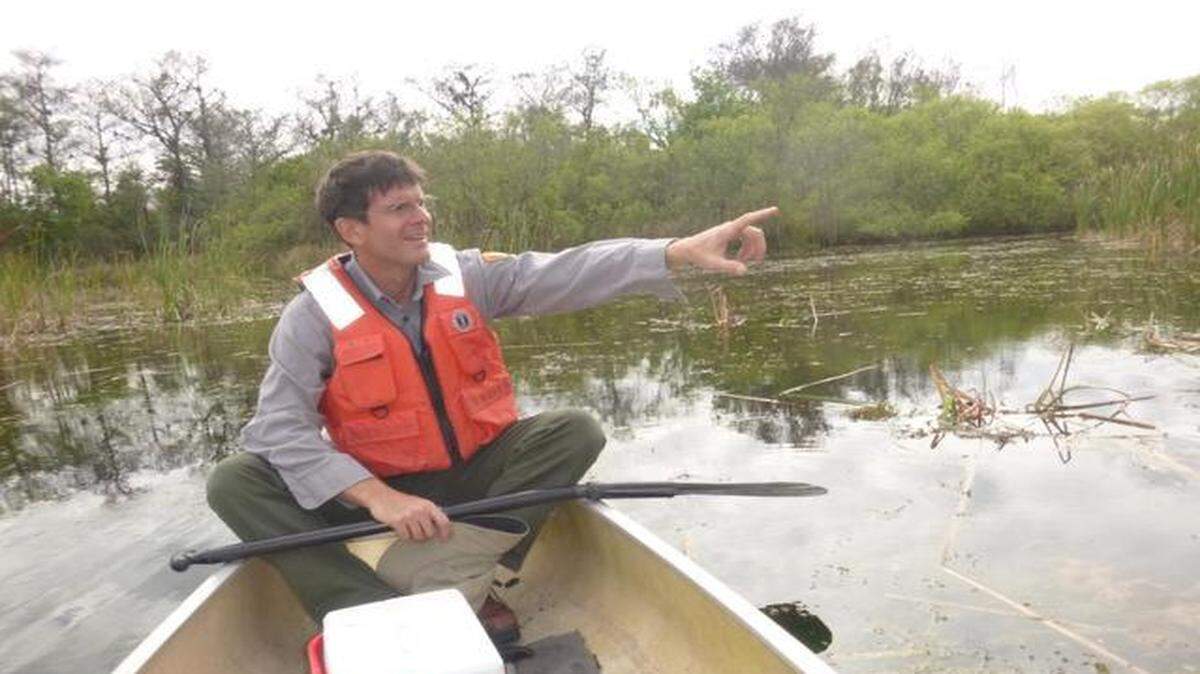
“We want to resuscitate the natural delivery system that sent water to the Turner River through sheet flow,” Sobczak said as he paddled a canoe slowly north from U.S. 41. It’ll improve recreational opportunities and the ecosystem. The basic principle is to spread out water and rehydrate every inch of the landscape.”
Hundreds of paddlers — individuals and guided tour groups — launch their craft each week at the small wayside park on the Turner River. They can only travel about a half-mile north — passing through two headwater pools to spy gators and wading and nesting birds — before the swamp becomes impassable in a tangle of pond apple and a single giant cypress that Sobczak calls a “sentinel” that mark the hydrological headwaters. It’s hard to envision a river here.
“This was the primary natural channel that fed the Ten Thousand Islands,” he said. “That’s why the settlers called it a river. We’re trying to help the river reclaim that distinction.”
Unlike the massive 30-year Everglades restoration program, which will cost tens of billions and involve legions of engineers and hydrologists from federal, state, county and tribal agencies performing studies and devising intricate public works projects, Sobczak says the Big Cypress should see benefits fairly quickly.
“The preserve was carved out to be its own watershed,” he said. “People think it’s just dependent on rain. It’s not connected to the whole South Florida infrastructure. There’s an exciting opportunity to do Everglades-scale restoration at a fraction of the cost and without the gridlock. It’s a river that was lost and now resuscitated.”