
Miami's multicultural Jewish community returns to its roots in mission trip to Israel
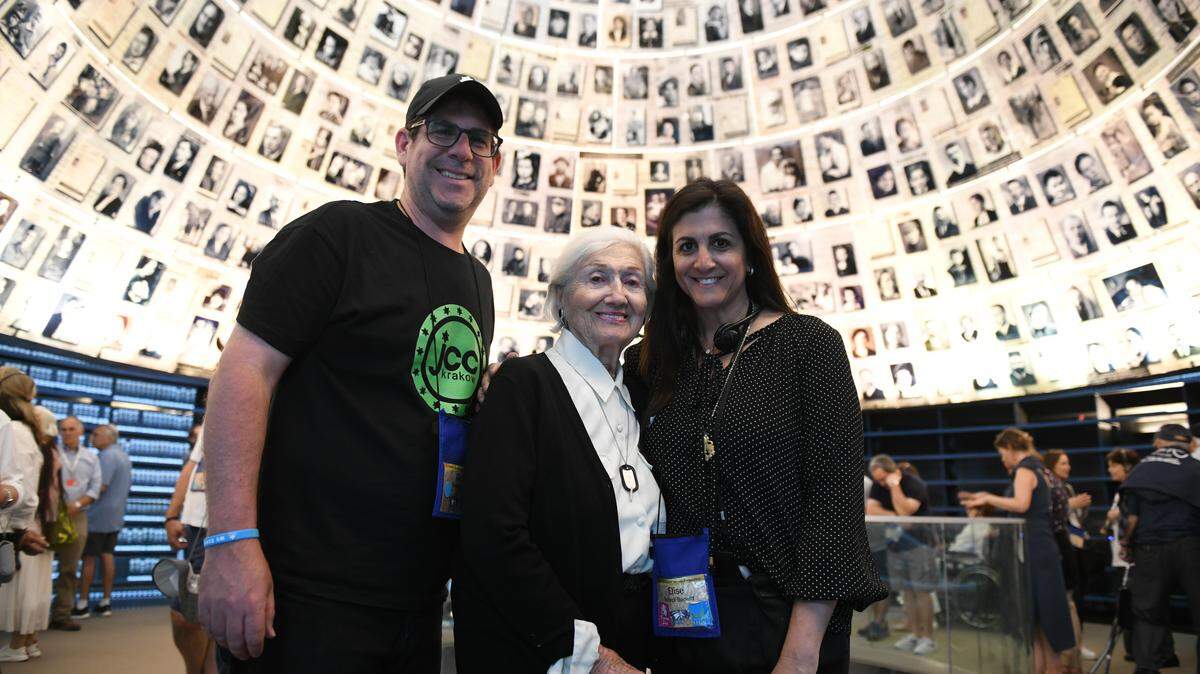
Israel celebrated its 70th birthday this week, and here for the party was one of the largest, most eclectic groups of visitors the country has ever seen — 820 South Floridians, ranging from 22 to 94, on a mission trip with the Greater Miami Jewish Federation.
One of the biggest missions to Israel ever, the group represents a microcosm of Miami’s diverse Jewish community. They hail from nearly a dozen different countries, including Venezuela, Argentina, Chile, Mexico, Colombia, Peru and, of course, Cuba. Of the 19 buses composing the caravan, five are predominantly Spanish speaking.
It is a fitting representation of Miami, the city with the highest percentage of Jews born outside the United States, said Jeffrey Levin, the federation’s chief development officer.
Yet many feel closer to Israel than anywhere else. Just 113 of the 820 had never been here before. Some have parents and grandparents who were born here, who fought in the country’s founding wars, and even helped establish the young state.
At the mission’s opening party in Tel Aviv, John Bussel thought of his late grandfather, Shepard Broad. Known for building the Broad Causeway and developing Bay Harbor Islands from swampland of mud and mangroves, Broad played a small yet crucial role in the founding of the State of Israel.
In 1945, Broad received a top-secret letter from the American Zionist leader Rudolf Sonneborn, Bussel said. Sonneborn had agreed with David Ben Gurion — who would become Israel’s first prime minister — to organize a group of American men who could help Jews in Palestine form a Jewish state.
“My grandfather was one of those men,” Bussel said.
The group convened just once, in Sonneborn’s New York apartment.
“Ben Gurion was there, and would later say that the State of Israel was born in that meeting,” Bussel said. “The Jews of Europe had lost everything. The only ones who could help were in America.”
Broad raised funds to buy two American cargo ships, and docked them in the Miami River. He told authorities they would sail to South America to bring bananas back to the United States.
“What they really did was head east and pick up Holocaust survivors from Europe and brought them to British Mandate Palestine,” said Bussel. “Many people here have no idea that Miami played such an important role in making this miracle of a country possible.”
About 3,000 Holocaust survivors were on Broad’s two ships, the Hatikva and the Geula. Yet due to British restrictions on Jewish immigration at the time, they were considered illegal migrants. The British sent one of Broad’s ships back to a refugee camp in Cyprus. Jewish immigration only became legal once the British Mandate ended and the State of Israel declared independence on May 14, 1948.
At the same party, Gil Bonwitt smiled as the loudspeakers blared Ben Gurion’s proclamation of independence 70 years ago, close to where he stood now. Bonwitt was thinking of his mother, who was born in Tel Aviv in 1929 and served in Israel’s pre-state underground military.
“One of the greatest highlights of her life was the power and excitement of that day,” said Bonwitt, whose mother passed away two months ago. When his grandparents moved here from Lithuania, he said, "They dreamed of a Jewish state, but never believed it would actually come true."
In Israel, holidays are celebrated according to the Hebrew calendar, and they begin at sundown. This year, Israel Independence Day fell on Tuesday, and continued through sundown Wednesday. Yet before Independence Day, Israelis commemorated the lives lost in the establishment of their state — which was attacked by five Arab nations the day it declared independence — and those lost in the years since. Israel’s memorial day for fallen soldiers and terror victims is called Yom Hazikaron.
These consecutive holidays create a jarring juxtaposition. One day, the country is in collective mourning, with graveyard visits, memorial ceremonies and a 2-minute-long, nationwide siren, when cars stop and Israelis stand still, bowing their heads in silence. That evening, they erupt in celebration, with fireworks across the country and parties that last until morning and the next day.
One week before these dual days of memorial and celebration is Yom Hashoah, Holocaust Remembrance Day, in commemoration of the 6 million Jews murdered by the Nazis.
“If you thought last night was intense, worry not. Today is going to be intenser,” said Rabbi Shlomo Sprung to the participants on Bus No. 6 as they traveled from Tel Aviv to Jerusalem.
Sprung, a rabbi at North Miami Beach’s Scheck Hillel Community School, was referring to the memorial ceremony they attended the night before. The crowd listened in tears as Israeli parents told stories of their children who had died fighting for Israel’s survival.
Just days earlier, a quarter of the mission participants were in Poland, visiting the Nazi concentration camps. From there they went to Israel, following the path of the survivors who went on to establish the Jewish state. Of the 820 participants, 130 are children or grandchildren of Holocaust survivors.
Bonwitt, whose father fled Germany after Kristallnacht, went to Poland with his wife, Elise, and their 18-year-old son, who was there with March of the Living, a Holocaust education organization that brings young people from around the world to Poland and Israel every Holocaust Remembrance Day. As their bus headed to Yad Vashem, the world’s largest Holocaust museum in Jerusalem, Bonwitt said, “Israel celebrates two memorials in one week: one for Jews who fell protecting our land, and one for Jews who fell because we had no land. You really get that sense coming here from Poland, from devastation to redemption.”
Gil and Elise walked solemnly through Yad Vashem with Magda Bader, an 88-year-old Auschwitz survivor from Miami. Bader is known by many parents on the mission, as she’s done several March of the Living trips with their children. She sees it as her duty to tell her story and educate younger generations about the atrocities she lived through. She returned to Auschwitz last week for that reason.
Within minutes of entering Yad Vashem, Bader saw an archival video of Jews in what was then Czechoslovakia in the 1930s. “That’s my town,” she said, her blue eyes watering as she pointed at the screen. In another film from 1930, children from her school were singing Hatikva, the song that would become Israel’s national anthem. “Most of these children never made it out of Europe alive,” said the tour guide.
Bader and her sisters were among the lucky ones. “When we arrived in Auschwitz, Mengele told us that we would only be separated now, but we would see each other after,” Bader told the group, referring to the infamous SS officer Josef Mengele. “In the selection, my mother, father, sister and her baby went this way, and me and my sisters went this way.” Her parents, sister and niece went straight to the gas chambers.
Before Independence Day celebrations began, the mission held a memorial ceremony outside the Holocaust museum. “As a witness and survivor I speak for my father,” said Holocaust survivor Israel Lapciuc. “I speak for the men and women who did not survive, whose faces I still see, whose cries I still hear, whose warm hands I can still feel. I have an obligation to tell their stories.”
As his voice broke and he burst into sobs, he continued, “I will never keep silent so the dead are not forgotten, so it cannot be said that this atrocity never happened. I speak to keep alive the memories of those who did not live, upon whose ashes this state was born.”
This story was originally published April 20, 2018 at 8:25 PM with the headline "Miami's multicultural Jewish community returns to its roots in mission trip to Israel."