
The U.S. spent billions fighting coca in Colombia. Why hasn't it made a dent?
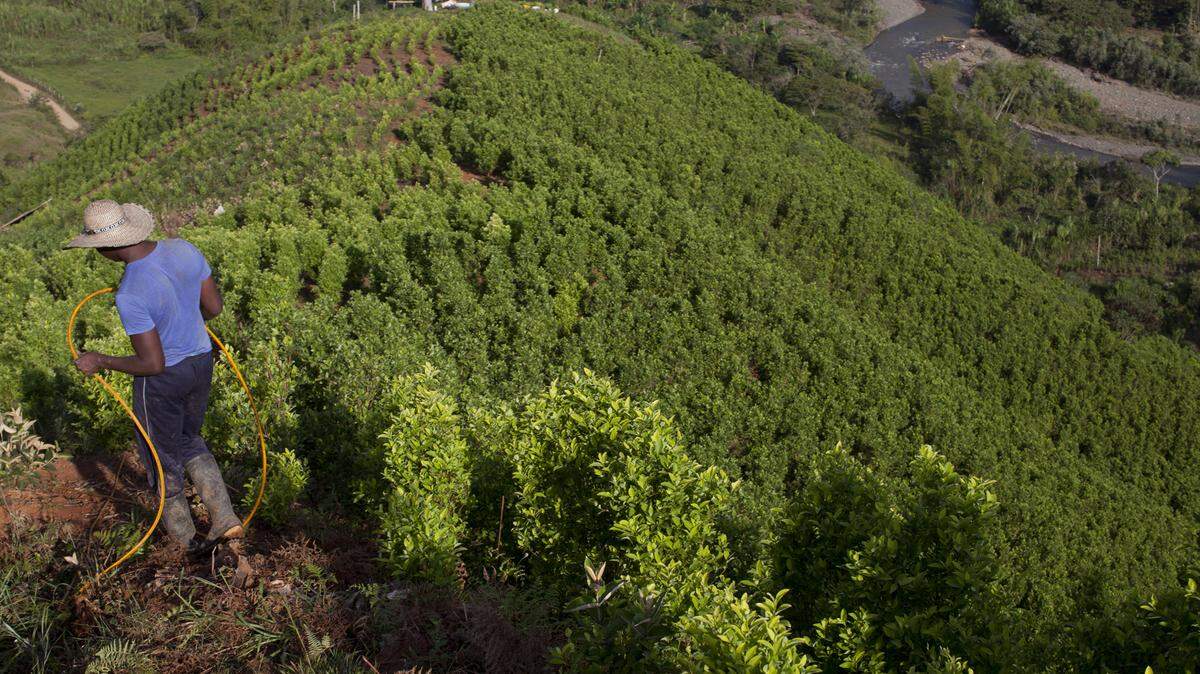
Despite billions of dollars spent and tens of thousands of lives lost, Colombia's coca crisis persists.
The country had more than 136,000 acres dedicated to coca production in 2016, according to the most recent United Nations data — more than anywhere else in the world. That's about the same number of acres as in 2000, before the United States helped launch an all-out assault on Colombia’s drug trade.
And yet, as the South American nation prepares for presidential elections on May 27, the majority of the candidates are, with a few exceptions, talking about doubling down on old approaches: using the military to forcefully eradicate crops while encouraging coca farmers to seek legal alternatives.
For Carlos Villalón, a Chilean photographer who has been documenting the drug war for almost two decades, it all has a familiar ring.
“When you’re talking about the drug trafficking industry, nothing that has been done in Colombia has worked,” he said. “All this militarization under [U.S.-backed] Plan Colombia … It was brutal. Towns were left abandoned and lots of people died. But nothing has changed.”
Villalón began following the cocaine trail in 2000, from Amazon drug labs to morgues in Medellín to gangland funerals in Mexico to addicts in the Bronx, living under bridges and shooting speedballs.
He’s turned that visual journey into a photo book called “Coca: The Lost War” — and is raising money for its printing through an online campaign.
With text written by Ethan Nadelmann, the founder of the Drug Policy Alliance; Wade Davis, a famed ethnobotanist and author; Calixto Kuiru, an Amazon healer; and Karl Penhaul, a fellow war correspondent, Villalón says he’s hoping it can help spur a badly needed policy debate.
“We need to have a real conversation about this topic because none of the things [that have been tried] are working,” Villalón said. “If you have a 30- or 40-year war that never ends, you naturally need to go looking for the answers to stop it. ... But it looks like everyone in politics is super comfortable with the idea of killing people and arresting guys.”
When Villalón arrived in Colombia in 2000, he was only planning staying for a month. But what he stumbled on in a far-flung village hooked him.
Deep in an area called Caquetá, he found a town that was so isolated — and so abandoned by the central government — that the locals were using coca paste (a precursor to cocaine) as currency.
“I saw these guys bartering cocaine for toilet paper or beers, and it was something I had never seen before,” he recalls.
His journey coincided with the ramp-up of the U.S.-backed Plan Colombia, which began in 1999 and would eventually pour more than $10 billion into fighting Colombian cocaine trafficking. Despite periodic progress, production surged 52 percent from 2015 to 2016, after the government suspended aerial spraying with glyphosate, amid fears that the herbicide was carcinogenic. And drug-related violence has made the Americas the deadliest swath on the planet.
When Colombian President Juan Manuel Santos signed a 2016 peace deal with the country’s largest guerrilla group, the Revolutionary Armed Forces of Colombia, or FARC, there were hopes that it might help curb drug production. But it hasn’t, and as new actors have moved in to fill the void left by the guerrillas, violence is on the rise again in some areas.
Villalón has come to the conclusion that legalization might be the only way to strip the violence out of the drug trade. While Colombian presidential candidate Gustavo Petro has been an advocate of legalization, he’s also said that until Washington and Europe take that step, there’s little that drug suppliers, like Colombia, can do about it.
But Villalón says the United States may already have proof of concept with legalized marijuana. Several U.S. states have approved marijuana for medical or recreational use, but it is still illegal under federal law.
“Marijuana was the devil 20 years ago in the United States, and now many of the states have legalized marijuana in a way that seems to be working,” he said. “The Mexican cartels that brought marijuana into the United States, those guys are going out of business. And the local governments have made a lot of money in tax revenue. And with this money they can do good things, like build schools and hospitals that really tackle the [addiction] problem.”
While Villalón is wrapping up the book, he says the coca trail is still full of avenues to explore. In particular, he’s curious about why Latin America always stars as the villain in the drug war. How is it possible, he asks, that despite U.S. intelligence and law enforcement efforts, tons of cocaine floods into America every year?
“It’s very strange to me that all of this cocaine can still make it through,” he said. “What’s going on? Is there corruption at the border — at the political level? We don’t know. ... But we should investigate.”
And the coca story in Colombia remains as pressing as ever. During a recent trip to a small village in Meta, Villalón tried to buy beer, but the merchant didn’t have or accept cash — she only took coca paste.
This story was originally published May 10, 2018 at 8:00 AM with the headline "The U.S. spent billions fighting coca in Colombia. Why hasn't it made a dent?."