
Teen concept could end deaths of children left in cars, saving dozens each year
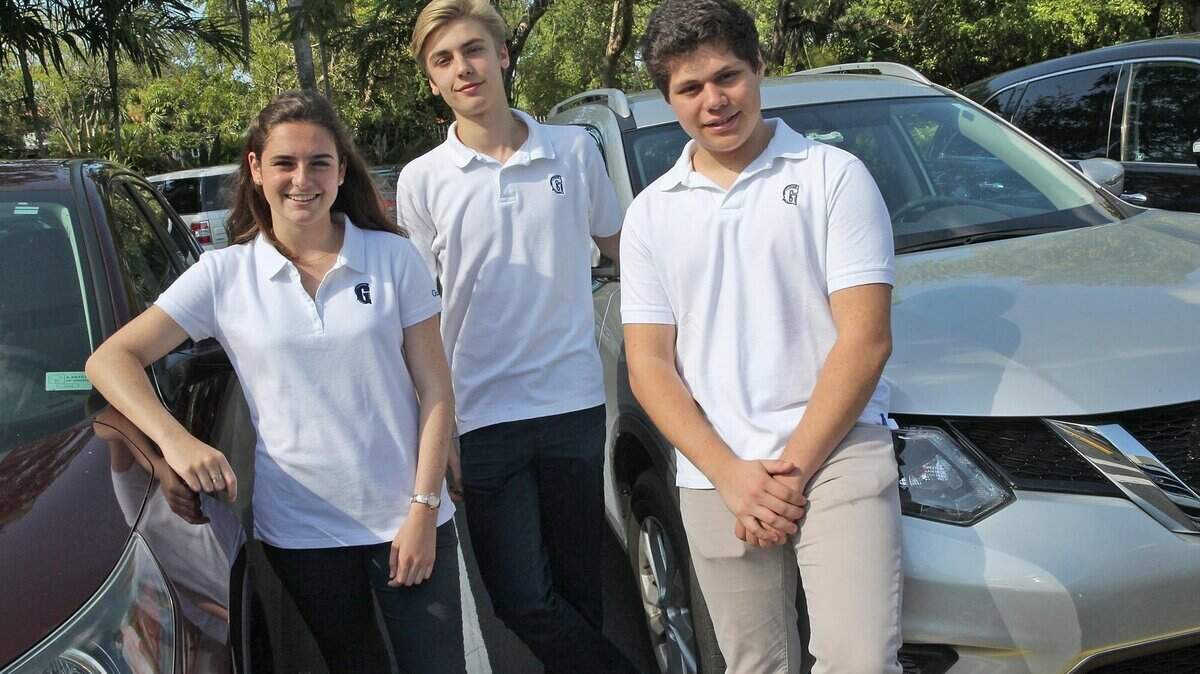
It was a chance encounter with a dog locked inside a hot car at a Whole Foods Market that got Gulliver Preparatory high school student Carolina Freund thinking. Instead of a dog, what if a child were in that car?
The result is SOL, Signs of Life, the concept that won second place in the 2018 Miami Herald Business Plan Challenge Teen Track.
Carolina joined forces with classmates Alexandre Roth and Santiago Vergara. Initial research indicated that nearly 2,500 children have suffered heat-related injuries inside locked cars over a 19-year period, and more than 700 of those resulted in death. “At the end of the day, the death of one child is one too many,” says Freund, 16, a junior.
For SOL, they imagined sensor and communication technology that would not only detect the presence of a child inside a locked car, but would also alert the parent and, soon after, the authorities. The business is in the concept phase.
Their business plan outlines a system of three sensors — thermal, pressure and low-powered radio — that would detect movement as subtle as breathing inside the car. Their plan reads: “If the sensors in the car detect a child, it would contact the owner of the car through an amber alert-style notification. After 30 seconds of no response … the doors will unlock and the alarm will start to sound as to attract as much attention as possible. An emergency contact will [also] be notified. After another 30 seconds of no response, the authorities will be contacted and given a location.”
SOL got the ear of some prominent politicians who are also hoping to find a solution to child mortality from hot cars. Sen. Richard Blumenthal (D-CT), a member of the Congressional Commerce, Science and Transportation Committee, introduced the HOT CARS Act of 2017 legislation last July “requiring all new passenger motor vehicles to be equipped with a child safety alert system.”
They also spoke with Xavier Hughes, President Barack Obama's Chief Innovation Officer for the Department of Labor. He told them, “The safety of my children is paramount to anything else. This product's ability to ensure their safety after a sleepless night or a stressful day at work makes it worth every penny; this is an amazing idea.”
Their teacher, Josue Basterra, a member of the Prep International Business and Entrepreneurship faculty, said, “SOL was very resourceful and self-driven. They spent a lot of time initially questioning whether there was a business there, but they went out, they asked people, they got feedback. They also worked very closely with our engineering teachers here at Gulliver to test different solutions.”
Initially, they see their product as an “aftermarket solution” sold directly to parents. After they prove the concept and start generating revenue, they hope to target car and baby seat manufacturers.
“We have started testing and prototyping different products,” says Vergara, 17, a junior who plans to double major in business and engineering in college. “We have 3-D sketches that we’re currently working on. We have talked to electrical engineers and other specialists in the field.”
Basterra also was impressed with SOL’s ability to define roles within its team: Vergara is the technical expert and engineer, Roth is the finance and numbers guy and Freund manages the brand’s public persona and relationship with the government.
Freund plans to major in political science, go to law school and become a corporate lawyer. Her family has a background in entrepreneurship and owns a chain of hardware stores in El Salvador. “I’ve been inspired to follow in their footsteps as a guiding force of what I might want to do when I’m older,” she says.
Roth, 16, a junior, hopes to study business in college and become an entrepreneur, following the lead of his father, who started a parking lot company in Brazil. This summer, he plans to travel to Brazil with his family and complete a three-week internship. Later, he’ll spend a month at Babson College in Boston for a summer entrepreneurship program.
Vergara says he gets his business acumen from his father, who is in finance. He plans to get a job this summer for practical work experience.
As for future plans with SOL, Roth says, “We’re still running the numbers, testing and simulating to see if we need to make changes to make this product the best that we can. Obviously, it’s the lives of children that we’re handling here and we want to make it as perfect as possible.”
This story was originally published May 2, 2018 at 6:24 PM with the headline "Teen concept could end deaths of children left in cars, saving dozens each year."