
Brazilian fans buzzing about Joao Fonseca, one of the talented teens at the Miami Open
Some of the best stories of a tennis tournament can be found away from Center Court, on the more intimate outer courts and practice courts. That certainly was the case at the Miami Open on Sunday afternoon.
In one of the far corners of the tournament grounds, outside practice Court 20, Brazilian fans pressed up against the fencing to catch a glimpse of rising star Joao Fonseca, the 18-year-old from Rio de Janeiro who has become a crowd favorite this week with back-to-back victories on Stadium Court.
“Joao! Joao! Joao!” the fans shouted, begging for selfies and autographs as the teenager left his practice session. Other Fonseca fans were perched along the top row of the adjacent Court 12 stadium, looking down into his practice.
Fonseca has had a meteoric rise from 2023 U.S. Open boys champion to No. 1 in the junior rankings to No. 60 in the world rankings. He is 26-4 since December and won his first ATP Tour title in Buenos Aires, becoming the youngest Brazilian champion in the Open era. He shocked No. 9 Andrey Rublev in the first round of the 2025 Australian Open, becoming the youngest man to beat a top 10 player there since 1973.
Monday night, he will play No. 10 ranked Alex De Minaur, and the match is scheduled for Stadium Court again.
“Joao is one of my idols,” said 15-year-old tennis player Pedro Martins, a Sao Paolo native who lives and trains in Port St. Lucie. “I became a fan of his when he made the quarterfinals of the Rio Open when he was only 17. I love his mentality, his focus, and how he talks to the fans. For us Brazilians, he’s our person. We love him. I think he can be No. 1 in the world in a couple of years.”
A few feet away, Sao Paulo native Erica Figuera, who moved to Miami four years ago, was standing on her tippy toes trying to catch a glimpse of Fonseca. She was there with her teenage daughter, who alerted her while they were watching a match that Fonseca was practicing.
They left the match and sprinted to Court 20.
“The last big Brazilian tennis star was Guga (Gustavo Kuerten), but that was a long time ago,” Figuera said. “My daughter and other young Brazilians never got to see him play, so this is their chance to see a great Brazilian player. I think the reason he is so popular is the passion he plays with. This is very important for us because all Brazilians are like this.”
The buzz around Fonseca has been building all week.
It started Thursday night when he beat American Learner Tien 6-7 (1-7), 6-3, 6-4 in front of an electric crowd that was largely Brazilian, wearing yellow shirts, waving Brazilian flags, and chanting “Joao! Fonseca! Joao! Fonseca!”
The scene looked more like a soccer game than a tennis match, and the courtside reporter joked that it was hard to tell whether it was Miami or Rio de Janeiro.
“I knew there were going to be a lot of Brazilians, but I didn’t know it would be that many,” a smiling Fonseca told a small group of reporters after the match. “I mean, 80 percent of the stadium were Brazilian, and if not, it seemed like it. I wrote on the camera lens, `Am I in Brazil?’ because I was really feeling at home.”
After the match, retired great Andy Murray posted on Twitter: “What an incredible atmosphere. Fonseca and Tien are amazing talents! Tennis isn’t broken after all.”
Saturday afternoon, when word got around that Fonseca’s match against Ugo Humbert was being moved from the Grandstand to Stadium Court, a sea of yellow and green began flocking across the tournament grounds to the stadium.
Nobody is more surprised than Fonseca about his quick rise. His mother, Roberta, was a volleyball player. His father, Christiano, likes climbing and biking. His brother is a surfer. Fonseca played soccer and tennis as a kid, and eventually gravitated more to the tennis court.
“Things got very fast, juniors, winning U.S. Open [juniors], and then after I turned pro everything got very, very, very crazy in a short time,” he said. “And well, here I am. Things in my career have been so fast, and are still happening. I’m still trying to process everything, but enjoying every moment.”
Fonseca is one of the young breakthrough players at this Miami Open, along with Russian 17-year-old phenom Mirra Andreeva, whose 13-match win streak was snapped Sunday night by Amanda Anisimova, who lives in nearby Aventura. Andreeva took a medical timeout and was clearly in discomfort during the match, but she continued to play. Anisimova prevailed 7-6 (7-5), 2-6, 6-3.
“Mirra is an amazing player, I knew it would be really tough,” Anisimova said. “It was an incredible match. I was super excited to play here. It’s my fourth Miami Open but my first time playing on stadium court.”
Andreeva, who is ranked No. 6, was coming off a title at the BNP Paribas Open in Indian Wells, California. She is 20-4 this season, the best record on the women’s tour. Her composure on and off the court are impressive, considering her age.
“It’s super cool to see someone so physically and mentally dominant at such a young age,” Miami Open defending champion Danielle Collins said of Andreeva. “Seeing the energy she plays with, the intensity, the passion, and not having a filter. And she’s still a kid, keeps it so fun.”
Madison Keys, the fifth ranked American and Australian Open champion, was beaten 6-4, 6-2 in the third round Sunday by another newcomer to watch, 19-year-old Filipino wild card Alexandra Eala, who has trained at Rafael Nadal’s academy in Mallorca since she was 13.
Eala, who entered the Miami Open ranked No. 134, has beaten two Grand Slam champions this week, Keys and 2017 French Open winner Jelena Ostapenko, whom she beat in the second round.
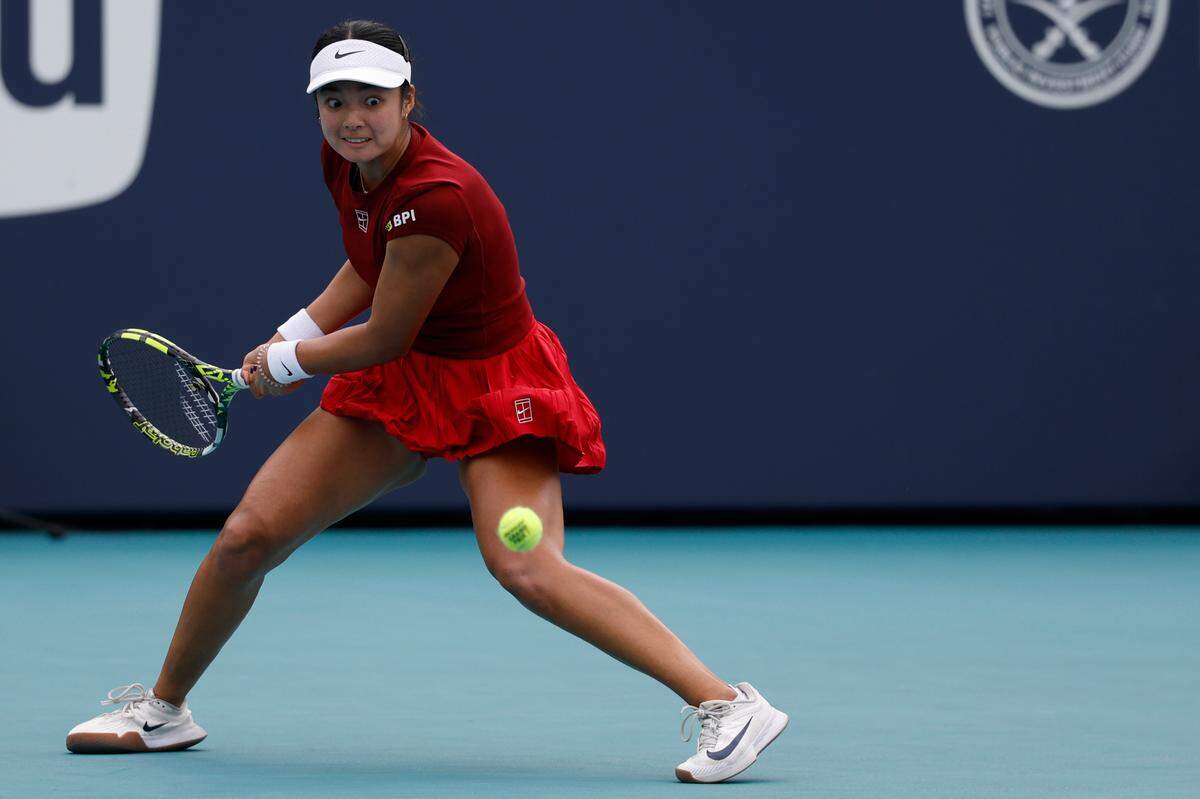
“Growing up it was tough, you didn’t have anyone from where you’re from to pave the way,” Eala said on the court after her win. “You had many people to look up to around the world, but I hope this takes Filipino tennis to the next step.”
In other Sunday matches: No. 2 Iga Swiatek reached the Round of 16 with a 7-6 (7-2), 6-1 win over Elise Martens, No. 24 seed Sebastian Korda upset No. 9 Stefanos Tsitsipas 7-6 (7-4), 6-3, and Grigor Dmitrov beat Karen Khachanov. French fan favorite Gael Monfils, 38, continued to turn back the clock and battled more than two and a half hours to reach the fourth round with a 7-5, 5-7, 7-6 (7-1) victory over Spaniard Jaume Munar.
Six-time Miami Open champion Novak Djokovic advanced to the Round of 16 with a 6-1, 7-6 (7-1) win over lucky loser Camilo Ugo Carabelli of Argentina.
Djokovic, the 24-time Grand Slam winner, is encouraged by rising talents such as Fonseca, Tien, and Jakub Mensik.
“Fonseca has been talk of the tour in the last several months. I mean, deservedly so,” Djokovic said. “He’s a very good tennis player. I mean, so young. Just incredible firepower from both ends of the baseline. Serve. He’s a very complete player. What is impressive is the way he strikes the ball, but even more so how he handles the nerves on the court for someone that doesn’t have experience at all playing at the highest level.”
He added that having a title contender from Brazil is good for tennis.
“He’s exciting for Brazil, for the world of tennis. I was saying back in Australia, for our tennis ecosystem, our sport, it’s super important to have a superstar, future superstar, hopefully coming from Brazil. Such a big country, big market, important. Of course, Miami, I think everyone knew that he’s going to have quite a support here.”
As exciting as Fonseca is to watch, Djokovic said, he is not the only teen player to watch.
“Maybe because people talk about Fonseca so much, they forgot about Mensik,” he said. “They’re the same age. Tien, as well. All those players are very young, but they have as good a ranking as he does. I think it’s exciting, I don’t know what should I call it, that new, new, new generation is bringing. Obviously [Jannik] Sinner and [Carlos] Alcaraz are the leaders of today, still very young. But then these guys, seems like they’re knocking on the door.”
This story was originally published March 23, 2025 at 5:34 PM.