Kelly: Dolphins built a roster full of exceptions. Has Miami lost its way? | Opinion
The Miami Dolphins clearly have not renewed the team’s subscription to Bill Parcells’ “Planet Theory,” a bigger-is-better philosophy that has governed many teams in the NFL for years, and that might explain why South Florida’s NFL franchise annually fades at the end of the season.
Even though Parcell’s three-year reign as the Dolphins’ top executive didn’t live up to the franchise’s expectations, and concluded early because of a brewing feud between then-coach Tony Sparano and general manager Jeff Ireland he wanted no part of, Parcells’ way — his teachings — still permeates throughout the NFL.
One in particular could explain the late-season fades that have plagued this franchise the past few years.
“Start drafting exceptions and you’ll have a team full of exceptions,” Parcells preached.
That’s a Parcell-ism I learned in 2008 when Ireland was teaching me about the importance of size molds.
He provided plenty of examples that reinforced why Miami stuck to position-by-position prototypes, which serve as the blueprint for players to draft and add as free agents.
The analytics community has since poured gasoline on these prototypes, helping teams create blueprints for their scheme based on size and measureables.
Stray from these prototypes for height, weight, speed and athleticism and next thing you know “you’ll have a team full of players who don’t fit the mold,” Ireland explained.
Eventually, with enough cycles of exceptions, you will have a substandard roster, one that struggles to stay healthy, and runs out of gas at the end of the season.
“As time has gone on my [thought] process has expanded a lot more. I’ve become a lot more open-minded to speed, size, and different discrepancies,” Dolphins coach Mike McDaniel said “I’m less rigid in the starting point and absolutes, which is probably [something that started] 10 years ago.”
Coincidentally, or not, that approach could be the problem South Florida’s NFL franchise has had for a decade plus.
Think about it.
Tua Tagovailoa is third-smallest starting quarterback in the NFL.
The sixth-year starter is only bigger than Carolina starter Bryce Young and Arizona starter Kyler Murray.
But Tagovailoa is also the league’s most fragile quarterback, and that goes back to when Miami drafted him in the first round the summer after he sustained a career-threatening hip injury while playing for the University of Alabama.
At 5-foot-9, 191 pounds, De’Von Achane is one of the NFL’s quickest tailbacks, but he’s also the league’s smallest starter.
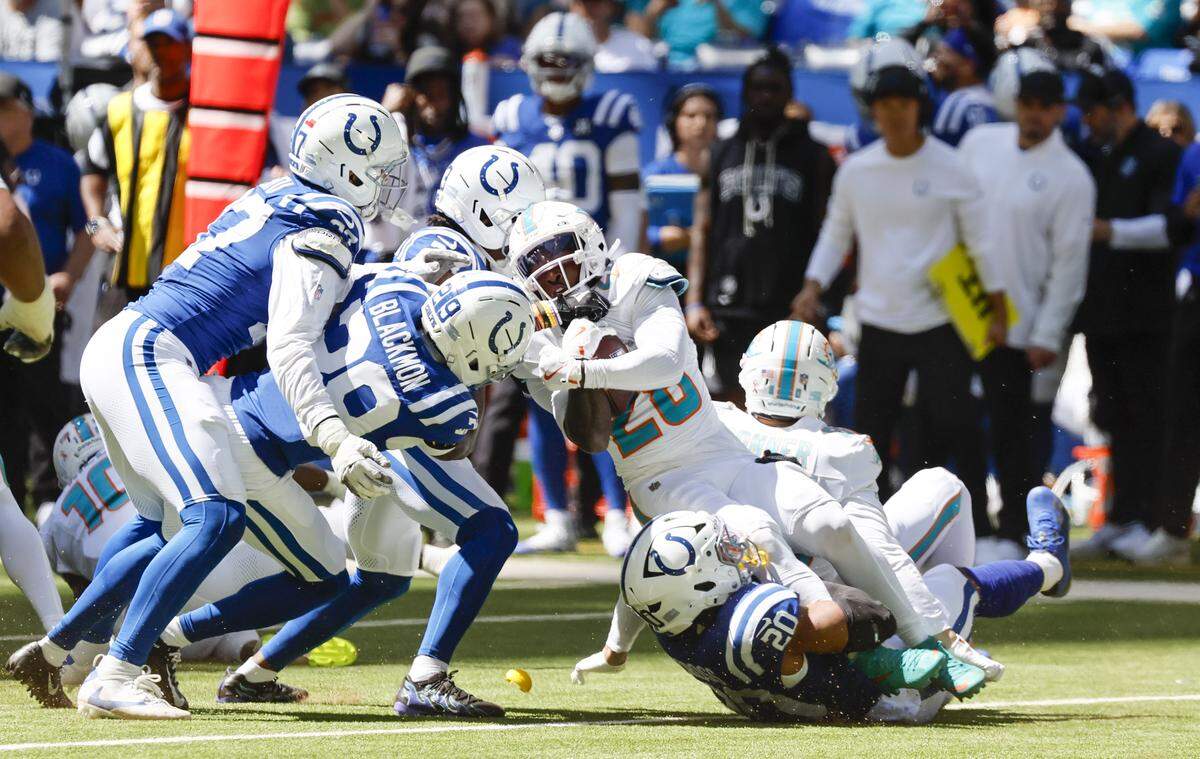
And Jaylen Wright, who is supposed to be the tailback who complements Achane, is only an inch taller, and 17 pounds heavier.
So with the exception of Ollie Gordon II, who is 6-2, 225 pounds, the Dolphins have a small tailback unit.
All but one (Nick Westbrook-Ikhine) of the six receivers on the Dolphins’ 53-man roster are 5-foot-10 or shorter.
Both of the tight ends who will play in Sunday’s home opener against the New England Patriots are former undrafted players, and one is a former college receiver.
We’re talking one to three inches here, and 15 to 25 pounds there. But when you add it all up the Dolphins become one of the NFL’s smallest teams at the skill positions.
And the exceptions don’t stop with the playmakers.
The Dolphins have the NFL’s smallest starting centers in Aaron Brewer, who checks in at 6-1, 295 pounds.
Miami has a foursome of what is viewed as small inside linebackers. Willie Gay Jr. is the biggest of the group at 6-foot-1, 246 pounds, and he’s been knocked throughout his career for his size.
Just this past offseason Miami put an emphasis on fortifying the trenches, correcting a past wrong, adding players with size and girth on the offensive and defensive line via the NFL Draft. We haven’t yet seen if that newfound emphasis is paying off.
The bottom line is that the roster general manager Chris Grier has built for Mike McDaniel and his staff to coach is full of NFL exceptions, and that’s not a healthy place to be.
Considering Grier served as director of college scouting during Parcells’ reign over the Dolphins, and worked under Ireland for six seasons, you would think he would know better.
But this isn’t solely his fault considering McDaniel has an obsession with speed, which has subsequently made a player’s 40 time and quickness more important than him fitting the size molds NFL teams use.
While the NFL is consistently changing, nobody in this organization should be surprised when the Dolphins are labeled a finesse team, and the roster’s toughness is consistently questioned, like it has been for McDaniel’s entire tenure.
In fairness to McDaniel, he comes from the Mike Shanahan coaching tree, and the former Denver Broncos and Washington Commanders head coach works from a different, less size obsessed blueprint than Parcells.
And it can be argued that Shanahan’s blueprint has been just as successful as Parcells’.
Some might say Shanahan’s blueprint is more relevant today than Parcells’ because the Bill Walsh protege has a thriving coaching tree — Kyle Shanahan (49ers head coach), Sean McVay (Rams), Matt LaFleur (Packers), Raheem Morris (Falcons) and McDaniel (Dolphins) — while all that exists of Parcells’ proteges in the league today is Denver coach Sean Payton, Tampa Bay’s Todd Bowles and Detroit’s Dan Campbell.
”The NFL is about evolution,” McDaniel said. “The game is the same but the principles and how people play it is always evolving.”
Hard to say whether that evolutions is a good or bad thing sometimes, especially without knowing the final outcome.