Kelly: Why has the Dolphins run game clammed up lately? | Opinion
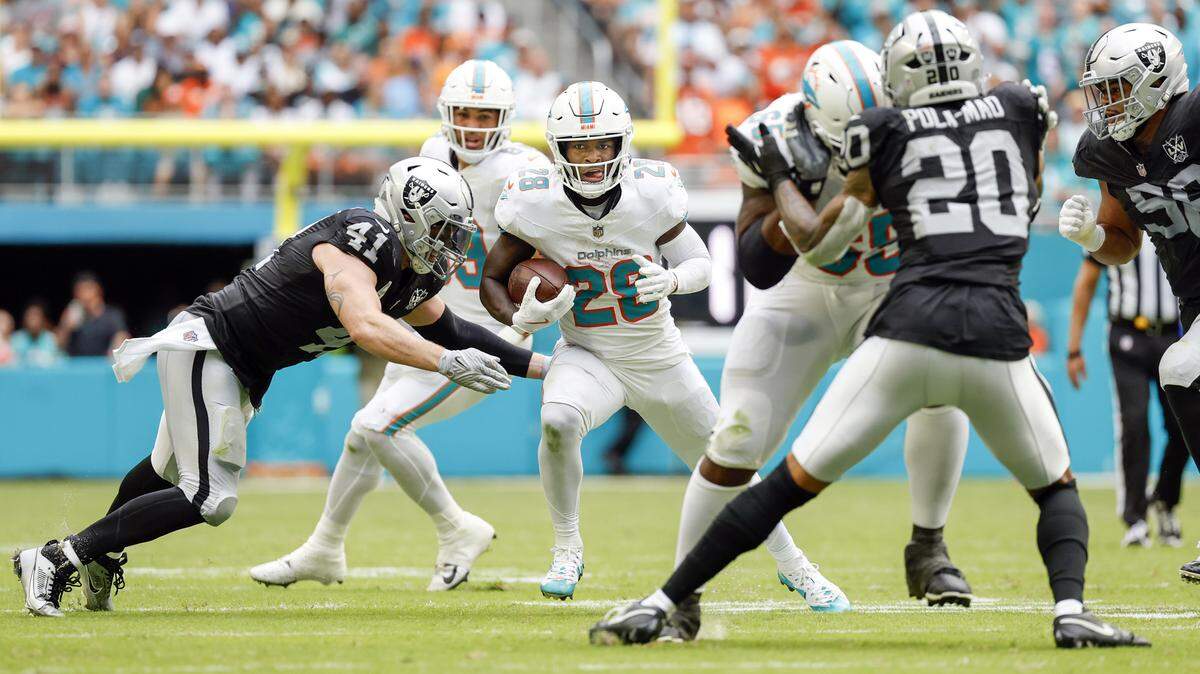
Terron Armstead hasn’t practiced in two weeks because of a lingering knee issue, or is it his advanced age?
“It don’t matter,” said Armstead, a five-time Pro Bowl left tackle who when healthy is a major catalyst for the Miami Dolphins run game considering he can routinely be found 10-to-20 yards downfield blocking for his tailbacks in his 12th season.
Fullback Alex Ingold, the battering ram who helped Miami’s I formation plays thrive earlier this season, is working his way back from a calf injury that has limited him to nine offensive snaps in three games.
And Raheem Mostert, the Pro Bowl tailback who set a franchise record with 21 touchdowns last season, is having one of his worst NFL seasons.
Mostert, who is averaging 3.6 yards per carry this season, lost his starting spot to De’Von Achane, and is actively working his way out of the coaching staff’s doghouse after committing two costly fumbles that contributed to two losses earlier this season.
Whatever the reasons, the Miami Dolphins’ run game has eroded lately.
Miami’s opponents have seemingly adjusted to the impressive stretch the team had earlier this season where they were 1-yard shy of rushing for 150 yards in three straight contests.
The Dolphins (5-6) gained 67 rushing yards on 22 carries in a 23-15 win against the Los Angeles Rams.
In Miami’s 34-19 victory against the Las Vegas Raiders the Dolphins gained 82 yards on 26 carries, and last week against the New England Patriots the Dolphins gained 65 yards on 24 carries in last Sunday’s 34-15 win.
“Man, we play New England two times a year and the first game we played them we ran the ball down their throat,” starting left guard Robert Jones said, referring to the 193 rushing yards Miami gained in the Week 5 victory against the Patriots. “This time they had a good scheme, a good game plan and as an offense we didn’t execute everything we wanted.”
That seems to be a trend the past few weeks, which explains why the Dolphins have averaged 2.97 yards per carry the last three games. That drought has plummeted the team’s 4.07 yards per carry average, which is .35 below the NFL’s average of 4.42 yards per carry.
Even though the Dolphins are riding a three-game winning streak, finding a way to jump start that aspect of the offense is the only thing stopping the Dolphins from being a December powerhouse in my humble opinion.
The run game is critical in December games because it translates to cold weather games, like the Thursday night nationally televised contest the Dolphins will play against the Green Bay Packers.
Think about it for one minute.
Imagine putting Tua Tagovailoa’s pass game efficiency with last year’s rushing attack, which produced 2,308 rushing yards, 27 touchdowns and averaged a league leading 5.1 yards per carry.
That should be the goal. But if we listen to Miami’s coaches, the passing game success is the reason the volume has been turned down on the run game.
“Sometimes they add another guy in the box which leaves them a little light on the perimeter, and then it’s your job as an offense to take advantage of that,” coach Mike McDaniel said.
“I think situationally, we’ve evolved as a football team and an offense in this case to where we’re just a little more adept at doing a variety of things,” he continued. “So you can kind of — when the matchups make sense, you can replace a couple runs with some aggressive quick game where your offensive line can short-set and still be aggressive as what the run game offers.”
But why can’t Miami — which has the 16th-best rushing attack, gaining 116.8 rushing yards per game, and 4.07 rushing yards per carry, which ranks 23rd - have both?
Keep in mind the Dolphins possessed the second-best rushing attack in the NFL last season, and did that despite finishing the season with three backups on the interior of the offensive line. Coincidentally, three of those backups are starters on Miami’s offensive line now.
“It’s efficiency,” offensive coordinator Frank Smith said when addressing the run game’s goals. “You obviously want to make sure that you’re always staying on schedule. However, our job is to score points. And if they’re going to defend a certain way to stop the run, OK, what’s the complement so that’s where we make sure that when we build the attack, if they’re trying to overcommit to stop something, they’re going to be vulnerable somewhere else.”
The problem is, those two styles should feed off one another in an ideal world, and that hasn’t happened yet. And it could be what keeps this team from turning the corner, performing well in these critical December games.