Kelly: Does Tyreek Hill have a future in Miami?
NFL receivers are pulling in record-setting contracts at the rate they’ve been pulling in receptions during this pass-happy era of football.
Justin Jefferson is the latest NFL wideout to receive a pace-setting contract from his employer, reportedly landing a four-year, $140 million contract extension from the Minnesota Vikings, which includes $110 million in guaranteed money.
With that deal Jefferson resets the receiver market, which was previously reset when the Philadelphia Eagles adjusted A.J. Brown’s deal earlier this summer, giving the three-time Pro Bowler a three-year extension worth $96 million, which reconfigured his contract, giving him a six-year deal worth $133 million.
This has been the summer for receiver extensions, which includes the five-year, $105 million contract the Dolphins signed Jaylen Waddle to last week, locking up the former Alabama standout till the 2028 season.
That leads us to wonder when Tyreek Hill, a five-time All Pro receiver, will get his contract addressed by the Dolphins?
IS HILL WORTHY OF AN EXTENSION?
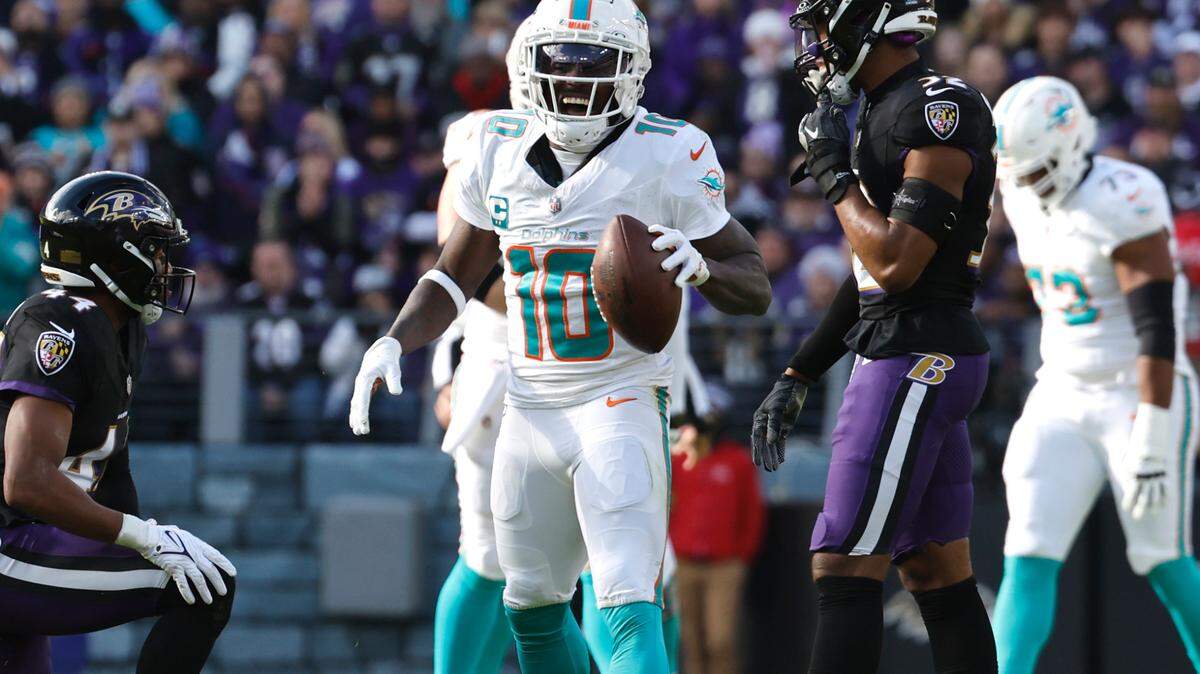
Hill, who turned 30 in March, has been one of the most dangerous weapons in the league since the 2017 season, and has taken his game to another level in Miami, producing 3,509 receiving yards and 21 touchdowns the past two seasons.
If the eight-time Pro Bowler stays on his present pace of producing 1,000-yards seasons for the next three or so years, he’ll seemingly be a lock for the Pro Football Hall of Fame and might gain first-ballot entry into the sport’s collection of legends.
Hill, who signed a four-year, $120 million contract extension when Miami acquired him from Kansas City two offseasons ago, was the highest-paid receiver in the NFL before this summer. But the guaranteed money portion of his contract concludes this season, and for players of his caliber that means it’s time to get a new deal.
Players like Jefferson, Brown and Calvin Ridley, who signed a four-year, $92 million deal with the Tennessee Titans, have raised the bar on how much Hill could demand if he produces like he has the past two seasons.
While his contract with Miami averages $30 million a season, Hill is really pulled in $24 million a season because he’ll likely never see his $45 million payday that’s slotted for the 2026 season. That balloon payment is only in the deal to artificially inflate his average salary. But the Dolphins have no intentions of paying Hill that, and he and his agent Drew Rosenhaus know it.
That means the window to get a deal done was/is this offseason.
DOLPHINS OPTED NOT TO EXTEND HILL
However, when Miami needed to clear $37 million in cap space before the start of the new league year on March 13, the Dolphins did everything but adjust Hill’s contract, and that was clearly intentional.
There can only be two theories why the franchise’s decision makers took that route.
Either Miami wanted to wait it out with Hill, who had a couple of off-field incidents that created unfavorable headlines the past two offseasons, and hesitated on extending his deal because of his conduct, or advanced age.
Or the team approached Rosenhaus about an extension, or contract adjustment, and a deal couldn’t be consummate.
It’s possible that Rosenhaus, who landed a pace-setting contract for Texas’ Nico Collins last month, was waiting for Jefferson, and possibly Cincinnati’s Tee Higgins and Ja’Marr Chase to reset the market.
Either way, the Dolphins will find themselves in an uncomfortable spot with Hill in the coming months as the peers he continues to outperform get raises, and he’s slated to make $19.8 million in 2024, and $22.9 million in 2025.
If the Dolphins added two years to Hill’s deal, and bumped up salary another $2-4 million a season the cap charge would drop from $31 million to $17 million if he’s given a $20 million signing bonus. And the charge would be reduced in each of the following two seasons as well.
The only downside of extending Hill’s deal is gambling on whether he’ll still be worth $24-28 million a season in 2025, and 2026 season, which is when the guaranteed money in a new deal would exist. But it’s hard to envision a player who was on pace to produce 2,000 receiving yards before suffering a troublesome ankle injury in the season’s final month falling off drastically, even though he’s struggled to finish the season healthy the past two years.
Hill hasn’t shown any signs of slowing down the past two seasons, and at this point the Dolphins franchise should be more worried about what Miami’s offense would look like without Hill than what an aging Hill can deliver.