
Cote: How Miami Project and forgiveness turned Marc Buoniconti’s tragedy to triumph
It was a third-and-1 play in the first minutes of the football game in Johnson City, Tennessee. This was a second-tier, small-college contest in what was then called NCAA Division 1-AA: East Tennessee State hosting The Citadel. No network TV was there that Saturday. Nobody cared but the two teams.
“The game was sort of ordinary,” Marc Buoniconti said.
It was until it wasn’t. Lives were about to change, one in particular. Well, two, really. And later, thousands. Because, not so far to the south, Miami was about to change, too, in a way profound, and everlasting.
An East Tennessee running back named Herman Jacobs took a pitch that afternoon and ran forward as the defense closed in.
“I’m on my horse,” recalled the then-19-year-old defensive player. “I’m running as fast as I can. I dove trying to stop him. I felt my body drop like a ton of bricks.”
The Citadel linebacker made the tackle, and it was the last one of his life.
Marc Buoniconti would never run again, or walk. “Before I hit the ground I was paralyzed,” he said.
As trainers and medics rushed onto the field that day, Jacobs stood watching on his sideline. He would never be the same again, either. His life had begun to wither, and sink.
It happened on October 26, 1985, 40 years ago.
This is the furthest imaginable from a happy anniversary, and yet it is one worth marking, worth appreciating, because it symbolizes what it looks like when tragedy becomes triumph. It also symbolizes the power of forgiveness to heal not body, but heart and soul.
The world-renowned Miami Project to Cure Paralysis exists to the magnitude it does today because of the catastrophic injury that, in an instant, rendered the young Buoniconti a quadriplegic with no use or feeling in his arms and legs.
It was that very day that Buoniconti’s prominent father contacted an equally prominent Miami neurosurgeon and, within weeks later in ‘85, Nick Buoniconti and Dr. Barth Green had co-founded The Miami Project — Marc’s life-altering injury the impetus.
Dr. Green already had been leading a research center focused on spinal cord injuries, but said this week, “The catalyst was Nick and the objective was Marc’s health. No doubt that was our booster shot. The launching pad. We went from being a good [local] center to international leaders. We couldn’t have done it without Marc and his family.”
The Miami Project is the medical research force of the initiative and part of the University of Miami School of Medicine. It is changing medical history. The affiliated Buoniconti Fund was later set up to help raise funds and awareness. Together the groups have raised more than $550 million toward research. Their annual gala fundraiser was held last month in New York, though Marc, who turned 59 that weekend, was not feeling up to attending.
Marc is aided by a nurse caretaker around-the-clock and by his partner, Cynthia, whom he calls “the love of my life.” Buoniconti’s mother Terry, a brother and sister also are very involved in his daily life. But the challenges are great and ongoing. Recently, for example, he has had difficulty speaking because of an illness related to his condition. (Thus many of Marc’s comments seen here were provided by The Miami Project or Buoniconti Fund.)
He fights on. As a sign in one his rooms reads, “NEVER NEVER NEVER GIVE UP.”
It was different for Marc growing up in Miami as the son of Nick Buoniconti, the longtime Miami Dolphins star linebacker, a force in the team’s 1972 and ‘73 Super Bowl championships, and a Pro Football Hall of Famer. Nick was famous for football, both playing and as a broadcaster, and wealthy both for that and as a high-end attorney whose clients included U.S. Tobacco.
Doors opened around town for a son of that father. Marc was a partier, the ‘80s teen of a rich and famous dad. While attending all-boys Miami Columbus High, him and some friends once thought it would be fun to go streaking through the courtyard of all-girls Lourdes Academy.
“If I didn’t have this injury, I might be in jail or dead,” Marc once told a friend.
I recall last seeing Nick Buoniconti among many former Dolphins players at a 2015 event in honor of the franchise’s 50th anniversary. Most of the old ex-players wore frumpy jackets and walked with limps. Buoniconti wore a tailored suit and glided regally through the cocktail hour looking like a retired senior U.S. Senator.
The elder Buoniconti would die of pneumonia in 2019 at 78. He became one of the hundreds of NFL players diagnosed posthumously with Chronic Traumatic Encephalopathy (CTE), the neurodegenerative disease linked to repeated trauma to the head — linked to concussions ... linked to football.
Buoniconti knew near the end of his life that the sport he loved was helping kill him.
In 1985, he was coming to grips over the same sport putting his son in wheelchair. Compounding the tragedy, the family came to learn Marc never should have played that day after sustaining a neck injury the week before.
“Nick didn’t want him to play; he had arguments with the coach and trainers,” Dr. Green told us. “They wouldn’t X-ray his neck. He actually had some fractures. In the ‘80s the rule was if you didn’t practice you don’t play. They were so desperate [for Marc to play] so they figured out a way to send him out there. They tied his helmet to his shoulder pads so he couldn’t move his head. That’s how he got paralyzed.”
There was an acrimonious lawsuit filed in 1988 on Buoniconti’s behalf against the school and its trainer and team doctor, both sides blaming the other. Eventually a settlement was reached. Nick went to his grave angry The Citadel had let Marc play that day.
Marc went years estranged from his former school as well, but it was the eventual reconciliation that helped him heal.
It helped someone else heal, too: Herman Jacobs, the opposing running back whom Buoniconti had tackled that fateful day.
Jacobs hadn’t led the easiest life. He lost his brother at a young age to gun violence. Left East Tennessee without a degree after his part in that tragedy left him sinking. He got divorced. Pinballed among menial jobs. He never left Johnson City, but he was lost. Buried in guilt over what he had done to Marc Buoniconti, able to rationalize but not to feel that he wasn’t to blame.
“Twenty years or longer I had that guilt,” Jacobs told us this week.
Then he met the one person he always had to but was too afraid: The guardian angel he’d put in a wheelchair.
The Buonicontis and The Citadel remained estranged until 2006, when, the day before he turned 40, Marc was invited back on campus to have his No. 59 football jersey retired in a halftime ceremony. Around that time Marc and his former teammates began reconvening around the campus for an annual tailgate party/reunion.
That in turn led Marc to act on a long-held desire to reconnect with Jacobs.
A Citadel teammate who knew that, Joel Thompson, tracked down Jacobs and gave him Marc’s phone number.
“I was scared to death to call him,” Jacobs said. “I didn’t call him right away. Two or three days later, I got up the courage. I had looked back at me being responsible for what happened with Marc. Twenty years or longer I held that guilt. Then he really let me know I wasn’t to blame, and I started feeling a lot better about myself. And our relationship started growing from there.”
Today, 20 years of guilt have dissolved into what’s going on 20 years of friendship. Forgiveness has helped mend both men.
“It was a healing process when I was talking to Marc,” says Jacobs. “More and more I wanted to be there for Marc. He’s my brother. I love him to death.”
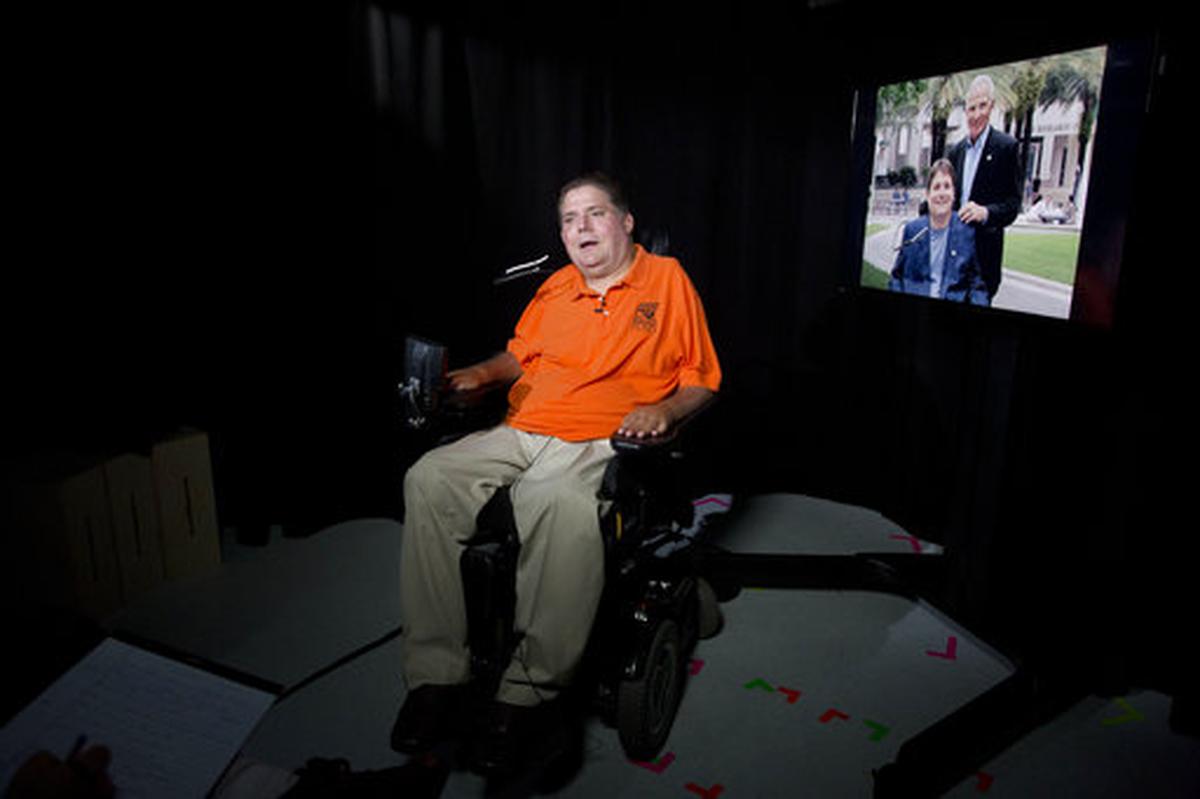
What led Buoniconti to want to speak with the stranger fate had connected to him?
“It just felt like something we were missing,” Marc said. “We helped each other. I’d heard [through others] he’d been really hurting. He was really having trouble in his life. I wanted to have a friendship, and for all of the past and all the negativity to drip away. And I saw that man change. We were brought together by an instant none of us could have ever prepared for. But sometimes you have to take an obstacle and make a reason why.”
Marc invited Jacobs to one of those campus tailgate reunions and, there, asked him, “What are your dreams?”
“I told him I always wanted to be a chef.” Because his mother and grandmother in the kitchen growing up had instilled that in him, and formed some of his best memories in a tough childhood..
Buoniconti set him up at Miami’s famed Johnson & Wales culinary program, watched him graduate.
Jacobs is two years older, but, Marc said, “I felt like a proud father.”
“Marc really opened the door for me,” says the grateful graduate.
They became so close that Jacobs lived with Marc for a time, helped care for him. They became closer than brothers, for what brought them together had the power to tear most apart.
Today Jacobs is a certified chef who works as kitchen supervisor at the famed Columbia Restaurant in Ybor City, near Tampa. It serves Cuban cuisine. He loves cooking Italian, personally.
“One thing I need to do for Marc is cook more,” he said, smiling.
Marc says of the man he calls his brother, “Crazy forces brought us together, and we’ve both bettered our lives by being together.”
The son fights on to forward his father Nick’s dream of helping find a cure for paralysis.
That catastrophic injury on a football field 40 years ago gave rise to the groundbreaking Miami Project and the Buoniconti Fund, both inspired by the man who remains their spiritual leader.
That day put Marc Buoniconti in a wheelchair but could not keep him down. It took the use of his arms but not the strength to lift Herman Jacobs from 20 years of guilt.
Tragedy to triumph, with forgiveness the bridge.
* * * * * * * * * *
To learn more about The Miami Project to Cure Paralysis visit www.TheMiamiProject.org or call (305) 243-6001. For more about the Buoniconti Fund visit here.
This story was originally published October 23, 2025 at 10:49 AM.
