
With thanks, here is how Don Shula meant the world to one father and son. The boy was me | Opinion
There is no better way to tell how much Don Shula meant to Miami and South Florida — to me and to generations of others — than to make it very personal. Start there. Because Shula was family, one of us. He was a part of the timeline of our lives, and such a big reason we cheered, drew together and felt pride as a community like we had never known before.
I was a pimply kid who’d just turned 15 when Shula first arrived, and a married father of two when he retired. Along that quarter century of my life there was no greater constant than the familiar coach steady on a Sunday sideline, arms folded across his chest and jaw jutting as his Miami Dolphins went to work, and won, and won, and lifted a city.
Donald Francis Shula left us Monday at age 90.
It was a death in the family.
The memories he created won’t leave us. They are eternal. They are his legacy. He is our heirloom.
Bob Griese, Dick Anderson and Larry Csonka were the former Dolphins who knew Shula longest. It’s funny, but when you talk to Shula’s players about him, the stuff you would expect — the Perfect Season, the back-to-back Super Bowls, the most wins ever — mostly comes up if you ask.
They want to talk more about the man than the coach. They want to talk about towering integrity.
Griese lost his father at age 10, to a heart attack while he slept. He called Shula “a father figure that I never had.” In the end, said Griese, “I lost a great friend.”
His old quarterback was the last former player to see Shula alive. They met for lunch at Gulfstream Park in March, just before the global coronavirus/COVID-19 shut everything down, a pandemic that would mean the mourning for Shula would get no public memorial, at least for a while.
Anderson recalls that Shula could be ornery with a wink. A teammate once asked the coach why he screamed at Anderson so much.
“He plays better when I yell at him!” came the answer.
Csonka said he never truly knew the depth of his feelings for the old coach until the morning his wife gave him the news.
“I felt a terrible loss,” said Zonk, his voice cracking. “I have never witnessed a more dedicated, ethical man.”
Most of the people Shula touched, he never knew.
Miami Dolphins first playoff victory
At the end of his second season here, on Christmas Day 1971, the Dolphins would win the first playoff game in their brief history. It was “The Longest Game,” in snowy Kansas City. It made kicker Garo Yepremian a folk hero, and began the minting of what would be Shula’s enduring, nearly mythic stature in South Florida.
In a lower-middle class home in west Hollywood, Florida, that Christmas, as Garo’s field goal knuckled true on our black-and-white Zenith TV as dusk fell, my father and I embraced and pogoed up and down, hugging all the while.
The fist bump and high-five hadn’t been invented yet. We improvised — moved by the kind of joy local sports had never shown us. Truth be known, the Cotes were never one of those touchy-feely families. My father was a carpenter who worked a second job helping a friend repair cars. He could be a gruff, irritable man.
That day was the first time I ever recall my dad and I hugging.
We were huggers the rest of his life.
I always felt like the Dolphins did that for us — Shula’s Dolphins — and that my father felt the same. We never spoke it aloud.
Thousands of Dolphins fans flocked to the Miami airport that night and waited, some for hours, to welcome the Dolphins home from their historic, watershed first playoff triumph. This was before the Internet. The reception was not organized, it was organic. Spontaneous. Surreal.
It was the bottom of our state, rising up. Announcing itself. There was no Heat or Marlins or Panthers back then. No heyday for Canes football. In sports, we were small time.
But thanks to one man, Miami had now arrived, Don Shula at the wheel.
My dad and I were there for that sudden combustion of celebration and civic pride. So, I found out much later, were my future wife whom I wouldn’t meet for seven more years, in college, and her mother.
(Within a year, I would answer an ad in the paper and be hired by the Miami Herald as a part-time clerk, answering phones and writing a local bowling column. What turned into a long career still going allowed me to know Shula well years later on a professional level, but what he meant to me personally, growing up, was something I could not separate, nor ever wished to).
Shula’s final season with Dolphins
Fast forward to the summer of 1995.
Don Shula was beginning his 26th season as Dolphins coach.
Nobody knew it would be his last.
My father was then about to turn 80, his health ebbing. It seemed the older he got the more he talked about Shula and those glory-days Dolphins. About things that made him happy, before all of the years raced past and took so much. “1972” and “17 and 0” meant only one thing and grew over time, the way legends do.
I did something that summer I rarely have ever done in my career. I used my standing as a sports columnist to ask a favor. Could I bring my elderly dad to training camp and have him meet Shula after a practice?
The great coach not only agreed but invited my father up into his office at the still-new Davie training camp. To my blue-collar dad, who never finished high school and won a Purple Heart in World War II, that office seemed palatial. Fit for a king.
“You gotta tell your son to go easier on me in what he writes!” Shula barked, shaking my father’s hand.
Dad took a second to know Shula was kidding and then broke into a huge, relieved smile.
We spent a good 15 minutes in his office, and Shula autographed the white panel of a football that my dad gripped tight as Zonk ever did crossing a goal line as we left.
Dad didn’t say much on the drive home, but he would talk about that day often the rest of his life, sometimes with slight embellishments that made me smile.
Wilfred Joseph (Bill) Cote passed away in 2004 at 88.
Shula left us in 2020 at 90.
One was my father, the other not less than the father of Miami sports.
And it struck me as the news of Shula’s passing rolled like tears across us last week, the news breaking like Dolfans’ hearts.
With Shula, as with an aging parent, you can have years to prepare for the inevitable, to expect the day. But when it comes you are never quite ready.
The mind insists your loved one “lived a long, full life.”
The heart aches it still ended too soon.
Joe Robbie signed football
My dad had been a carpenter at the old Everglades Hotel, which used to be on Biscayne Boulevard across the street from where the Miami Heat’s arena is now. The original expansion Dolphins held their Touchdown Club fan meetings at the Everglades, and once dad brought me home a football that owner Joe Robbie had signed.
I had a Dolphins pennant on my bedroom wall back in those days. (Remember pennants?). I collected Dolphins player cards that Royal Castles gave out. I remember the pro wrestler-turned-linebacker Wahoo McDaniel wore an Indian headdress on his. There is a rusted original Dolphins seat cushion in my garage to this day that I cannot bear to throw away.
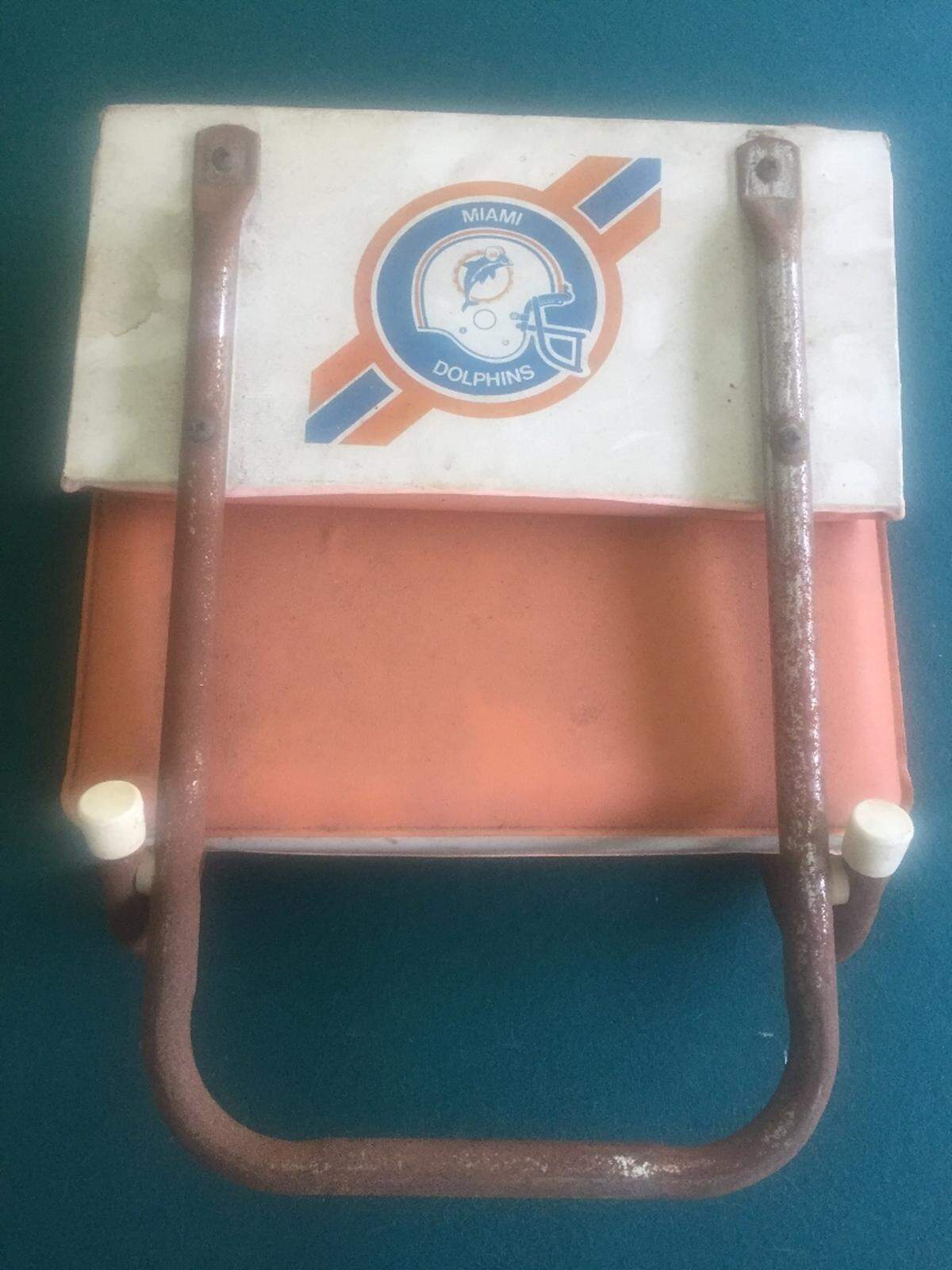
The Miami Dolphins were what my father and I had in common, and for so long the Miami Dolphins were Don Shula. He was our bond. Dad would come home from work, bone tired, and I would toss him a football and we would head to the backyard, where I would run routes and he would throw passes. I was Paul Warfield.
We were in the Orange Bowl for that first ever AFL game in 1966. We would watch the Dolphins every Sunday in our living room. Dad was not a churchgoer. He joked that he prayed every Sunday morning at “St. Mattress.” The Dolphins were our religion. My mom wasn’t interested and my older brother was away in the Army. It was just dad and I.
Growing up, the only time I ever heard him curse was when his beloved Dolphins lost a crucial fumble or were victimized by the !@#$%&! referee.
He was ready for a fight if anybody ever criticized Don Shula.
The only times in my life I ever saw my father cry were when John F. Kennedy was assassinated, a faint memory, and when Shula was made to retire some five months after that summer we had visited him, that memory distinct.
Life goes on, until it doesn’t.
The news cycle is merciless.
Shula’s passing was all over ESPN.com’s main page the Monday he died. By late Tuesday it was nowhere to be seen.
It is different in Miami and South Florida.
The loss is indelible.
We have had a death in the family.
So many of us grew up with the Dolphins, grew up with Shula, in a way that isn’t true of our other teams or anything else in our lives. The coach who grew old with us endures as the face of halcyon days, the face of glory — the memories all that is left for Dolphins fans who lived that magical distant time that has seen no reprise.
Wistfully now we face our own mortality as we hold the memories dear and grip the heirloom tight.
Donald Francis Shula was more than we dared ever dream.
This story was originally published May 7, 2020 at 12:12 PM.
