
Van Dyke stays at UM after receiving NIL overtures elsewhere. Ruiz discloses his own plans
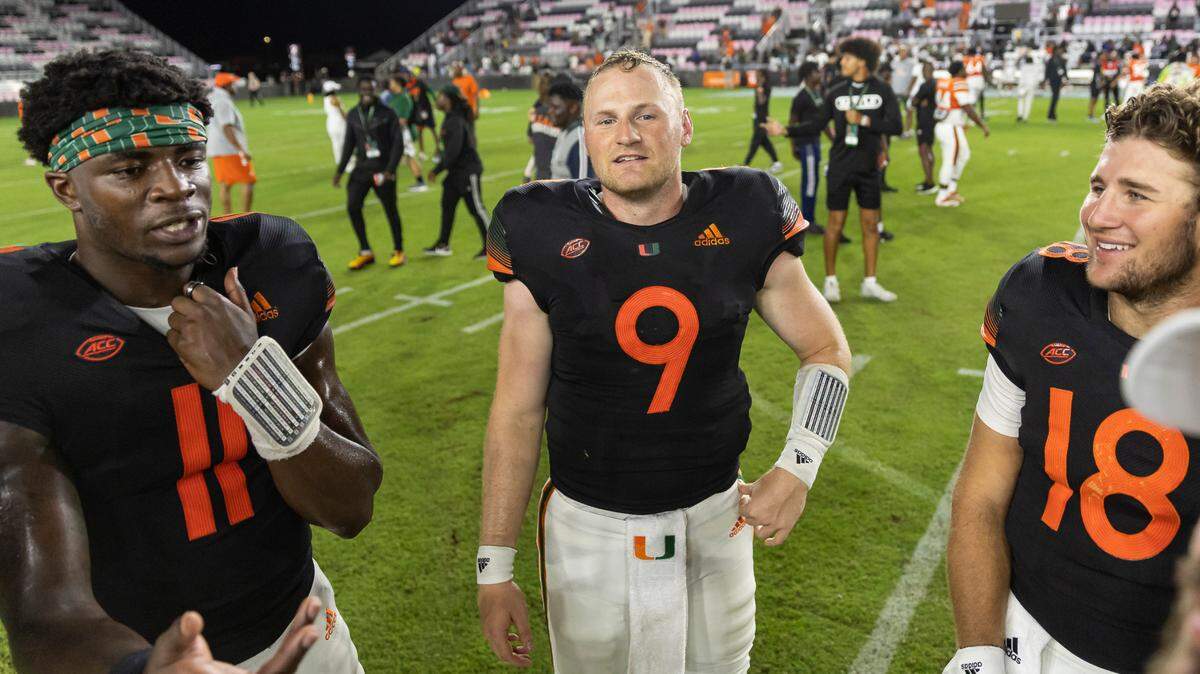
Quarterback Tyler Van Dyke has decided to stay at Miami, according to a source, in the wake of a report that he was weighing whether to enter the transfer portal.
Canesport reported Thursday morning that Van Dyke and his camp are “frustrated” with the total value of his NIL deals at UM and have substantial offers from other schools.
Drew Rosenhaus, who handles Van Dyke’s NIL deals, declined to comment.
But a source said Thursday evening that Van Dyke will remain at UM and downplayed any suggestion that he planned to leave. “When was he ever leaving?” the associate said.
Van Dyke also retweeted a tweet from the Hurricanes official twitter account which said: “Relentlessly working. All focus on 2023. 100% CANE!”
Meanwhile, UM benefactor John Ruiz — who has been financing the vast majority of NIL deals involving UM players — said the report of Van Dyke’s unhappiness is “news to me.”
Van Dyke has had a deal with Ruiz’s LifeWallet, but Ruiz indicated that Van Dyke hasn’t made any recent requests for more money.
“I haven’t spoken to anyone from his side in weeks,” Ruiz said. ”We have honored all agreements with him. We believe all of our deals are fair and tied to ROI [return on investment].”
Canesport reported that collectives representing multiple schools have approached Van Dyke, via Rosenhaus Sports, with “sizable” offers and said one of those schools is believed to be Alabama.
Football players are permitted to enter the transfer portal during two windows each year. The second of those windows began April 15 and ends April 30.
Last April, the Herald reported that Rosenhaus Sports had negotiated more than 20 NIL deals for Van Dyke, totaling well into six figures, including four trading card deals and working as a brand ambassador for Moocho. He also has a deal with Dan Le Batard’s show and donated $10,000 of that money to Hurricane Ian relief efforts.
Keeping Van Dyke was critical, because the transfer portal is currently bereft of clear-cut starting quarterbacks except Cincinnati’s Ben Bryant, who entered the portal Thursday morning. He threw 21 touchdowns and seven interceptions last season and completed 61.2 percent of his passes.
Other uncommitted quarterbacks in the transfer portal include NC State’s Ben Finley (four TDs, five interceptions in eight games over three seasons), UNLV’s Harrison Bailey (six touchdowns, three interceptions in 13 career games, including two seasons at Tennessee and one at UNLV) and Oregon State’s Chance Nolan (seven TDs, eight interceptions last season).
Now, if UM adds a quarterback in the portal, it would be a backup to compete with Jacurri Brown.
Meanwhile, Ruiz this week said that recent news surrounding his businesses, including an eyebrow-raising filing with the Securities and Exchange commission, will not impact his ability or willingness to continue paying Miami Hurricanes student athletes to promote his businesses.
In an SEC filing last week, Ruiz said that any financial information, including filed earnings releases, investor presentations and other communications released by his company LifeWallet over the past year “should no longer be relied upon.”
Ruiz said, via text messages, that “LifeWallet continues to remain active. The delayed filing was because of a restatement in accounting whereby an entity that owns claims was now consolidated into the LifeWallet financials and had to be reconciled. The restatement as publicly disclosed related only to non-cash items and has no impact on cash.”
Asked if he plans to pull back on new NIL deals, Ruiz said: “We continue to do business as usual. Nothing has changed or is changing generally. But as any business, one always looks at how to maximize investments. We have a very good NIL platform.”
Ruiz added that “all athletes have always gotten paid and continue to get paid. Those contracts are in place and are properly budgeted for. LifeWallet continues to do business as usual.”
Ruiz has given NIL deals to more than 120 UM student athletes, who in turn must promote his companies, LifeWallet and in some cases, Cigarette Racing Team.
Whether the total value of Ruiz’s deals diminish over time remains to be seen. It might be difficult to sustain giving select transfers the type of two-year, $800,000 deal that Ruiz awarded UM guard Nijel Pack to promote LifeWallet after he transferred last spring from Kansas State. Pack was a key cog in UM’s run to the program’s first Final Four.
But Ruiz insisted that he’s not averse to selectively giving deals in that lofty financial range ($800,000 over two years).
“Deals of different dollar values are always measured against a ROI,” Ruiz said, referring to return on investment. “The Nijel Pack deal, I submit, may be one of the best deals ever in NIL from an ROI perspective.”
But do deals of that size make financial sense any more?
“LifeWallet continues business as usual and will study all business opportunities,” he replied.
UM is vigorously pursuing players in the football and basketball portals but hasn’t added any players since another football portal window opened Saturday and since the basketball season ended.
That has led some fans to conclude that Ruiz is not making six figure NIL offers for basketball players. Is that true?
“That is totally off the mark,” he said. “UM just finished their season. Both LifeWallet as well as other NIL entities directly connected with UM have resources to make NIL deals.”
Schools are permitted to discuss potential NIL opportunities with transfers but cannot, as an example, set up a meeting between Ruiz and a recruit or transfer.
UM’s athletic program was placed on one year probation, and coach Katie Meier was suspended for the first three games last season, after it was determined that Meier facilitated a meeting between basketball players Haley and Hanna Cavinder and Ruiz, who the NCAA said provided the Cavinders an impermissible meal in April 2022 while they were in the transfer portal after leaving Fresno State.
One aspect of LifeWallet’s business involves suing insurance companies that should have paid for medical bills that Medicare or Medicaid ended up financing.
This story was originally published April 20, 2023 at 11:55 AM.
