
Pembroke Pines high diver Steven LoBue takes a leap of faith in every competition
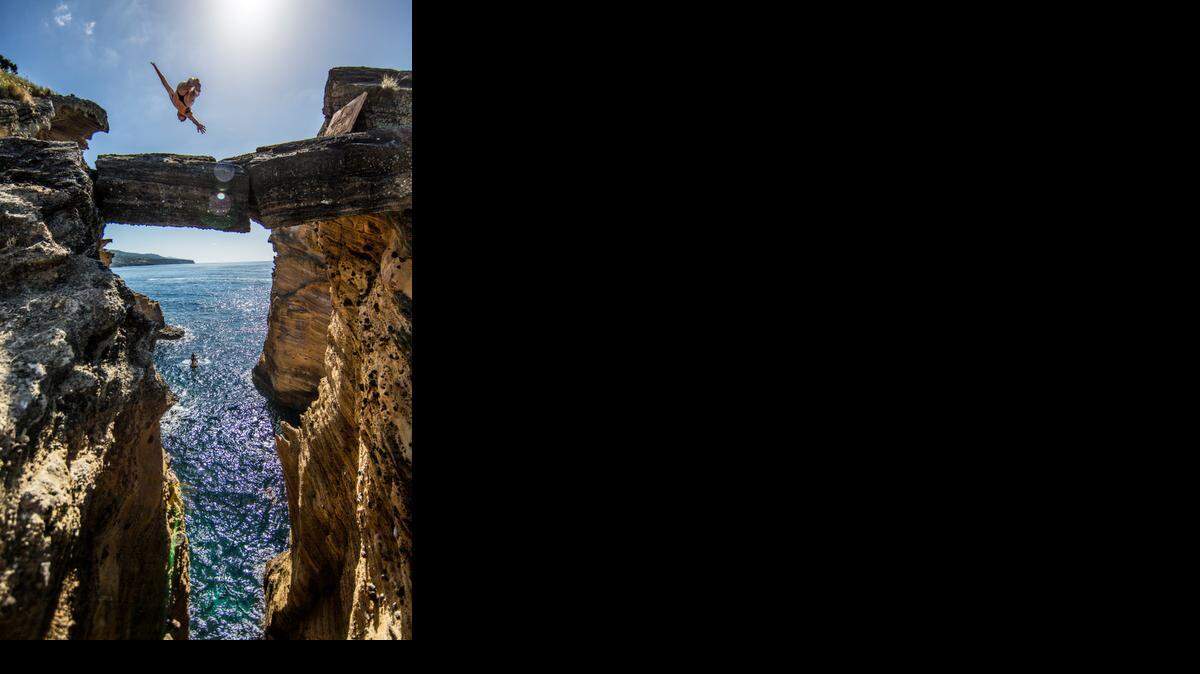
Steven LoBue typically takes a moment to savor the scenery when he is perched on the edge of a cliff, preparing to plunge nine stories while flipping through five somersaults before hitting the water at 60 mph.
“Rather than feel scared of my vantage point, I try to absorb some calm from the beauty of it,” he said.
The view can be absolutely breathtaking for high diver LoBue, who has propelled himself from the side of a volcano, the rim of a canyon, the top of a medieval fortress and the roof of an opera house in competitions around the world.
But not too breathtaking. LoBue must not let his mind race into panic mode when he’s standing on the 89-foot-high platform, controlling his heartbeat and visualizing the perfect dive.
“The key is maintaining the right balance between fear and zen-like confidence to maximize my concentration up there,” he said.
LoBue will take more leaps of faith Saturday in the Red Bull Cliff Diving World Series finale. The seventh competition of the season is set for Mexico’s Yucatan Peninsula at the Ik Kil cenote, a 90-foot-deep sinkhole near Chichen Itza that was once used for Mayan human sacrifice ceremonies and is now a popular swimming spot for tourists.
LoBue, who lives in Pembroke Pines and trains at the International Swimming Hall of Fame pool in Fort Lauderdale, is in contention to finish No. 2. Great Britain’s Gary Hunt has locked up the title.
LoBue intends to perform his showcase dive, which he calls the quint half — five somersaults with a half twist in the pike position.
“It’s a dive that had injured a couple people, and no one had done it in pike,” said LoBue, who is 5-4. “But I’m one of the shorter divers on the circuit, so I have a smaller spin radius. It took me a while to master it, but now it’s my trademark.”
Cliff divers, also known as high divers, dive from a height of 89 feet, and the bone-jarring impact necessitates landing feet first. They are judged on form, difficulty and entry. Compare that to Olympic-style diving, in which the highest dives are off the 33-foot tower and divers can hit the water at a velocity as high as 35 mph.
In cliff diving, not only are the grace and athleticism of the divers a feast for the eyes but so are the locales, which range from exotically dangerous remote sites to stunt venues that Evel Knievel would admire.
The Red Bull series has taken LoBue to the roofs of the opera house in Copenhagen and the Institute of Contemporary Art in Boston Harbor and La Salve bridge in Bilbao, Spain, with the Guggenheim Museum as backdrop.
LoBue won his first gold medal on tour diving into the 52-degree water of an old slate quarry in Wales. Other stops: A gorge in Oman’s Wadi Shab, the windy ramparts on Corsica’s southern tip, a volcanic cliff in the Azores, and the Scaliger Castle wall in Malcesine, Italy. Divers have been to Easter Island, Brazil and Possum Kingdom Lake, Texas.
Getting to the platform can be a feat in itself. LoBue said the most treacherous climb was in Thailand’s Phi Phi islands last year, where divers — wearing harnesses — had to scale bamboo ladders up 100 feet of craggy rock face, then walk across a narrow bamboo bridge and rappel down to the platform.
LoBue, 29, finished third overall in 2012. He started in 2011 after qualifying by .01 point at a competition in Australia despite fracturing his tailbone the day before when he over-rotated on a practice dive. He didn’t realize the extent of the injury until he flew home — in agony.
“That first season I spent mostly in a state of terror,” he said. “I had trouble sleeping and eating. On the platform, I had to fight the flight instinct.”
LoBue’s wife, Lindsay Lowell, who was a diver for Cooper City High, the Fort Lauderdale Diving Team and FIU, marvels at the skill, spatial awareness and mental strength of high divers.
“I put my hands over my eyes and crack my fingers when I watch,” she said. “It’s one of the toughest sports you can do physically, and they have to overcome anxiety on every dive. I’m a daredevil — I’ve been skydiving and I love rollercoasters — but I was petrified when I stood on a platform in Italy. I wanted to film Steven’s practice dives but my hands were shaking and sweating so badly I had to give the camera to someone else.”
Like Lowell, LoBue was a diver from a young age. At 7, he switched from swimming to diving in his hometown of Ewing, N.J., when a coach saw him flip off the 10-foot board — into a bellyflop. He was an All-American at Purdue.
“I was best at platform even though I found it nerve-racking,” he said. “Now it’s like a playground.”
He made it to the finals of the 2004 U.S. Olympic Trials in synchronized platform, but a torn wrist tendon in 2006 ended his Olympic aspirations. He spent summers acting as a pirate or acrobat in dive shows at Six Flags Great Adventure in New Jersey and the Indiana Beach boardwalk. Then he got a job at an amusement park in Shenzhen, China, where he first dove from 89 feet.
“It was a flaming dive in a fire suit,” he said. “It was about as safe as it can be considering you’re lighting yourself on fire.”
LoBue has become a fan favorite on the Red Bull tour, which attracts crowds as large as 70,000.
“At a meet at an indoor pool, you can hear a pin drop,” he said. “Outside, it’s like a party. After years of being in a rigidly-judged sport, it’s fun to show your creativity.”
After a year in China, LoBue worked in a show on the Allure of the Seas cruise ship. He now works as a personal trainer and coaches Fort Lauderdale Diving Team kids.
“Steven can spin incredibly fast, but he’s also very strong, pound for pound,” said FLDT coach Dave Burgering. “The main difference in high diving is you have to have a lot of confidence and courage in doing the tricks. Because of the extreme speed, you can’t land wrong too many times. Water is not soft. But it’s the same with race cars or luge — these athletes train to minimize risk.”
Injuries are commonplace, especially to the hip, groin and lower back. If divers don’t align their bodies in time for a vertical landing, “it can feel like Mike Tyson uppercutted you,” said Hunt, who performs a front quad with 1.5 twists and a back triple with four twists.
“I chipped a tooth in Boston,” LoBue said. “I’ve seen a couple guys get knocked out with concussions. There are broken ribs, bruised lungs, bruised hearts.
“Safety divers are always in the water, but we’re pushing the limits with new dives with higher degrees of difficulty.”
The increased quality of the dives combined with the spectacle of the sport have attracted the attention of the International Olympic Committee. FINA, governing body for swimming and diving, has added high diving for men and women (who dive from about 66 feet) to its world championship menu. A world cup was held in Russia in August (where LoBue placed third). Greg Louganis, who has judged Red Bull competitions, sees Olympic potential.
“It’s perfect for the Olympics,” LoBue said. “Powerhouse TV ratings guaranteed.”
This story was originally published October 17, 2014 at 7:38 PM with the headline "Pembroke Pines high diver Steven LoBue takes a leap of faith in every competition."