A legendary coach and life as an agent shaped Zito. Now he’s shaping contending Panthers
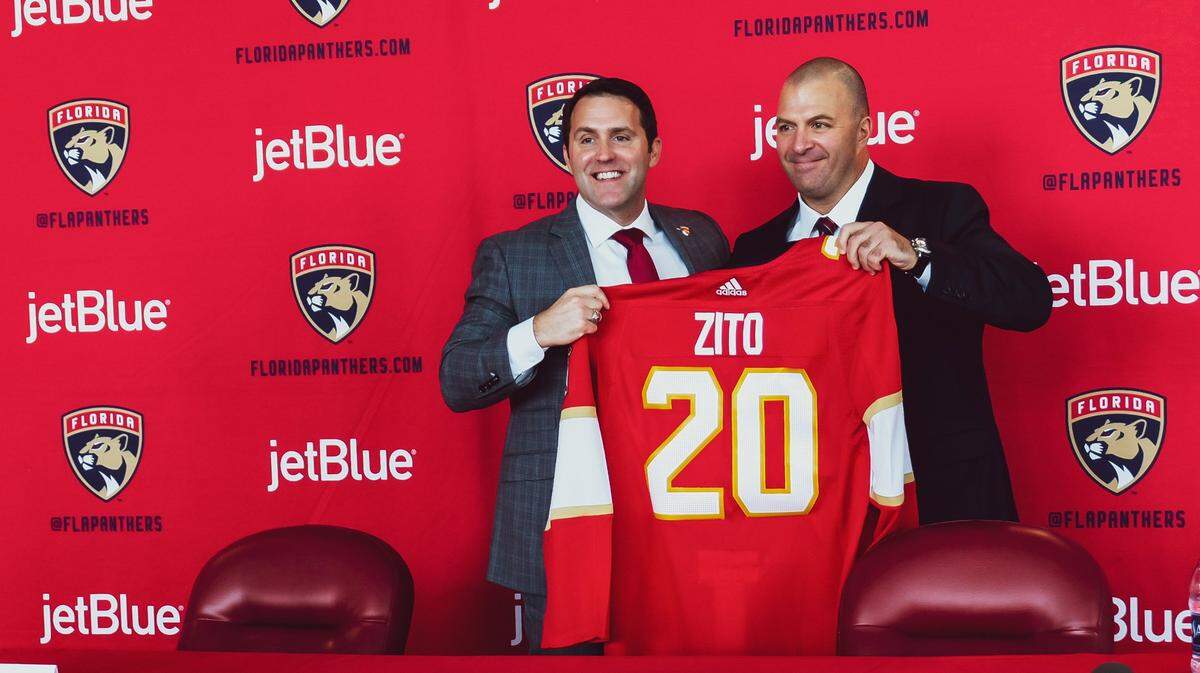
It was sort of fitting for Bill Zito’s first addition as general manager of the Florida Panthers last year to be Patric Hornqvist.
First of all, Zito spent more than seven years in the Columbus Blue Jackets’ front office, where he was repeatedly tormented by Hornqvist’s Pittsburgh Penguins — he knew well what the right wing would add — but Hornqvist was also exactly the sort of player Zito has always had an affinity for, dating back to his playing days with the Yale Bulldogs and all the way through his time as a high-profile agent for Acme World Sports.
Zito was always a bottom-line player at Yale — a self-described “grinder” — and he made his first splashes as an agent representing undrafted clients who turned into champions. Hornqvist was the final pick of the 2005 NHL Entry Draft, then won two Stanley Cups with the Penguins before Florida traded for him in Zito’s first month as GM. The Panthers’ rapid-fire retool was officially on.
“People have likened roster-building to a symphony,” Zito said. “You want to get the violin player and the cellist, and the percussion and the bass.”
In just seven months, Zito has put together a symphony unlike any South Florida has ever seen. The Panthers (26-11-4) are on pace for their best points percentage ever, in the thick of a Presidents’ Trophy race and a legitimate Cup contender, and they have done it with help from some of the additions Zito made in the offseason. Two of their top four scorers are newcomers, as are two of their current top four defensemen. Few of those acquisitions would qualify as splashy at the time, as Zito passed on highly paid defensemen in favor of undervalued contributors across the board.
Zito learned from the best, playing for legendary coach Tim Taylor at Yale, then spent two decades attending “hockey university” as an agent before joining the Blue Jackets in 2013. In Florida, he’s putting his education to use to turn the Panthers (26-11-4) into the NHL’s most unlikely contender, and he will have a chance to keep tinkering this weekend with the trade deadline set for Monday and Florida with the cap space to make a move.
“You want to try to reward the room, and buttress and support the team,” Zito said. “The team is a delicate thing, so anything we do would obviously be with the goal of supporting the team and keeping the long-term plan in place.”
With virtually every move Florida made in the offseason, Zito and his staff earned confidence. Hornqvist is fourth on the team with 27 points. Forward Carter Verhaeghe is playing at an All-Star level and leading all NHL forwards in plus-minus after he scored just 13 points as a rookie last year for the Tampa Bay Lightning. Gustav Forsling is now playing on the top defensive pairing after the Panthers picked him up off waivers less than a week before the season began and fellow defenseman Radko Gudas has helped Florida go from a bottom-five defense last year to the middle of the pack in 2021.
They have helped make a perfect supporting cast for the Panthers’ cadre of flashy soloists, such as star forwards Aleksander Barkov and Jonathan Huberdeau — both of whom are having career years in coach Joel Quenneville’s second season.
Bill Zito and Tim Taylor
Zito was always part of the supporting cast at Yale. When Zito was a senior, Taylor called a team meeting at the beginning of the season and told his players, point-blank, “You’re not good.” They had one future NHL player and a narrow path to victory, “but,” Zito recalled him saying, “if you trust me and you do what I ask you to do, we should be able to compete.’”
“We had a very high understanding of the game and strategically how to play,” Zito said, “because we had to.”
It launched him into coaching — he was an assistant coach for two years with the Wisconsin Badgers while attending law school — and empowered him to spend more than 30 years working in hockey.
His work as an agent started just as a side project. While he was an assistant, Zito advised some of his graduating players as they vetted prospective agents. Instead, they came back to him, asking if he would represent them. One of his first clients was Brian Rafalski — a quintessential Zito find.
Rafalski played for Zito at Wisconsin and couldn’t find an NHL suitor. Zito found him a home in Europe, where Rafalski played for four years before finally getting a shot with the New Jersey Devils. The former defenseman won three Cups and went to three NHL All-Star Games.
“He’s always had a great eye for talent — not just physical talent, but I think he’s a great evaluator of an athlete’s mental capacity. That’s very important,” said Markus Lehto, who co-founded Acme with Zito and is now the executive vice president of hockey at Wasserman Media Group. “What has benefited him is that a lot of the guys who are working on the team side — they never actually coached or they were never agents.
“When you’re working as an agent, you get to know these players really well.”
200 games in 365 days
Zito was comfortable after his coaching career ended. He was working as an appellate litigator at “sort of like a Wall Street law firm,” he said. He had far-off deadlines and a mostly six-month calendar. He could balance his legal work with his side project as a hockey agent.
A few clients eventually became a handful, and then it got out of hand and a new venture began.
“The hockey started to grow and I went, OK, this is my passion,” Zito said. “I took a risk and I had a little bit of savings, and I hit the road. ... I basically hit the American [Hockey] League and the colleges, and watched 200 games a year.”
He found Rafalski at Wisconsin and John Madden with the Michigan Wolverines — the undrafted center went on to win three Cups and a Frank J. Selke Trophy, and is now an assistant coach for the San Jose Sharks. He uncovered gems in Tim Thomas and Kimmo Timonen — ninth- and 10th-round picks, respectively — and helped Antti Niemi go from undrafted to a Vezina Trophy.
They were the sort of finds he could only uncover with his effort.
“That was Billy as a hockey player: a hard-working, persistent, stick-to-itive kind of guy,” said Dan Poliziani, who was an assistant coach at Yale when Zito played there. “He’s a dog on a bone. If he knows what he wants, he’s going to go find it and go get it, research it and make the best-informed decision he can make.”
He learned the way players felt about everything — coaches, other players, executives — and interacted with nearly every general manager. He would see which scouts really put in the work, which ones left early and which ones were out drinking every night. He found some of his closest confidantes by striking up conversations with Rick Dudley and Paul Fenton — now his senior advisors — in mostly empty minor-league rinks.
It helped teach him who to trust. Florida claimed Forsling off waivers because Dudley and assistant general manager Paul Krepelka “went to bat” for the AHL castoff, Zito said. They signed Verhaeghe after agent Ian Pulver “was very adamant that he was going to surprise a lot of people.”
Both players were buried on their teams’ loaded depth charts.
“Make no mistake: Tampa didn’t make a mistake,” Zito said. “I’d be lying if I told you, Oh, yeah, he’s a first-line player in the National Hockey League, but he definitely was somebody who had a work ethic, who had character, who had skill, who had upside.”
Zito’s lessons from Tim Taylor
Not long before Zito joined the Blue Jackets and not long before Taylor died, they crossed paths again at tryouts for the USA Hockey National Team Development Program in Ann Arbor, Michigan. Taylor was picking the team. Zito was there to do some scouting and spend some time with his former coach.
He stood on the side of the rink with Brett Peterson, an agent at the time and now his assistant general manager, to watch 80 or so of the best American teens compete. When Taylor mentioned one player he wanted to take, Zito pushed back and offered an alternative. They started to argue and Taylor, notoriously thrifty, made a proposal.
“He goes, ‘You and Chubsy, go to the Outback. Here, I’ll buy dinner,’ and he gave us 20 bucks,” Zito recalled. “I was like, ‘What are we going to have? Water?’”
Still, he and Peterson took the challenge. They went to dinner, picked 18 players with ease, then agonized over those last five spots. Should they prioritize sheer talent or a fit with the roster? How much would personality or background matter?
It was a crash course in roster-building just years before he actually joined a front office, and he and Peterson went back to Taylor the next day with their selections.
“Here’s the irony: If you pick your 20 guys, five of them you’re going to have to release and they’re going to get in the car, and they’re going to go home and they’re going to say, That Chubs Peterson and Bill Zito are bad people,” Taylor told them. “And you’re going to sit in the room heartsick because you like those kids so much. You’re like, How could I let that guy go? ... That’s just the nature of how you do things.”
“It resonates to this day with me,” Zito said.
His hardest decisions are on the horizon now. He spent his whole life preparing for them.