Are the Panthers a real Stanley Cup contender? Three reasons to believe at midseason
Aleksander Barkov doesn’t like to get too excited when things are going well — frankly, there haven’t been many opportunities to get too excited — but he couldn’t wipe a grin off his face after the Florida Panthers’ latest victory Monday in Sunrise.
It wasn’t about the spectacular play he made to create a game-winning, short-handed goal in the 6-3 win against the Chicago Blackhawks. It wasn’t about his increasing consideration as a candidate for the Hart Memorial Trophy or Joel Quenneville’s position as front-runner for the Jack Adams Award. He summed it up in three words.
“We’ve been winning,” the star center said Monday, “so this is a lot of fun.”
“Obviously, the last couple of years we haven’t been having any success and people don’t really talk about us that much,” he added. “This year is a whole lot different. We’ve been winning games. We’ve been playing really well — really good hockey — and, as you can see, everyone’s having fun on the ice and that’s when everyone starts to notice you.”
The 2020-21 NHL season is now halfway over for the Panthers, and no one in the league has been a bigger surprise than Florida. The Panthers (19-5-4) jumped into sole possession of first place in the Central Division with their win Monday at the BB&T Center and moved into a tie for the league lead in points.
Florida looks like a real Stanley Cup contender, with one of the best offenses in the league, an emerging Hart Trophy hopeful and the best coach in the league, and it comes after years of irrelevance. The Panthers haven’t made the traditional 16-team Stanley Cup playoffs since 2016, so it’s understandable to be hesitant about trusting this team, but Florida is providing real reasons to believe it can keep up its play in the second half of the season.

Panthers offense better than ever
Since the start of the 2018-19 NHL season, the Panthers have had one of the four most prolific offenses in hockey. With 590 goals in the last two-plus seasons, only the Tampa Bay Lightning, Toronto Maple Leafs and Washington Capitals have scored more often than Florida. Go back to the start of the 2016-17 NHL season — when Barkov and left wing Jonathan Huberdeau broke out, solidifying Florida’s offensive-minded identity — and the Panthers rank seventh in the league in goals, and four of those six teams ahead of them have at least played in the Stanley Cup Finals in this four-year stretch.
This is all to say it’s not a surprise to see Florida once again solidly among the NHL’s top offenses. Even for the Panthers’ lofty offensive standards, this group has stood out, though.
Florida is tied for second in the NHL with 3.5 goals per game and its 34.1 shots per game — also second most in the league — suggest it’s far more sustainable than a year ago, when the Panthers finished the regular season sixth in scoring, then crashed out of the qualifying round of the expanded postseason by scoring just seven goals in four games.
In fact, this offense may even be underproducing right now given how well its playing. Florida is just a middling team in Corsi for — a popular advanced statistic, which combines shots on goal, missed shots on goal and opponents’ blocked shots in 5-on-5 action — but the Panthers rank second in the league in expected goals in 5-on-5, while only actually having the seventh most 5-on-5 goals. It’s a sharp shift from last season, when Florida had the fifth most 5-on-5 goals despite ranking just 24th in expected goals.
.png "download (2).png")
.png "download (3).png")
Like Corsi, expected goals are a popular advanced stat, which is “based on where the shots are coming from, compared the league-wide shooting percentage from that shot location,” according to Hockey-Reference.com. Collectively, they paint a promising picture for this offense.
“We’re just a different team this year,” defenseman MacKenzie Weegar said Monday. “The league’s starting to notice that, and we deserve all the credit that we’re getting right now.”
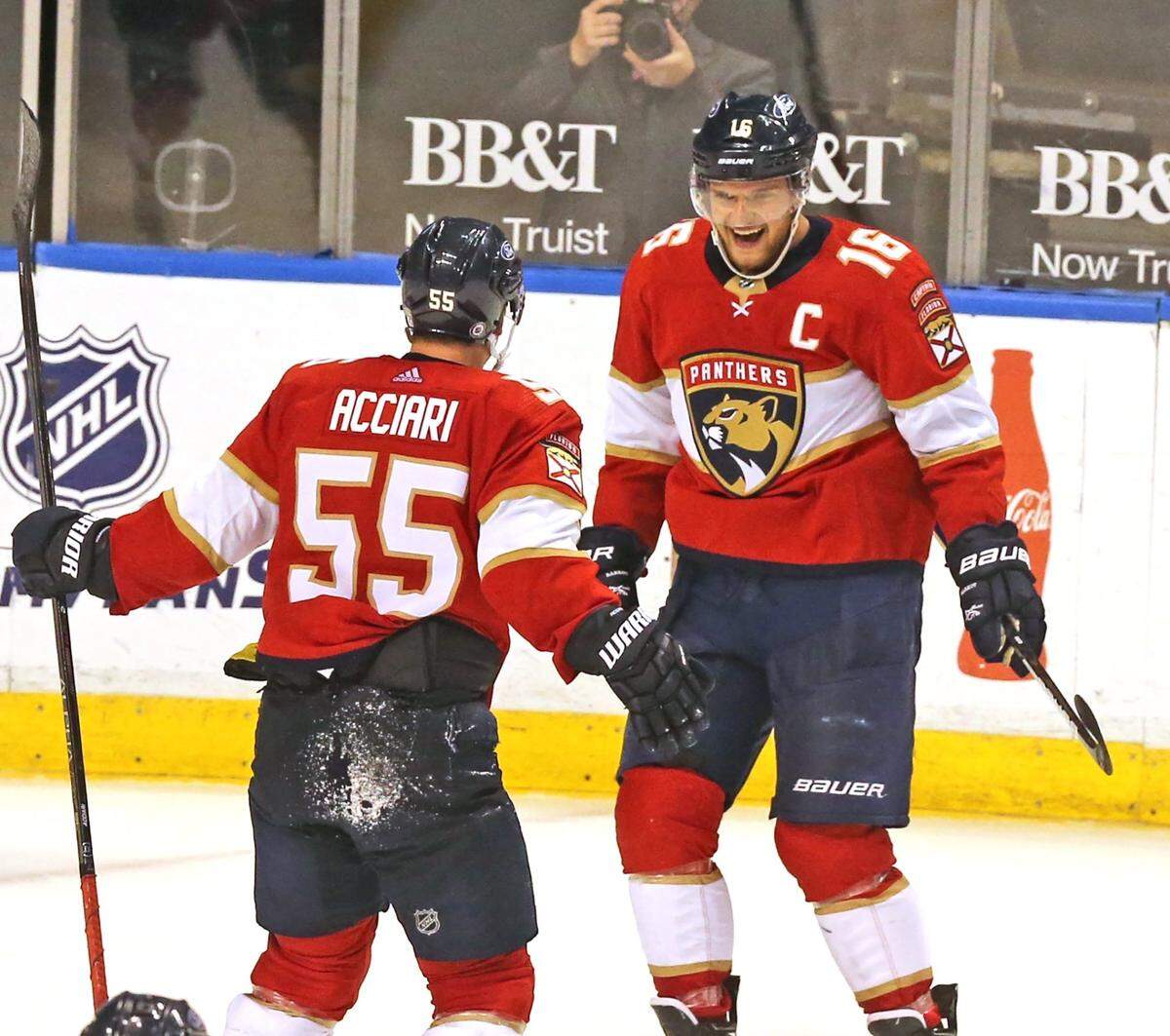
Barkov has plenty of help
Barkov is in the middle of Florida’s growth. The 25-year-old is the Panthers’ clear most valuable player, and he’s playing more aggressively than ever. His total shots are up from 4.0 per game last year to 5.3 this season, his shots on goal are up from 2.6 to 3.6 and his Corsi for — which measures the team’s total chances when he’s on the ice — is up from 15.5 to 16.6.
Huberdeau and right wing Patric Horqvist are also producing at star-type levels, with 10-plus goals and 12-plus assists, and Florida is as deep as it has been in years. The Panthers’ fourth line has a 62.1 Corsi for percentage and their third line, which includes top rookie Eetu Luostarinen at center, is holding its own at 48.9 percent.
Meanwhile, the Panthers’ top two lines are solidly winning their minutes, and the Florida is outscoring opponents 18-2 when Barkov, Huberdeau and Hornqvist all play together — typically as the top power-play grouping.
.png "download (4).png")
“It seems like everybody across the board is adding to the mix,” Quenneville said Saturday, “and we’ve been pretty consistent.”
Panthers defense even more improved
The Panthers’ grand plans were never supposed to be just about Barkov and Huberdeau, and, for a time, they weren’t. Aaron Ekblad, the No. 1 pick in the 2014 NHL Draft, was drafted the highest of the three and was first of the trio to make an All-Star Game, going in back-to-back years in 2015 and 2016.
The 25-year-old hasn’t been back since, although his drought probably would have ended were there a game this year. He has always been Florida’s top defenseman and a productive statistical player, and now he’s doing it for a competent defense.
Last year, the Panthers allowed 3.25 goals per game — tied for third most in the NHL. This year, Florida is allowing the 11th fewest. Solidly average is more than enough, considering where this team has been the last few years.
Since the start of the 2018-19 season, the Panthers have allowed the fifth most goals in the league. Stretch it back to 2015-16 and they have still allowed the 10th most.
While Florida is allowing just about as many shots as it did last year, the quality of shots have plummeted.
Last year, the Panthers gave up the fourth most high-danger chances in the league. This year, they’re giving up the seventh fewest. Florida’s expected goals against is the sixth best mark in the league. The Panthers are giving up basically nothing in front of the net or anywhere in the slot. The vast majority of shots they’re allowing are coming from far and outside, even on the penalty kill.
.png "download (5).png")
.png "download (6).png")
So much still hinges on Sergei Bobrovsky. The $10 million-a-year goaltender still ranks only 32nd in the league with a .905 save percentage, but he’s 7-0-1 with a .919 save percentage and 2.75 goals against in his last eight starts.
Right now, opponents are scoring on 18.9 percent of those high-danger chances — the most in the league. Last year, they scored on 11.6 percent of them. There’s still another level for this defense to get to and Bobrovsky is trying to take them there.
“He’s coming off a great trip and a good start to this homestand,” Quenneville said. “He is growing in his composure in the net and it feels good to be standing behind the bench or watching him play in front of him as players. We all like the progress.”