Get your wings, beer and arguing hat: Our picks for the 10 best Super Bowls of all time
Flying cars remain in the future, but the 21st century has brought Super Bowls consistently worth watching for more than the commercials.
Considering the skill of the average American driver and the fluctuating cost of fuel, that might just be the universe looking out for us.
Maybe it’s the salary cap jumbling rosters, maybe it’s players reaching the NFL more accustomed to playing in games watched by a large chunk of North America, maybe it’s rules making points cheaper than coffee. But don’t blame presentism for this list leaning toward the modern.
Don’t look for either of the Pittsburgh-Dallas 1970s Supers in the Orange Bowl, Super Bowls still unmatched for star power, or the Steelers win over the Rams that actually was better than both the games against Dallas.
But, you will find the Steelers and the Rams on the list.
SUPER BOWL XLIII
PITTSBURGH 27, ARIZONA 23
▪ Feb. 1, 2009
▪ Raymond James Stadium, Tampa
▪ MVP: Pittsburgh WR Santonio Holmes, nine receptions, 131 yards and a touchdown, four catches for 73 yards and a TD just on the final drive.
▪ Should’ve Been MVP: Holmes
▪ Super Bowl Rank: First
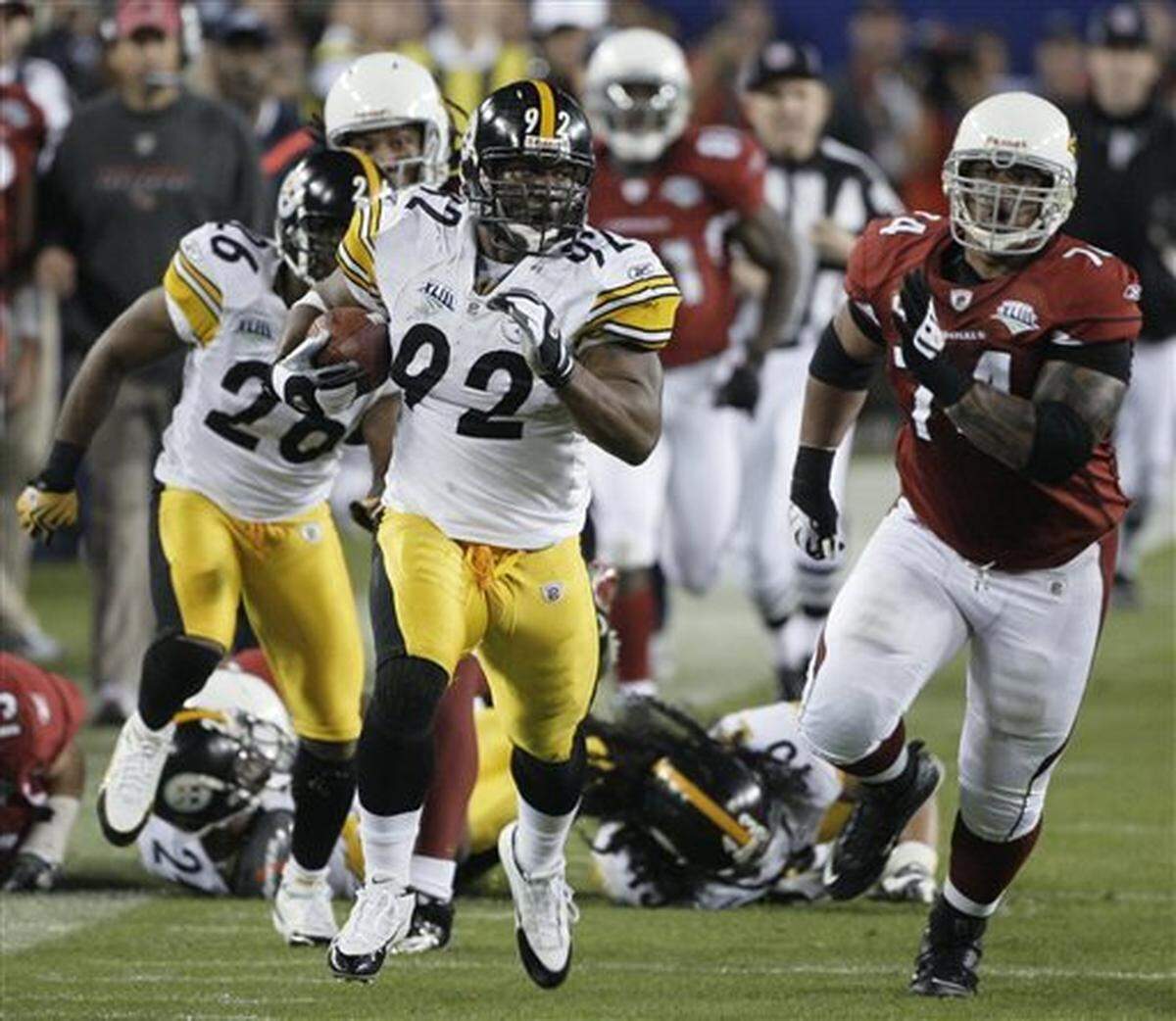
How epic, awe-inspiring and just plain oh-my-funky-goodness was this game? The longest scoring scrimmage play in Super Bowl history probably wasn’t even the second-most exciting play of the night.
Linebacker James Harrison faked a blitz, then stayed in coverage, right where Arizona quarterback Kurt Warner didn’t expect him to be. Harrison picked off the pass and began trucking downfield. Harrison reached the end zone on his 100-yard interception return as his steam and the first half clock ran out and Arizona’s Larry Fitzgerald almost caught him.
That gave the Steelers a momentum-grabbing 17-7 lead. It was nearly an afterthought two hours later.
Because, for all the good Pittsburgh had done through three quarters to build a 13-point advantage, all was undone by a fourth-quarter meltdown.
Two Larry Fitzgerald touchdown receptions bookended a safety, and with 2:37 left in regulation, the historically awful Cardinals led for the first time, 23-20.
Fitzgerald’s second score, a seam route that turned into 64-yard touchdown as he raced with dreadlocks flying away from defenders, looked like one of those NFL Films visions generations of football fans would take to their graves. And the underdog story of quarterback Kurt Warner, off the bench to lead an unlikely Super Bowl winner, appeared as if it would replay itself in Arizona the way it had with the Rams in St. Louis in 1999.
But with an eight-play, 78-yard drive that took just 2:02, Pittsburgh’s Ben Roethlisberger secured his place among the league’s elite quarterbacks and Santonio Holmes assured himself a spot in NFL history.
Roethlisberger quickly moved the Steelers to the Arizona 6 by completing 6 of 8 passes, including a 40-yard catch-and-run to Holmes. Then on third-and-goal, Roethlisberger wanted to go Holmes again.
With three defenders surrounding him, Holmes pulled down a high pass thrown by Roethlisberger in the back right corner of the end zone while keeping his toes down with 35 seconds left.
“I never thought we could have topped last year’s Super Bowl, “ NFL Commissioner Roger Goodell said after the game, referring to a game just a little lower on the list. “We might have just done it.”
They topped every Super Bowl played before and after.
SUPER BOWL XXXVIII
NEW ENGLAND 32, CAROLINA 29
▪ Feb. 1, 2004
▪ Reliant Stadium, Houston
▪ MVP: QB Tom Brady, New England, 32 of 48 for 354 yards and three touchdowns.
▪ Should’ve Been MVP: Brady.
▪ Super Bowl Rank: Second
The “wardrobe malfunction” of the halftime show starring Janet Jackson and Justin Timberlake as well as the bawdiness of some commercials overwhelmed national conversation for months after the game.
Too bad. This was a Super Bowl of sudden thrills, as unexpected as lightning.
It was two games, but not broken down as they usually are. The first and third quarters hearkened back to the defense-dominated 1970s Super Bowls, which seemed logical after each team’s defense won its respective conference championship game. No points, few first downs, tense waiting for the big bang.
That came in the second and fourth quarters with plays big and wild. With 3:30 left in the first half, the game sat 0-0. At halftime, the Patriots led 14-10.
Crammed into that short span were a Tom Brady-to-Deion Branch touchdown pass; a 95-yard Carolina drive to a 39-yard Jake Delhomme-to-Steve Smith touchdown pass; a Brady-Branch 52-yard connection setting up a Brady-to-David Givens score; and a 50-yard John Kasay field goal.
In the fourth, the Patriots extended their lead to 21-10, but DeShaun Foster’s 33-yard run and Mushin Muhammad’s 85-yard touchdown catch put Carolina up 22-21. Linebacker Mike Vrabel caught a touchdown pass from Brady (32 of 48 for 354 yards). A successful two-point conversion gave the Pats a 29-22 lead with 2:51 left.
Carolina needed only 1:43 to tie it on a Ricky Proehl touchdown catch. But, Kasay booted the kickoff out of bounds, giving New England the ball on the 40. That made a game-winning drive almost too easy for the Patriots. As was the case two years earlier (see Patriots vs. St. Louis Rams below), Proehl’s game-tying touchdown catch was followed by Adam Vinatieri’s game-winning field goal, this time from 41 yards.
SUPER BOWL XXV
NEW YORK GIANTS 20, BUFFALO 19
▪ Jan. 27, 1991
▪ Tampa Stadium
▪ MVP: RB Ottis Anderson, Giants
▪ Should’ve Been MVP: Anderson.
▪ Super Bowl Rank: Third
The Gulf War brought extra security and patriotism to the Super Bowl. Whitney Houston surged through a version of “The Star-Spangled Banner” so rousing, pop radio stations later played it as a single.
Coincidentally, each team’s color scheme was red, white and blue. And the game matched Houston’s anthem in the “rousing” category.
Buffalo came in firing the fast-paced “K-Gun” offense with Jim Kelly distributing the ball to wide receiver Andre Reed, James Lofton and all-purpose back Thurman Thomas. In place of injured starter Phil Simms, career backup Jeff Hostetler handled the Giants offense, mostly by handing the ball to Ottis Anderson, an NFL rookie when Thomas was in junior high.
The Giants brought a big, physical defense, the NFL’s hardest to score on, in contrast to Buffalo’s athletic, dynamic one. New York’s canny defensive coordinator, Bill Belichick, figured he’d sacrifice pass rush to punish Buffalo’s receivers, limiting yards after catch and inducing a few drops from receivers who didn’t have time for the pain.
Up 12-3 after Bruce Smith sacked Hostetler for a safety, Buffalo was driving toward the score that would’ve jerked the Giants out of their time-consuming, possession-limiting run game when Reed dropped a third-down pass. A Stephen Baker touchdown catch ended the half 12-10, then the Giants opened the second half with a march that took 9:29 and put them up 17-12 on an Anderson touchdown. Twice, linebacker Darryl Talley missed third down tackles that would’ve ended the drive.
Counting halftime, Buffalo’s offense hadn’t been on the field for a real possession in over an hour.
Thomas raced 31 yards to shove Buffalo back into the lead, 19-17. Matt Bahr’s field goal gave the Giants the lead again. As time ran down, Buffalo got to the Giants’ 30. Though they had time for one more play, Bills caoch Marv Levy decided to go for a tough game-winning field goal attempt – 47 yards, off grass. Right-footed Scott Norwood’s kick off the right hash never curled toward the middle. Wide right.
Afterwards, Talley and Reed consoled Norwood by saying but for their miscues, he wouldn’t have been in that position. The Giants, having left what they had left on the field, left the stage. Coach Bill Parcells retired for the first time. Lawrence Taylor, Anderson and many others reached the gloaming of their careers.
SUPER BOWL LII
PHILADELPHIA 41, NEW ENGLAND 33
▪ Feb. 4, 2018
▪ US Bank Stadium, Minneapolis
▪ MVP: QB Nick Foles, Eagles, 28 of 43 passing for 373 yards and three touchdowns. And one reception for 1 yard and one touchdown.
▪ Should’ve Been MVP: Foles.
▪ Super Bowl Rank: Fourth.
All things get rebooted in the 21st century. A different bunch of Patriots, save quarterback Tom Brady and head coach Bill Belichick, were ready to finish a rerun from 13 years before — win their third Super Bowl in four seasons by unplugging Philadelphia in a matchup of No. 1 seeds.
But other than the names, the uniforms, Brady and Belichick, little else in setup resembled the earlier New England-Philadelphia Super confrontation. Well, there was the team from the Keystone State losing a keystone offensive player when quarterback Carson Wentz tore an ACL. In trotted backup Nick Foles, a journeyman on his third team in three years since after being cut by the team that made him a third round draft pick in 2012 — the Philadelphia Eagles.
Certain Super Bowls act as NFL GPS, telling you where the game is and where it’s going. The defense and turnovers that flooded Super Bowl V predicted a decade dominated by the stopping side of the ball. Super Bowl XVI’s matchup of West Coast Offense 1.0 vs. West Coast Offense 2.0 showed what would be the most influential offense of the next two decades.
Super Bowl LII showed Fusillade Football runs the NFL in the second decade of this millennium. Offensively overwhelm your opponent into panic or submission. Take all your shots and woe to he who leaves a weapon unused.
Each team went for it on fourth down twice. When the Eagles did it on fourth and goal from the 1 with seconds left in the first half, Foles caught a pass from tight end Trey Burton for a touchdown and 22-12 halftime lead. “The Philly Special,” the Eagles called it. Foles made the first Super Bowl touchdown catch by a quarterback on the second ball thrown to a quarterback in this game (Brady stumbled when Julian Edelman threw him the ball earlier).
It was one of Brady’s few stumbles. And 75-yard touchdown drives on each of New England’s first three second half possessions ended with Brady touchdown passes as the Patriots took their first lead with 9:22 left in the game.
But it was only a 33-32 lead because the Eagles offense owned the Patriots defense almost as completely. Foles’ third touchdown pass, an 11-yarder to Zach Ertz put the Eagles back in front 38-33 after a missed two-point conversion.
The Eagles didn’t only fly, they marched. Former Patriot LeGarrette Blount and former Dolphin Jay Ajayi combined for 147 yards rushing on just 23 carries, 6.4 yards a pop. Meanwhile, New England rolled up a Super Bowl-record 613 yards of offense, 505 by the arm of Brady.
Defenses ranked fourth (Philly) and fifth (New England) in fewest points allowed during the regular season got stampeded and strafed so badly that there were more extra point kicks missed (two) than punts (one).
Like any game overwhelmed by one side of the ball, it would be decided by the other side. On the second play after Ertz’s touchdown, Philly defensive end Brandon Graham swatted the ball from Brady and Derek Barnett fell on it at the New England 32. The first sack of the game by either team produced the first Eagles stop of the half.
This allowed the Eagles to run down the clock to 1:05 before booting a 46-yard field goal.
A Brady Hail Mary bomb fell incomplete. For the first time since the first season of the American Football League, the Philadelphia Eagles were the NFL champions.
SUPER BOWL LI
NEW ENGLAND 34, ATLANTA 28
▪ Feb. 5, 2017
▪ NRG Stadium, Houston
▪ MVP: New England QB Tom Brady, 43 of 62 for 466 yards passing and two touchdowns
▪ Should’ve Been MVP: Brady.
▪ Super Bowl Rank: Fifth.
Animation film buffs often note that in Daffy Duck vs. Bugs Bunny, Daffy’s smart, but just insecure enough to keep talking until he outsmarts himself. Bugs is smart but secure enough to let Daffy keep talking until he outsmarts himself.
This brings us to the little black-and-red birds from Atlanta and those Super Bowl-winning rabbits from New England.
Bucking (Buckheading?) the trend of what happens on Super Sunday when the No. 1 scoring offense meets the No. 1 scoring defense, the Falcons led 28-3 in the third quarter. The Falcons even got the first playoff pick six against Brady in his career, an 82-yard interception return touchdown by Robert Alford.
But it was at 28-12 with 8:33 left, third and 1 on their own 35, when Daffy didn’t remember that he could run.
The Patriots needed a short field. Though they’d scored on consecutive possessions, the drives took 6:25 and 5:07. Atlanta just needed to keep the clock moving, avoid a turnover, blocked punt or long punt return and they’d cross the finish line eased up.
But with 8:33 left and third and 1 on their own 35, the Falcons came out in a shotgun formation with running back Devonta Freeman offset to quarterback Matt Ryan’s front right. They were throwing and not hiding it. Linebacker Dont’a Hightower shot by Freeman, who barely brushed him. Had Freeman even thrown a Lookout Block – whiff but turn and yell, “Look out!” – it would’ve been better for Ryan, who Hightower blindsided into a fumble. Alan Branch recovered for New England at the 25.
Considering the time, score, play call and formation call, it might’ve been more straightforward stupid than the Russell Wilson pass Malcolm Butler intercepted two years earlier (when Atlanta head coach Dan Quinn was Seattle’s defensive coordinator – way to learn). The Patriots later called it the biggest play in the comeback.
Just 2:28 later, a 6-yard Amendola catch and a White conversion brought the Pats to within one score, 28-20, with 5:56 left.
A 39-yard reception by Freeman and a balletic toe tap sideline 27-yard catch Julio Jones seems too big to make put Atlanta on the Patriots’ 22, well within NFL scoring leader Matt Bryant’s dependability range. Only 4:40 remained. The Patriots had two timeouts. And Daffy tried to fly again. And the Patriots got another huge sack, a 12-yarder by Trey Flowers. A holding penalty on tackle Jake Matthews negated a completion and put Atlanta out of Bryant’s field goal range.
A punt and the Patriots had 91 yards to go, 3:30 to do it and two timeouts with which to do it. A 16-yard pass to Chris Hogan on third-and-10 got the drive going. On the most pivotal play, a pass Alford batted away wound up bouncing into Julian Edelman’s hands among a flock of Falcons for 23 yards.
That’s when the feeling permeated the stadium, the crowd, the TV audience, maybe even the Falcons -- the Patriots would tie the game. The Patriots would win the game in overtime.
Which they did. White plowed over from the 1 with 57 seconds left. Amendola caught the two-point conversion. In overtime, the Patriots took the ball and marched down to White’s 2-yard run on a pitch play for the game-ending, Super Bowl-winning touchdown.
That’s all, folks.
SUPER BOWL XLII
NEW YORK GIANTS 17, NEW ENGLAND 14
▪ Feb. 3, 2008
▪ University of Phoenix Stadium, Glendale, Ariz.
▪ MVP: New York QB Eli Manning, 19 of 34 passing, 255 yards, two touchdowns
▪ Should’ve Been MVP: Someone off the Giants front four, such as Justin Tuck, who had one and a half sacks and caused a drive-ending fumble.
▪ Super Bowl Rank: Sixth
The 1972 Dolphins remain as unique as they were perfect.
The 2007 Patriots loaded up on wide receivers – deep threat Randy Moss, slot receiver Wes Welker, Donte Stallworth – began firing on the first possession of the season and didn’t stop until the last. Added angry fuel seemed to come from accusations of cheating in during the 2001 playoffs, the Spygate controversy. On their way to a record 589 points, Brady threw a record 50 touchdown passes and Moss caught a record 23 of them.
Those records fell as they finished off a 16-0 regular season with a come-from-behind 38-35 win against the Giants. But the Giants took confidence from how they’d pressured Brady with their front four and had led most of the way in that game. That confidence carried them through playoff wins at Tampa Bay, Dallas (the last playoff game in Texas Stadium) and Green Bay (Ice Bowl II, the third coldest game in NFL history).
The Patriots cruised into the Super Bowl, but didn’t look the obliterating Death Star they’d been during the regular season. Starting with an opening drive lasting 9:59, this year’s model of the Giants shortened the game as their predecessor had against Buffalo in Super Bowl XXV. And after New England took a 7-3 first quarter lead, the Giants pass rush, led by defensive ends Michael Strahan and Osi Umenyiora, began knocking around Brady like a piñata.
Despite five sacks and numerous post-pass hits on Brady, the Patriots still led 7-3 until Eli Manning hit David Tyree with a 5-yard touchdown pass early in the fourth. Brady answered three drives later with an 11-yard touchdown to Moss: Patriots, 14-10 with 2:42 left.
The Giants survived a fourth-and-1 when immense Brandon Jacobs plowed for 2 yards. But it was a third-and-5 conversion that would be the play of the game, maybe the decade and one of the most instantly iconic catches in NFL history.
Quarterback Eli Manning, who had forever scuffled in the shadow of big brother Peyton, wiggled out of a sure sack and then essentially threw a pass up for grabs. With Patriots safety Rodney Harrison yanking on the ball securing arm, Tyree pinned the ball between his hand and his helmet and went to the ground without it coming loose. A few plays later, Manning hooked up with Plaxico Burress on a 13-yard touchdown pass, and the epic upset was complete.
It was the Patriots’ first Super Bowl loss in the Tom Brady-Bill Belichick Era, snapping a three title-game winning streak. Brady threw the ball 48 times, but completed just 29 of the passes for 266 yards and one touchdown.
SUPER BOWL XLIX
NEW ENGLAND 28, SEATTLE 24
▪ Feb. 1, 2015
▪ University of Phoenix Stadium, Glendale, Arizona
▪ MVP: New England QB Tom Brady, 37 of 50 passing, 328 yards, four touchdowns.
▪ Should’ve Been MVP: Brady
▪ Super Bowl Rank: Seventh.
What you might not remember about this game:
Seattle quarterback Russell Wilson didn’t have a completion until the second quarter.
Tom Brady completed 74 percent of his passes against the NFL’s best defense, partially because the passes and routes at which he’s such an artiste don’t directly challenge Seattle’s secondary.
The teams scored three touchdowns in the last 2:16 of the first half, which ended 14-14. The last score, an 11-yard Wilson-to-Chris Matthews pass, paid off a characteristic gamble by Seattle coach Pete Carroll. Carroll went for the touchdown when most coaches would’ve settled for a half-ending field goal.
Down 24-14 in the fourth quarter and working against the NFL’s best defense, Tom Brady drove the Patriots to two fourth quarter touchdowns. The Bradyesque show ended with trademark short pops to Danny Amendola and Julian Edelman.
On the final Seahawks drive, Jermaine Kearse made a catch that rivaled any Super Sunday grab by one-hit wonder David Tyree (see above) or Hall of Famer Lynn Swann.
Kearse and Patriots cornerback Malcolm Butler went up for a deep ball on the right sideline and Butler got his hand on it...but Kearse came down with it after double catching it, Super Bowl X Swann style. Butler alertly finished the play, pushing Kearse out of bounds at the Patriots’ 5 after Kearse scrambled to his feet.
Marshawn Lynch manfully barged to the Patriots 1-yard line on the next play.
What everyone remembers:
Instead of pounding Lynch at a Patriots defense weary at the end of a frantic two-minute drill, the end of a game, the end of a long season, Seattle let the clock run down to 26 seconds...and threw the ball.
It shocked everyone but the well-prepared Patriots. Butler and Brandon Browner recognized the formation and anticipated the route combination. When Seattle wide receiver Brandon Lockette moseyed through his route, Butler beat him to the spot for the interception.
No call in NFL history has been more questioned. Analytics geeks flung numbers describing why the play call was fine, Lockette’s route was soft. Most analysis kept it simple, as they felt the Seahawks should have -- near the end of the game, needing a yard to win the Super Bowl, you give it to power back Lynch and get that yard.
Seattle’s never been the same. The Patriots? They stayed the same.
SUPER BOWL XXXVI
NEW ENGLAND 20, ST. LOUIS 17
▪ Feb. 3, 2002
▪ Louisiana Superdome, New Orleans
▪ MVP: New England QB Tom Brady, 16 of 27, 145 yards passing, one touchdown, one game-winning drive.
▪ Should’ve Been MVP: New England CB Ty Law, interception return for a touchdown, defused football’s most explosive receivers.
▪ Super Bowl Rank: Eighth
In the wake of the Sept. 11 attacks, patriotism painted the Super Bowl.
St. Louis’ Greatest Show on Turf brought the stars while New England brought the red, white, blue and “Patriots.” They also brought head coach Bill Belichick, the Giants’ defensive coordinator when they held Buffalo’s K-Gun to 19 points in Super Bowl XXV.
U2’s halftime show closed with a scrolling of the fatalities in the Sept. 11 attacks. Toward the end, lead singer Bono pulled open his black leather jacket to reveal its American flag lining.
The Patriots refused to be introduced individually, instead ran out as a team. As the game started, the Patriots pass rushers hit running back Marshall Faulk on their way to Kurt Warner to disrupt the Rams’ timing. Ty Law jumped an Isaac Bruce out route and raced to a 47-yard interception return touchdown that gave the Patriots a 7-3 lead. Another turnover, a Terrell Buckley fumble recovery, set up the 8-yard Tom Brady-David Givens touchdown pass that gave the Pats a 14-3 halftime lead.
But the potentially crushing turnover, a 97-yard touchdown fumble return by Tebucky Jones with New England up 17-3 in the fourth, got nullified by a defensive holding penalty. The Rams scored on that drive and on a 26-yard pass to Ricky Proehl to tie the game with 1:30 left.
Though out of timeouts, instead of playing for overtime, New England’s staff trusted Brady to drive the Patriots’ 53 yards to the Rams’ 30. Adam Vinatieri nailed a 48-yard field goal as time ran out.
One potential dynasty had been aborted by a true dynasty rising.
SUPER BOWL XLVI
NEW YORK GIANTS 21, NEW ENGLAND 17
▪ Feb. 5, 2012
▪ Lucas Oil Stadium, Indianapolis
▪ MVP: Giants QB Eli Manning, 30 of 40 for 296 yards passing and one touchdown.
▪ Should’ve Been MVP: Manning.
▪ Super Bowl Rank: Ninth.
The general rule in Super Bowl rematches with similar casts: what you’ve seen is what you’ll get.
Pittsburgh over Dallas by four through the air in Super Bowls X and XIII. Dallas over Buffalo with turnovers being pivotal in Supers XXVII and XXVIII. Maybe that’s why, though the Patriots entered Super Bowl XLVI as betting line favorites, the buzz in Indianapolis around the official hotels and media centers slightly favored the 9-7 Giants.
Each key side subtracted a future Hall of Famer: no more Randy Moss running long for the Patriots, no more defensive end Michael Strahan chasing quarterbacks for the Giants. But the Patriots still lived by the pass and the Giants lived to kill the pass. Besides, the Giants beat the Patriots 24-20 in the regular season.
Retellings of this game usually center around fourth quarter events. The momentum swings of the first three quarters deserve notice.
The Patriots found themselves fighting to stay in the game after an early 9-0 deficit, then did that Patriots thing: close the first half with a touchdown, a 4-yard Brady-to-Danny Woodhead pass at the end of a 96-yard drive, and open the second half with a touchdown, Brady to Hernandez for 12 yards and a 17-9 lead.
A pair of New York field goals had cut the lead to 17-15 when the aforementioned late game events started. Wes Welker failed to make a twisting, but achievable catch of a deep ball with four minutes left. A punt two plays later left New York on the 12, not buried, but definitely not at street level.
On the first play, Manning launched a bomb up the left sideline that sliced down between defenders to a feet-dragging Manningham and, boom, New York was at the 50.
Futilely challenging Manningham’s catch cost the Patriots one timeout. They spent another as the Giants moved inexorcably into gimme field goal range. Once the Giants reached second and goal at the Patriots’ 6 with 1:03 left, the timeout-poor Patriots were helpless to stop New York from running down the clock to a field goal with minimal time left.
Unless they gave the Giants a touchdown.
Bradshaw burst through the given hole, then realized too late what he was doing. He spun himself while trying to brake, but still fell backwards into the end zone.
The Patriots got the shot they needed. They moved close enough for a Hail Mary heave to reach the end zone...and fall incomplete.
SUPER BOWL XLIV
BALTIMORE 34, SAN FRANCISCO 31
▪ Feb. 3, 2013
▪ Mercedes-Benz Superdome, New Orleans
▪ MVP: Baltimore QB Joe Flacco, 22 of 33 passing, 287 yards, three touchdowns.
▪ Should’ve Been MVP: Flacco
▪ Super Bowl Rank: 10th
The Super Har-Bowl.
Taking sibling rivalry beyond Bobby and J.R. Ewing but short of Cain and Abel, this Super matched the ultra-competitive Brothers Harbaugh as head coaches: John in his fifth year with Baltimore vs. Jim in his second year with the 49ers.
John still had the same starting quarterback, Joe Flacco, as when he ascended from Eagles special teams coach to Ravens head coach. After literally dropping the ball in the previous year’s AFC Championship Game at New England, Baltimore hung on against Denver in the Divisional Round with a ridiculous 70-yard Flacco-to-Jacoby Jones bomb behind two bumbling Broncos defensive backs with 31 seconds left in regulation. An overtime win sent the Ravens to New England, where they wore down the Patriots 28-13.
Jim didn’t have the same starting quarterback that he did in September. When veteran dual threat quarterback Alex Smith suffered a concussion, second-year dual threat quarterback Colin Kaepernick played as if Smith should forget about the job no matter the state of his memory. When both were healthy, Harbaugh stayed with Kaepernick, who gashed Green Bay and Atlanta in the playoffs with his right arm and both legs.
The final game for linebacker Ray Lewis, the franchise’s greatest player in its Baltimore incarnation, started like a 1980s Superdome Super Bowl blasting. When Jones, Baltimore’s expert at scoring from afar, returned the second half kickoff 108 yards to go with his 56-yard touchdown catch, the Ravens held a 28-6 lead.
Minutes later, the building went metaphor. The Superdome lights on the half of the building with the 49ers sideline went as dark as San Francisco’s chances.
The game stopped for 34 minutes. The Ravens stopped for much longer. Or, as Atlanta and Green Bay would argue, San Francisco’s offense was too good to keep down the whole game.
The 49ers began ripping off gains by the yard – backyard, front yard, Harvard Yard. Kaepernick would average 10.8 yards per pass and 18.9 yards per completion for the game. Running back Frank Gore ran for 110 yards at 5.79 yards a pop. A pair of touchdown drives and a field goal chopped Baltimore’s lead to 28-23 before the fourth quarter started. A Ravens field goal got countered with a 15-yard Kaepernick touchdown run.
A failed two-point conversion left the 49ers down 31-29. One more Justin Tucker field goal gave Baltimore a five-point buffer that could only be overcome by a touchdown. Big difference going into the 49ers final drive, especially after splash plays by Gore (33-yard run) and wide receiver Michael Crabtree (24-yard pass) got the 49ers to first and goal on the Ravens 7.
A 2-yard run. Then, incomplete and incomplete. Instead of giving Gore the ball or using Kaepernick on a pass-run option, the 49ers fell back on the cliched fade. The Super Bowl came down to a Kaepernick lob for Crabtree to the right sideline. Despite the wax-on, wax-off handfighting between Crabtree and Jimmy Smith and more jersey grabbing than a sports memorabilia store’s Going Out of Business sale, no flag fell as the pass fell beyond Crabtree’s reach.
The Ravens ran the clock down and took an intentional safety. They had their second Super Bowl title. Ray Lewis had his perfect career ending.
And John Harbaugh had bragging rights at every family dinner for the foreseeable future.